|
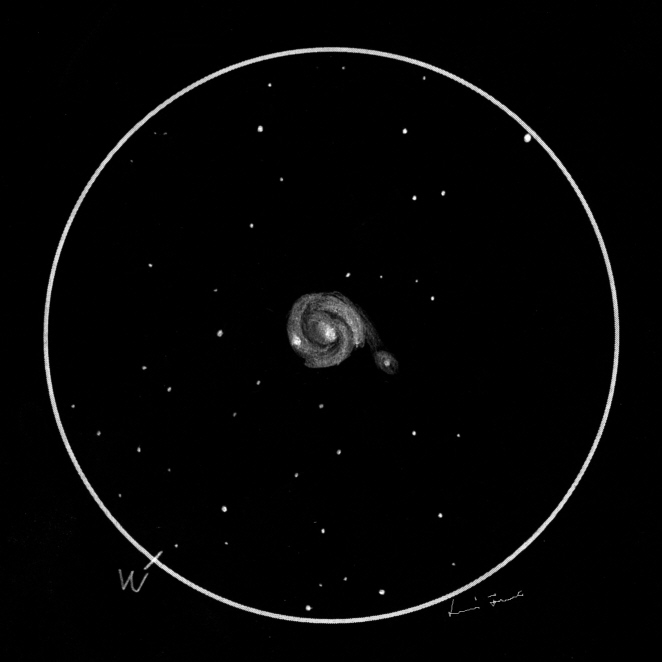
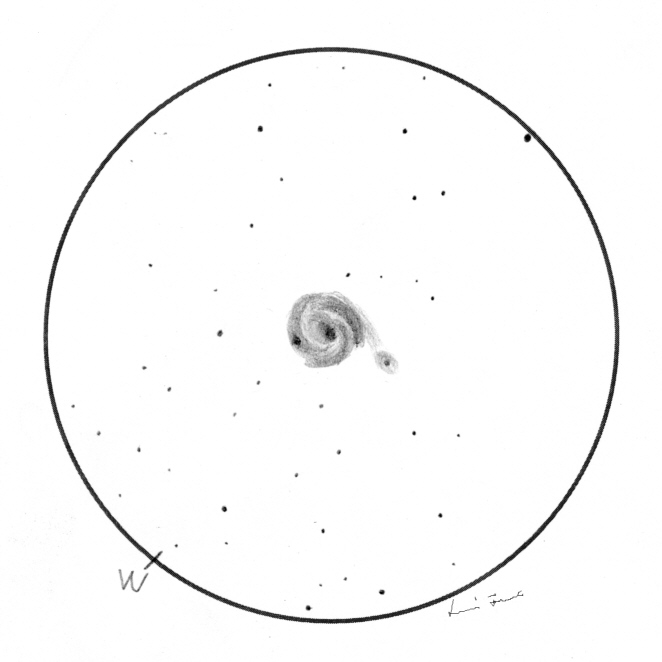
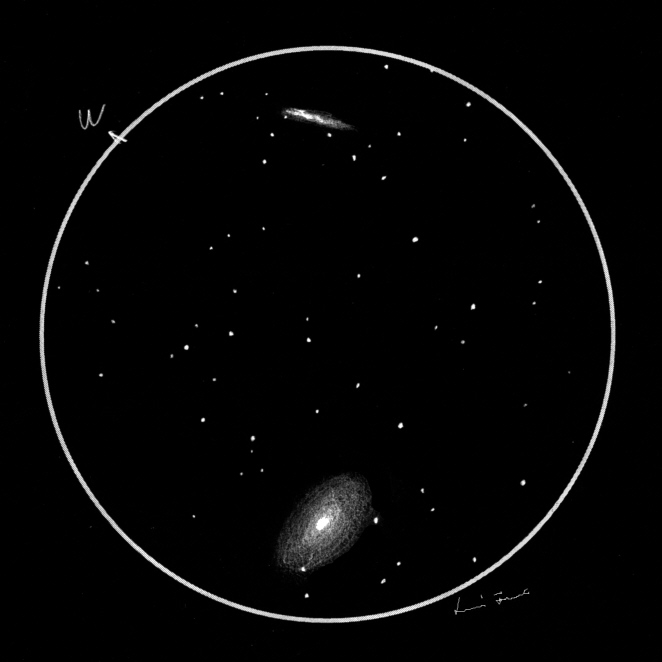
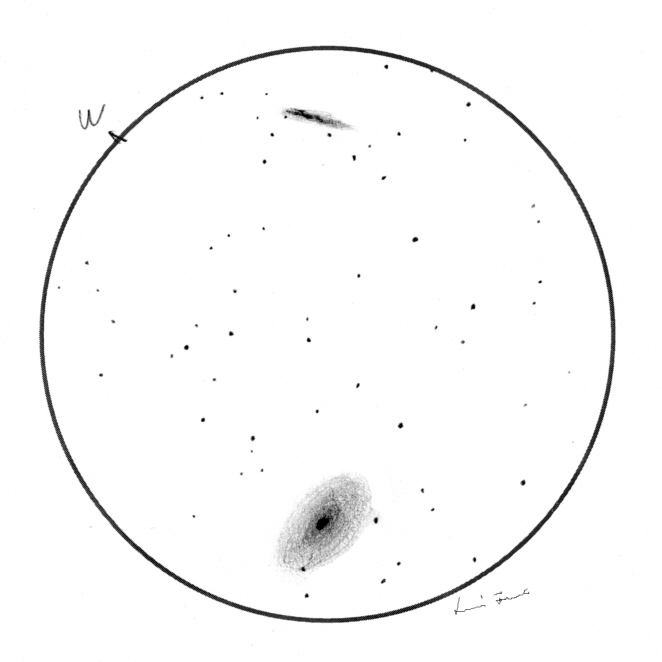
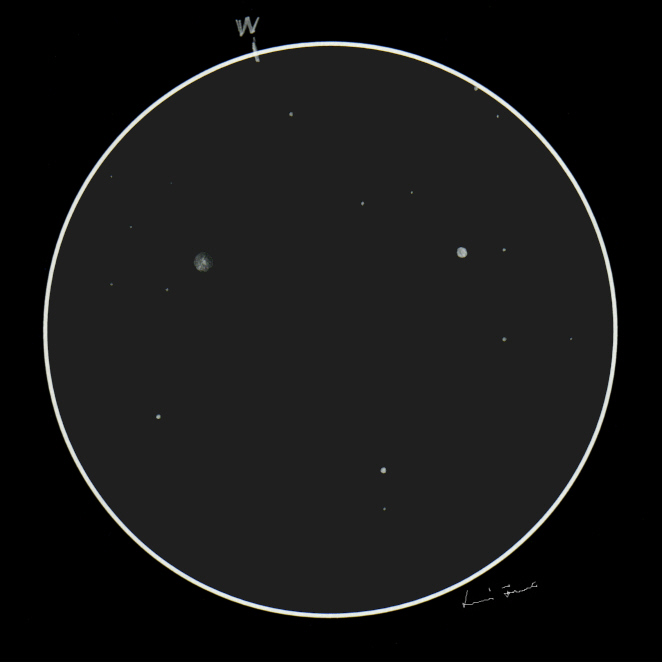
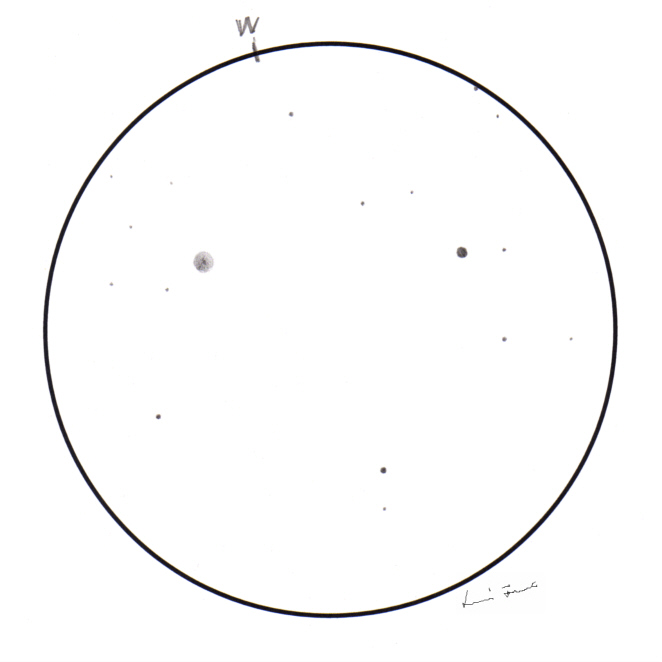
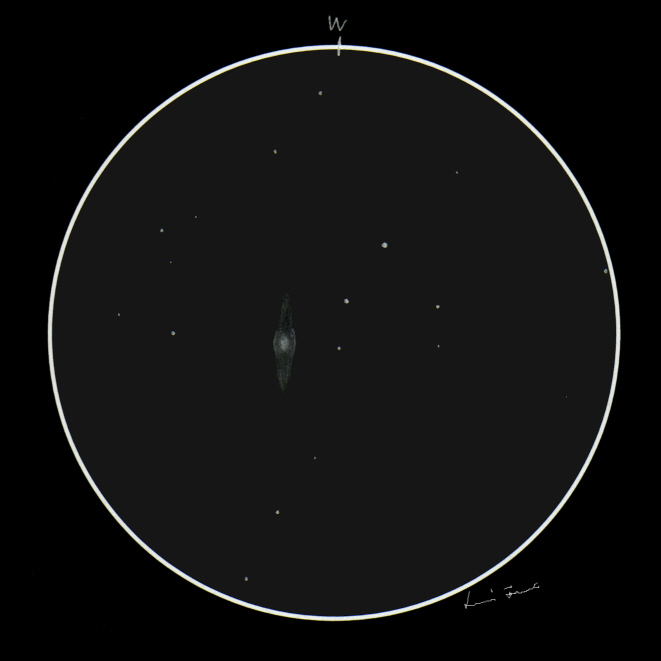
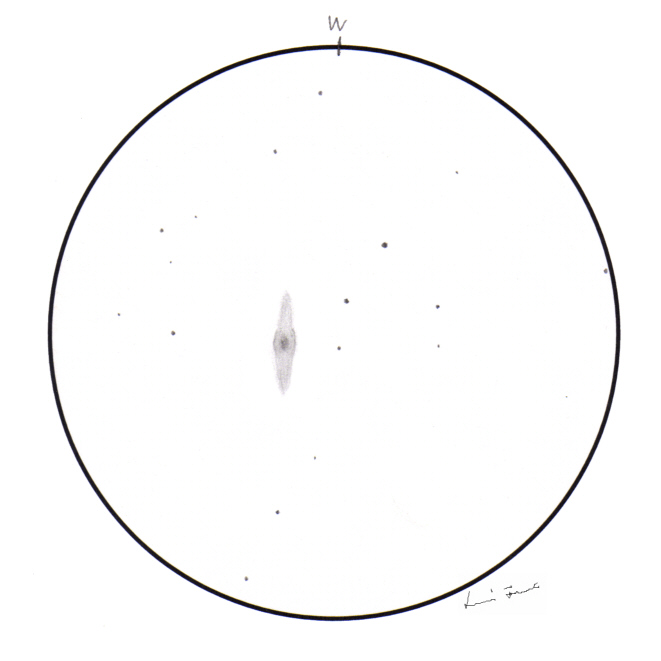
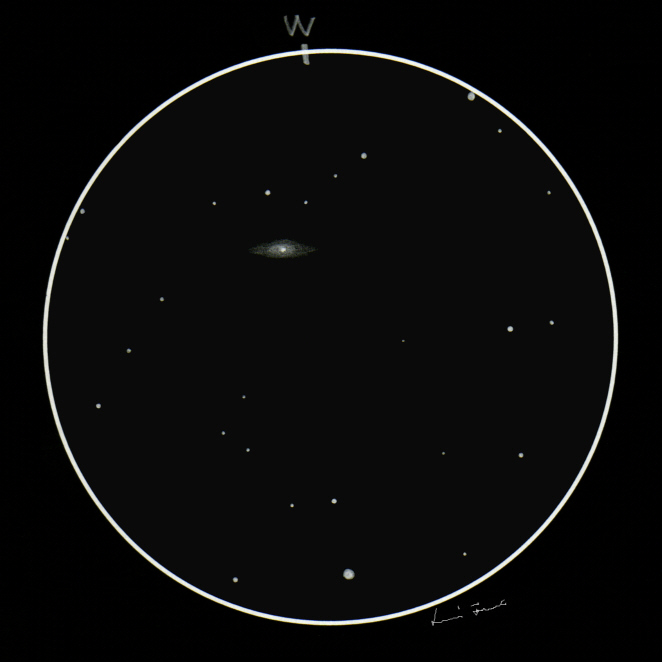
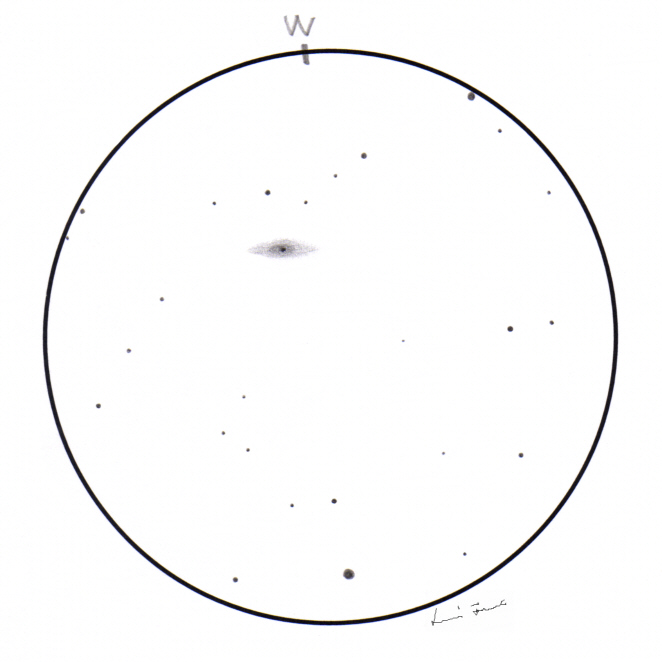
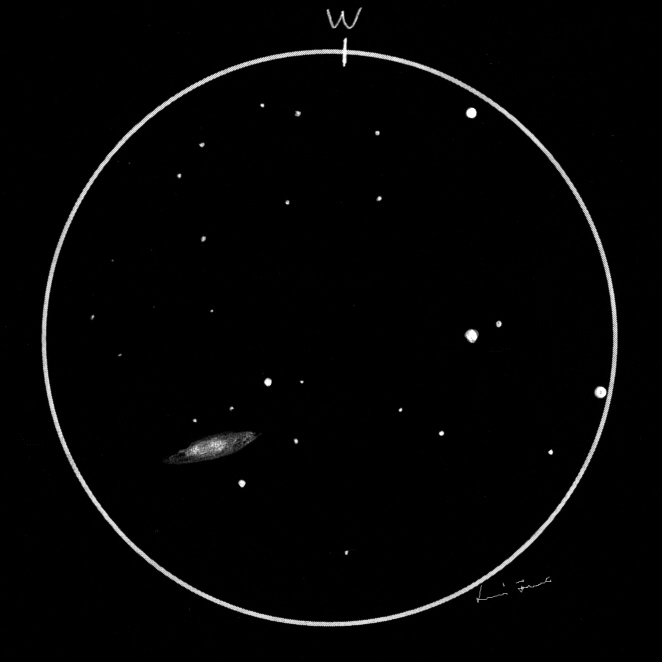
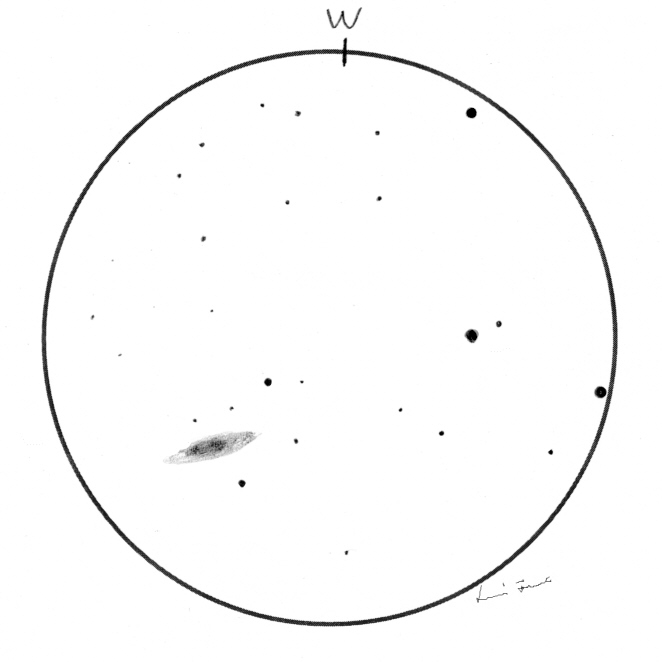
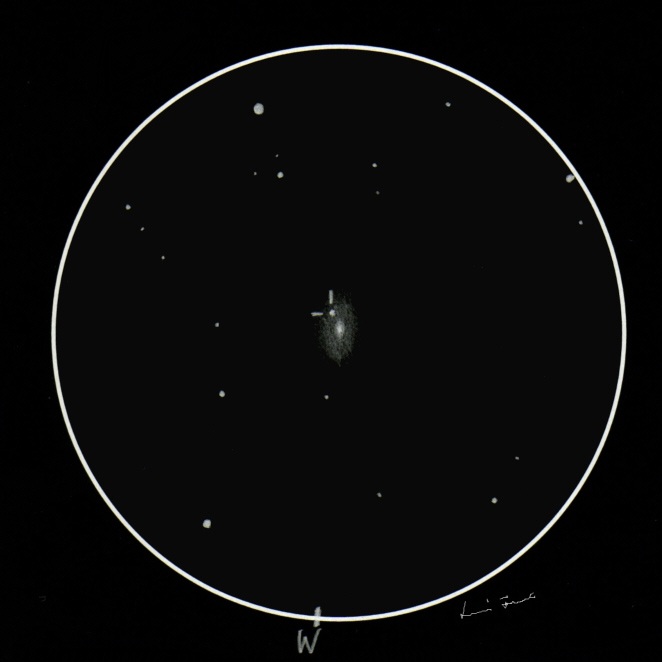
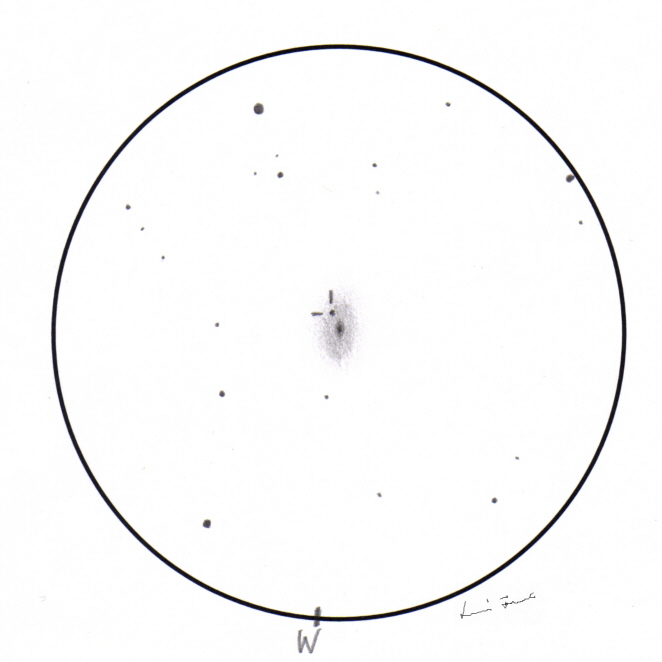
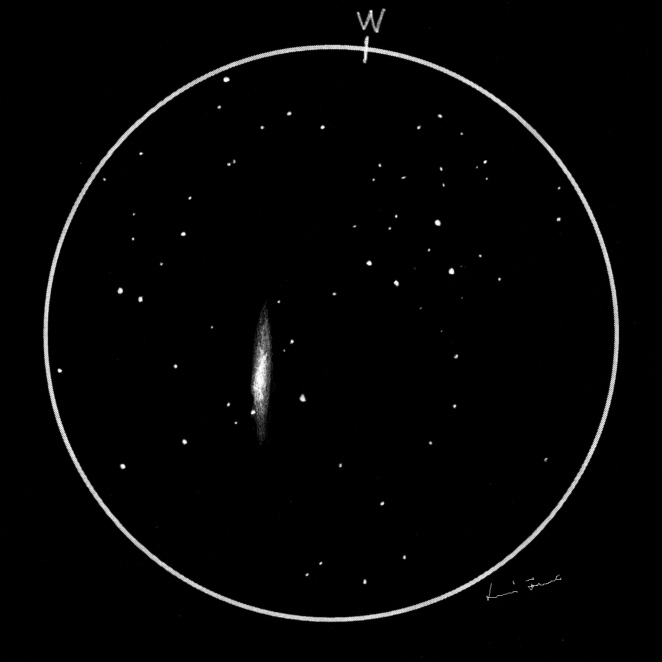
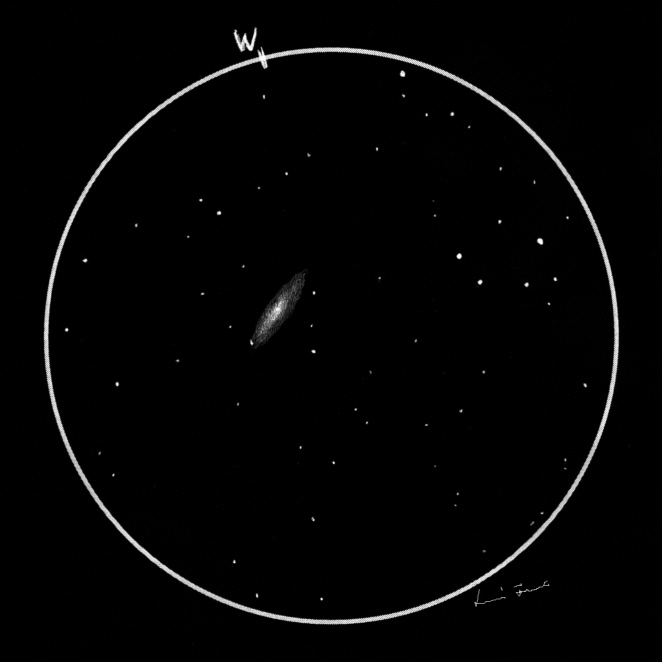
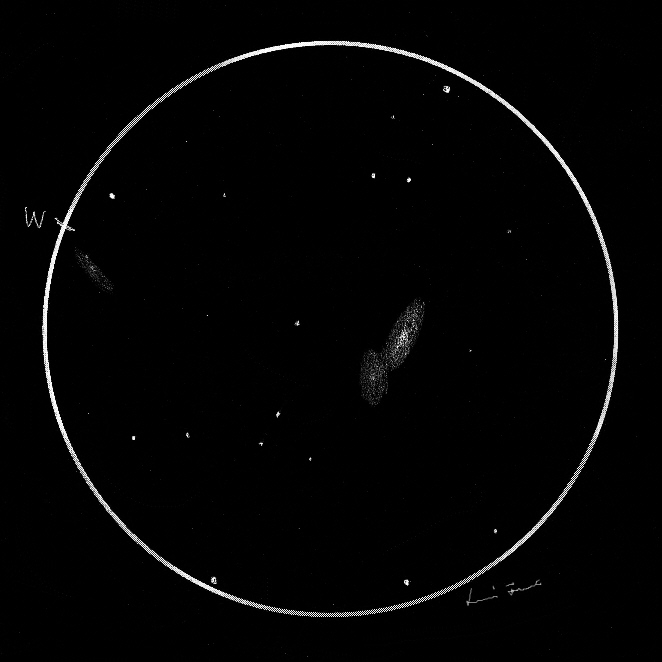
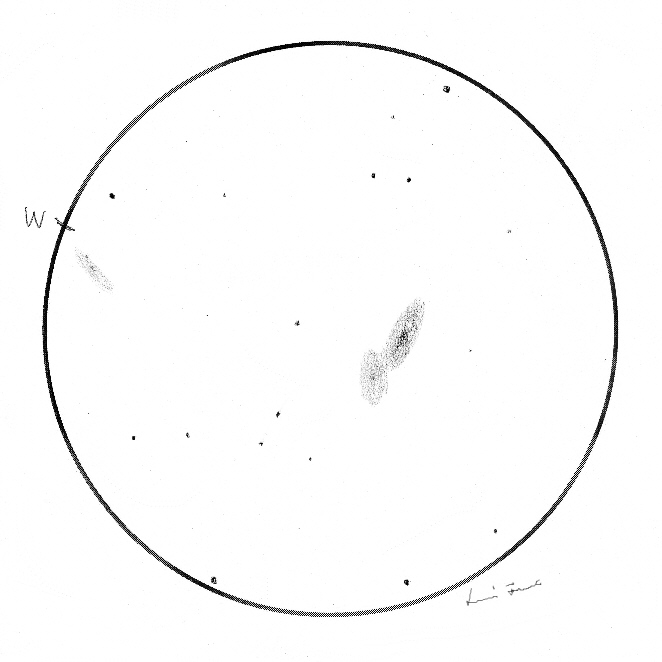
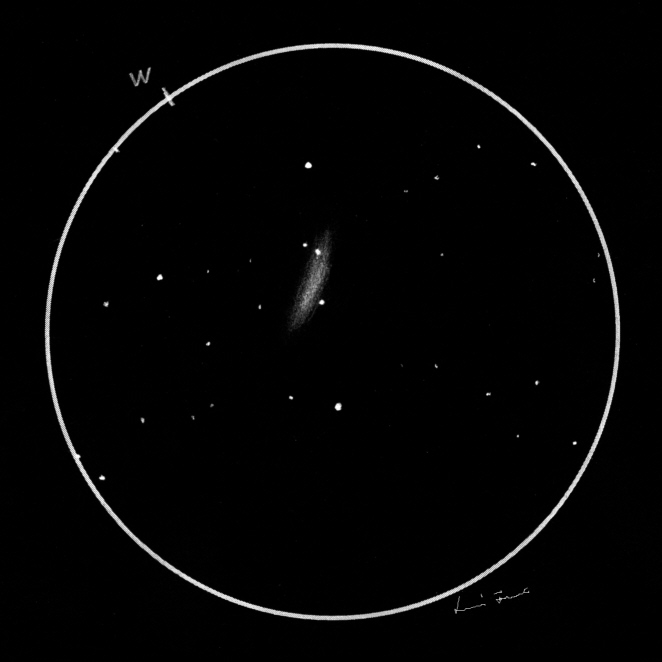
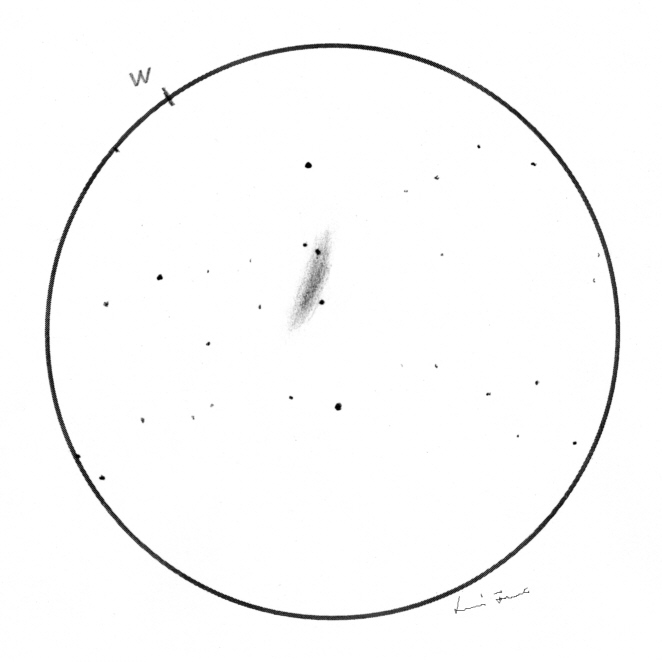
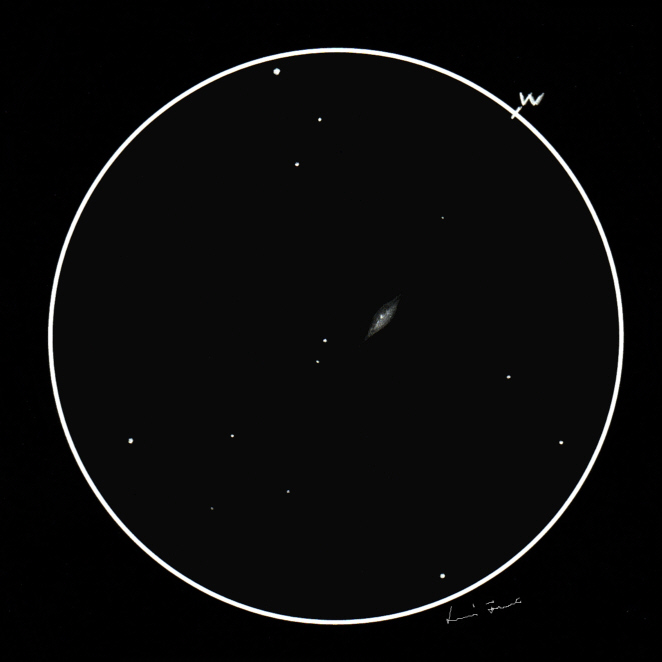
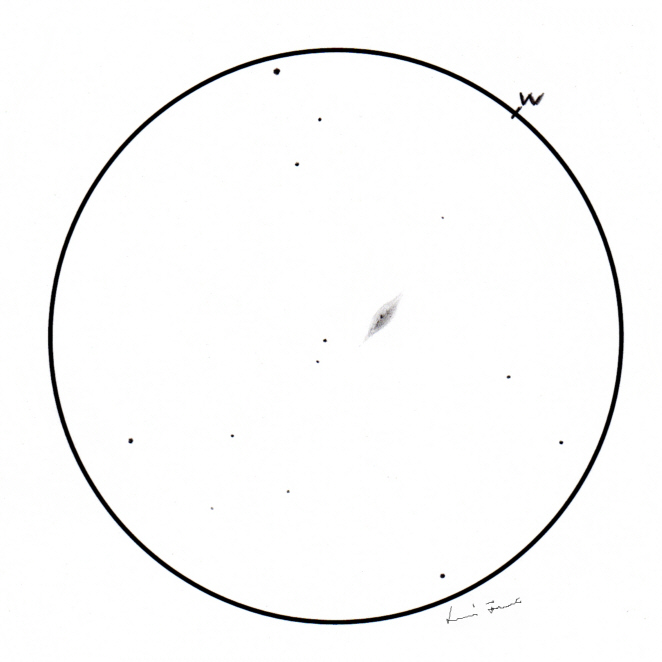
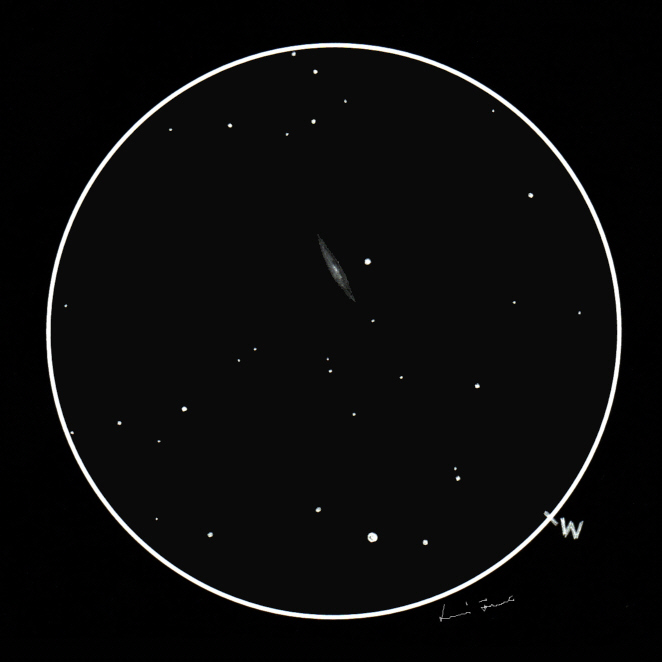
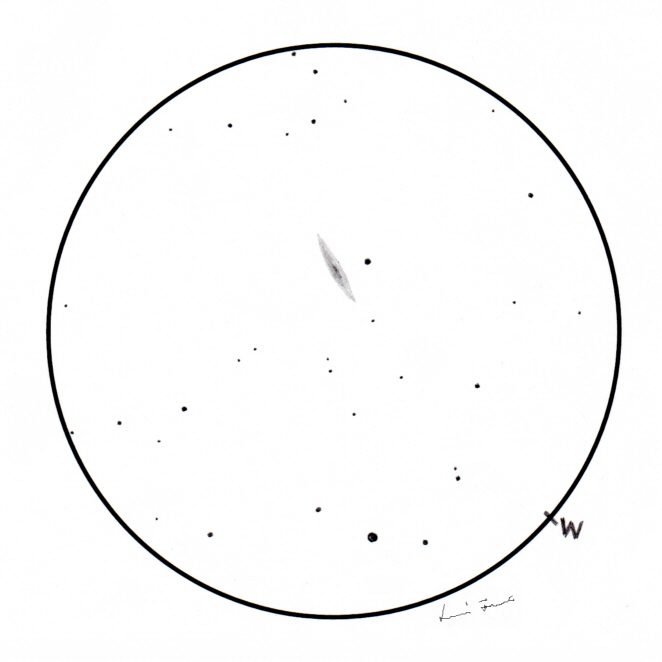
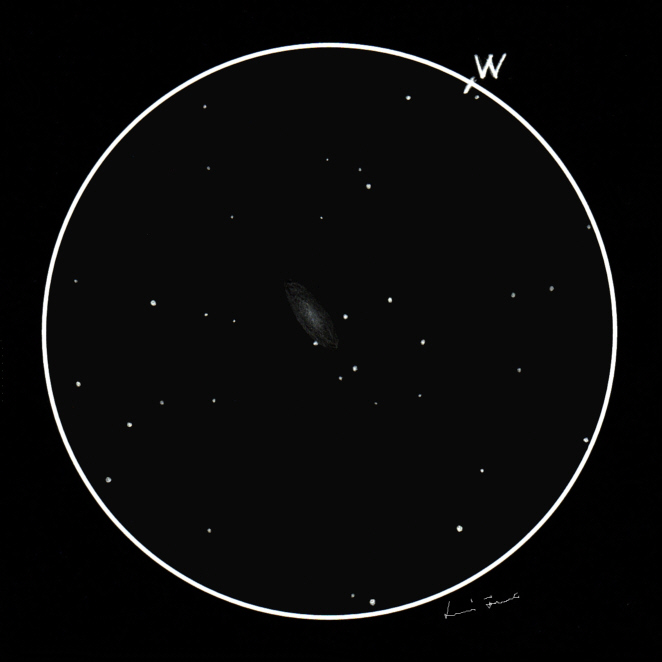
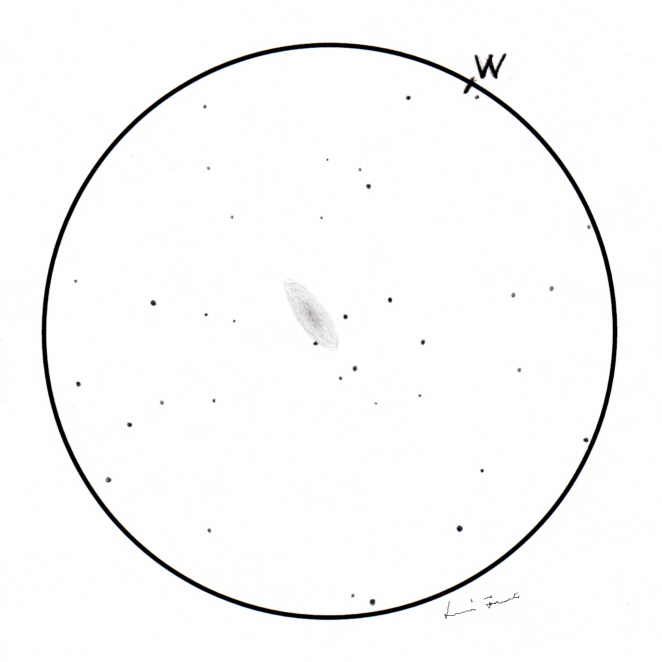
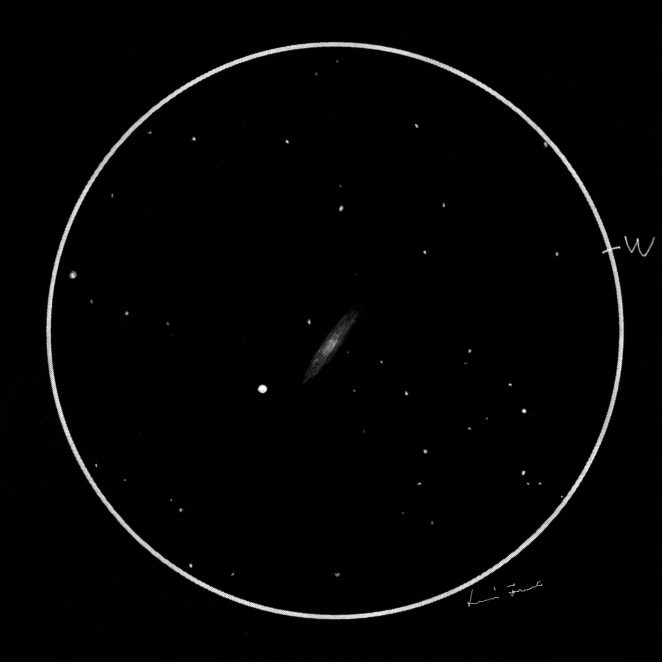
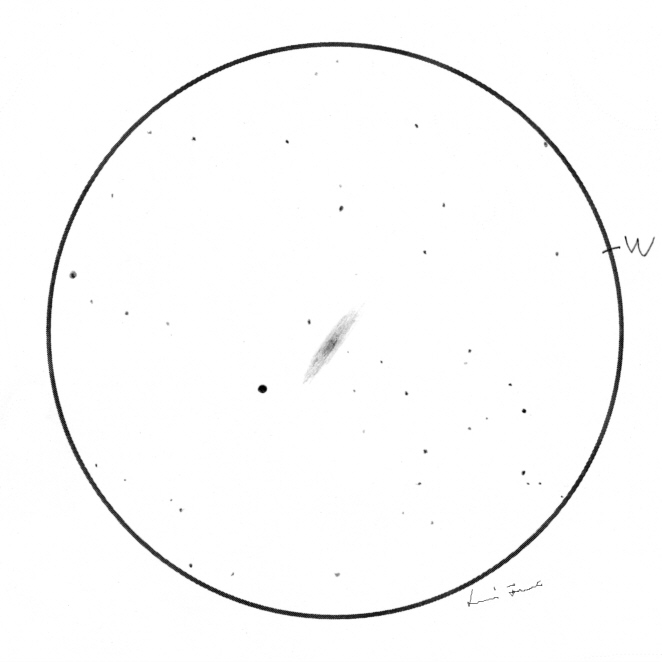
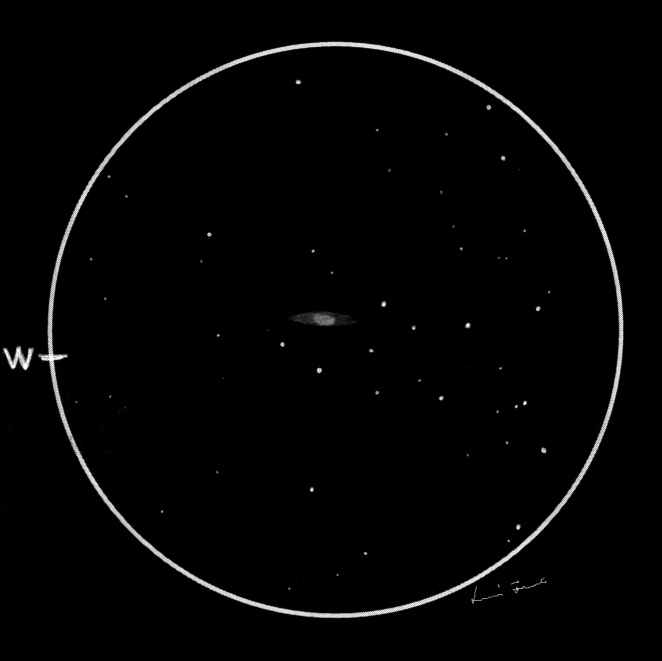
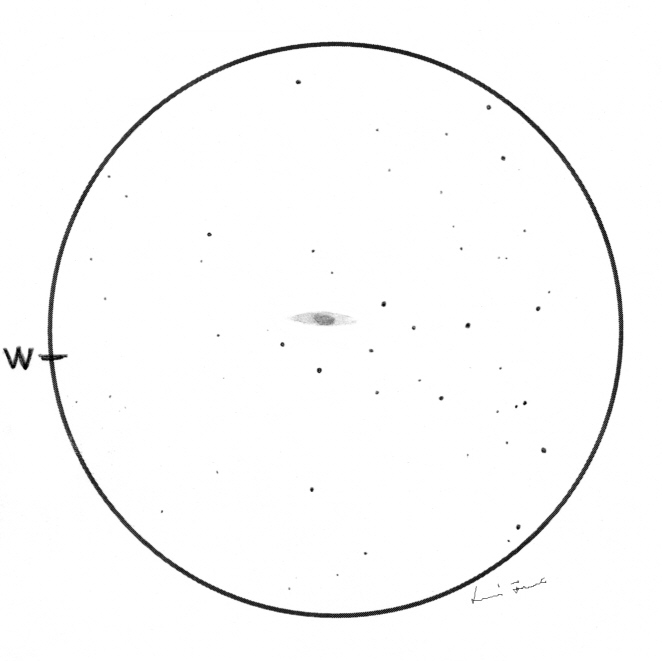
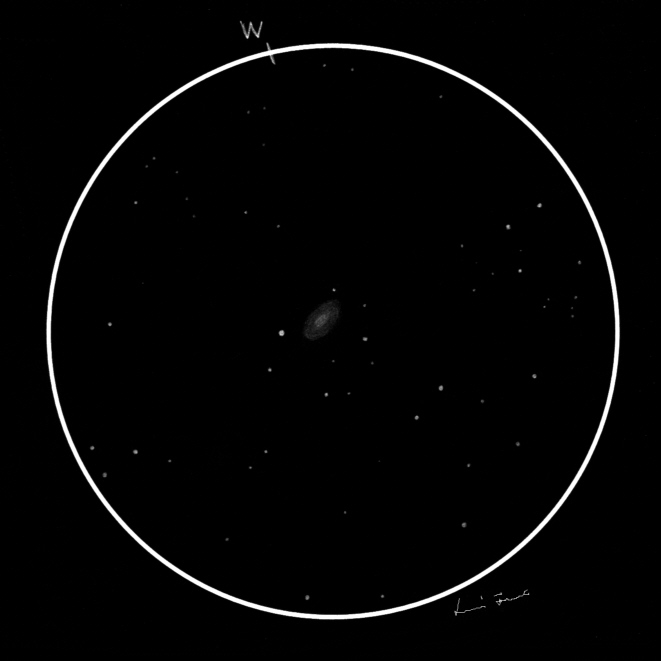
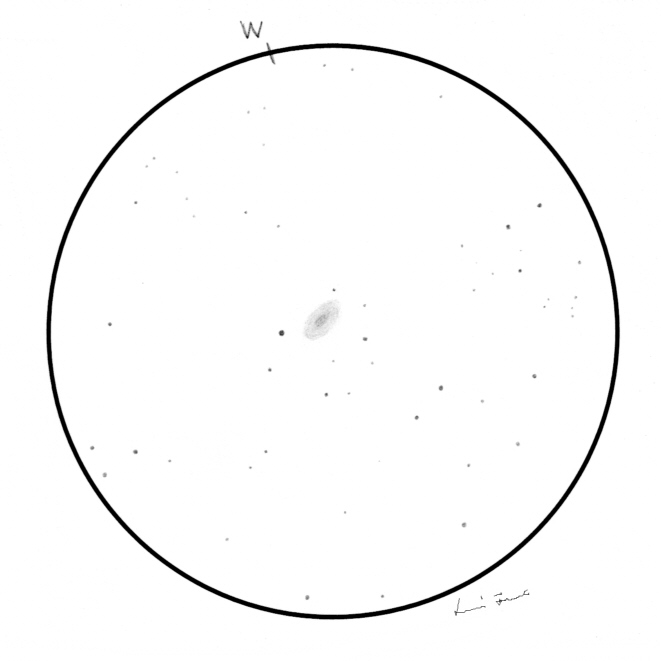
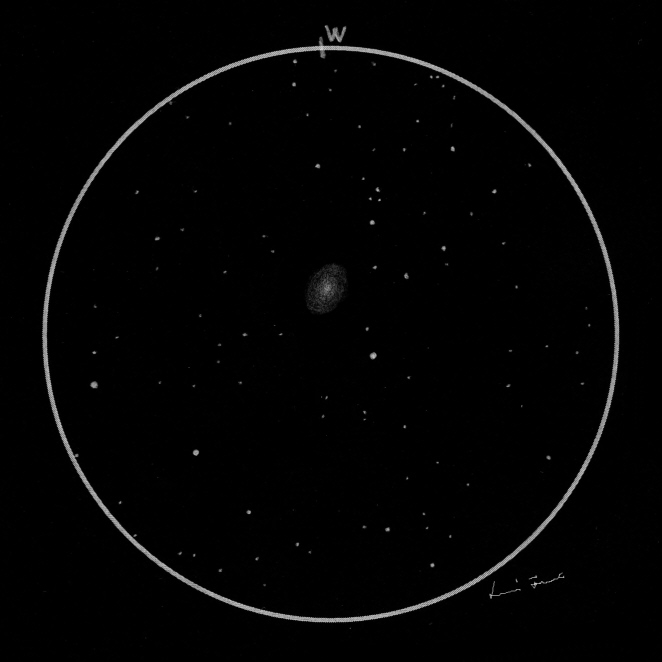
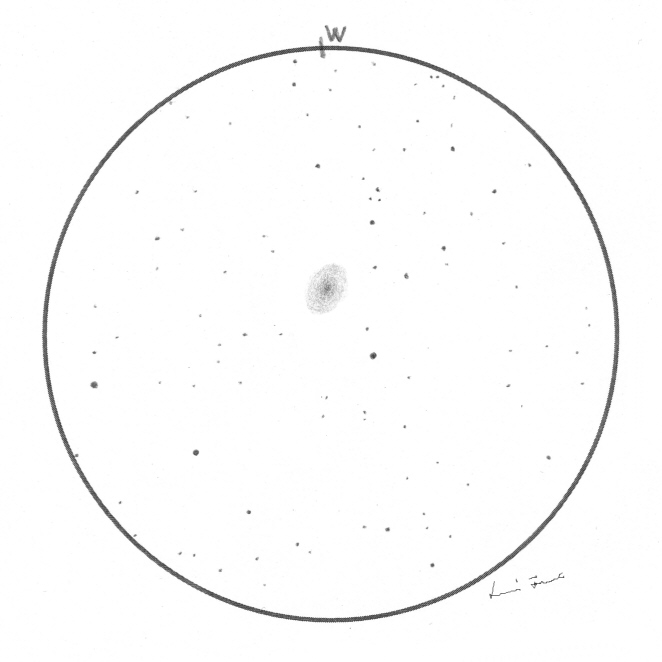
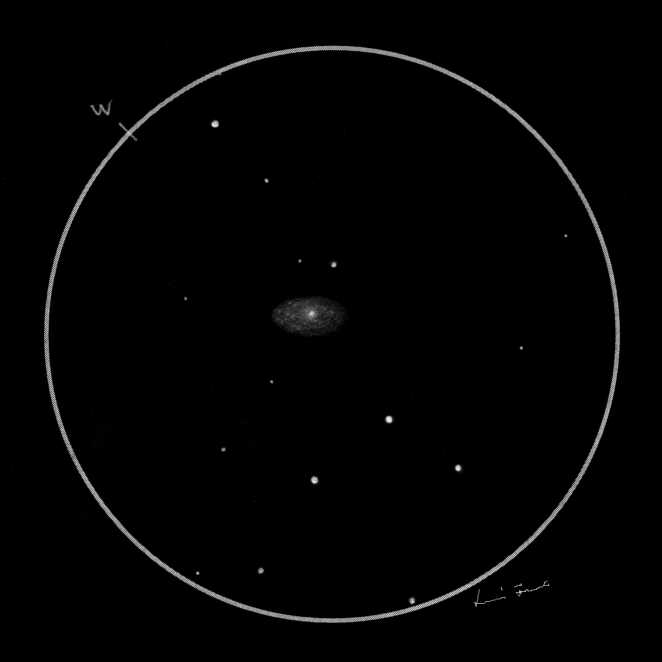
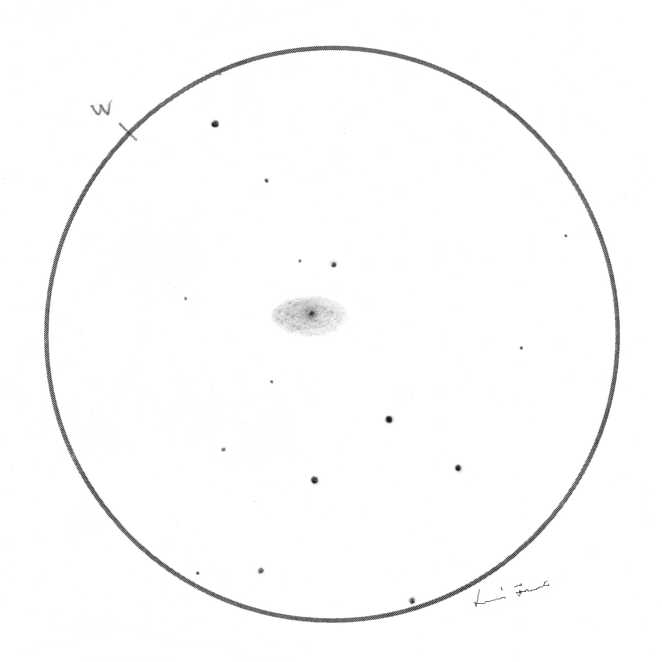
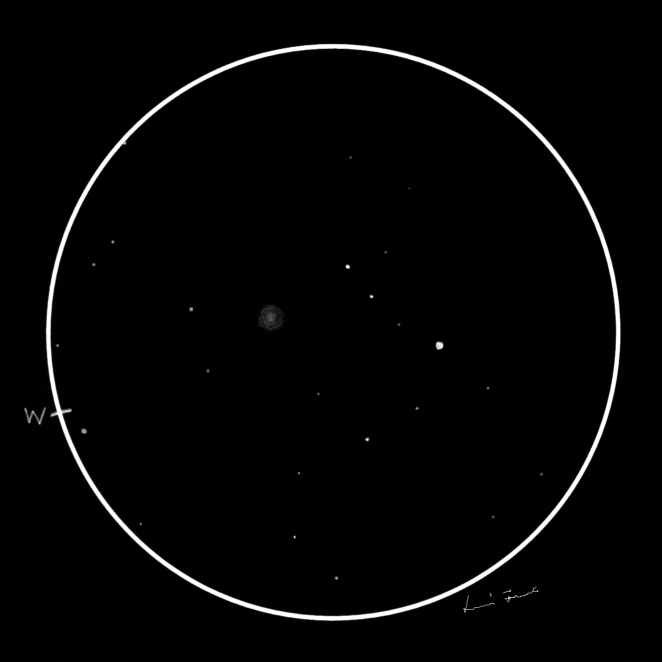
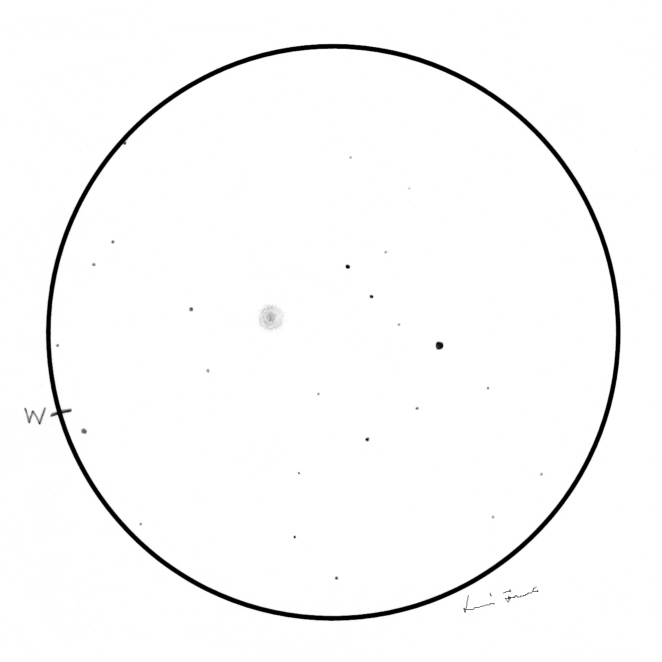
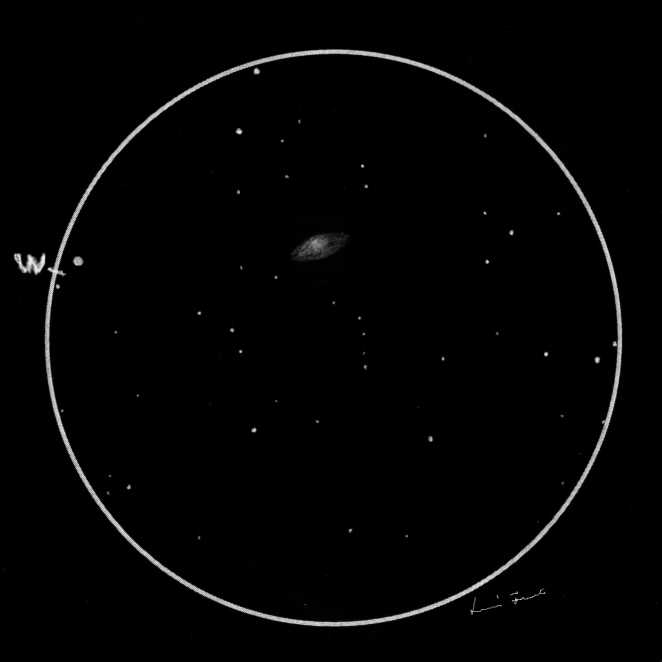
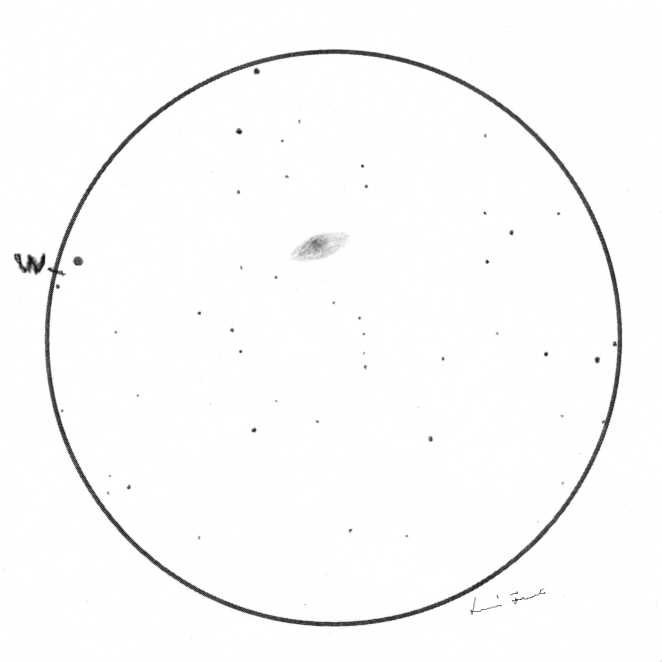
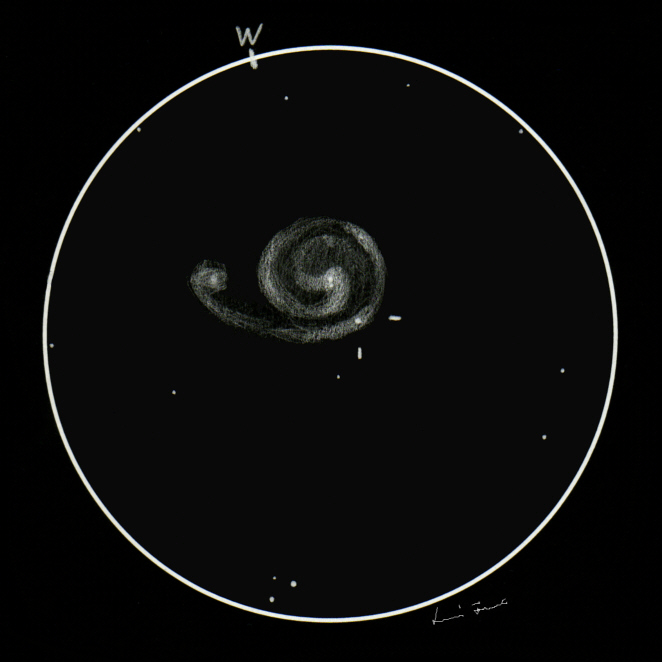
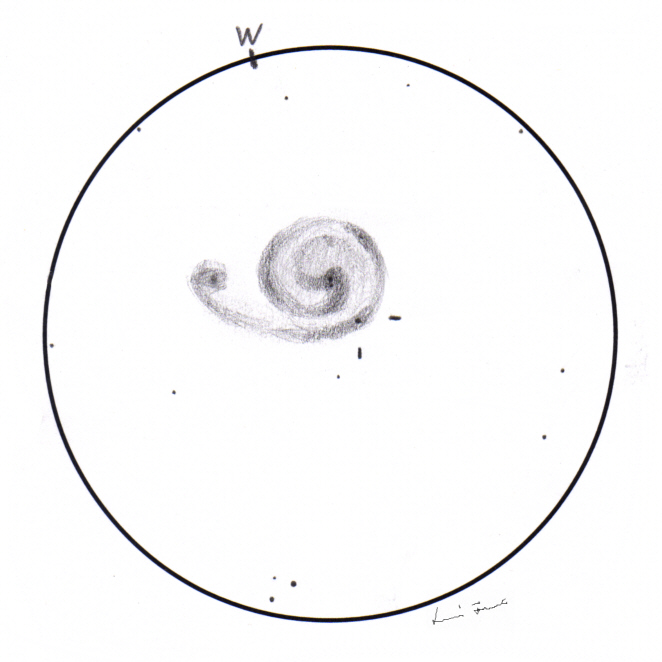
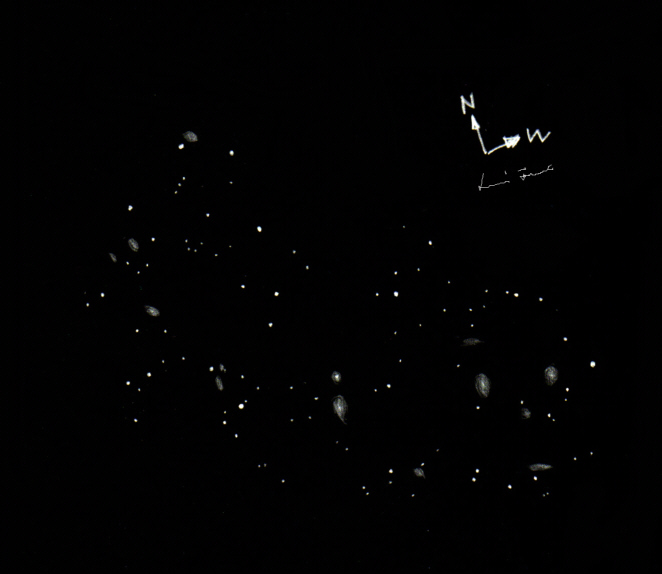
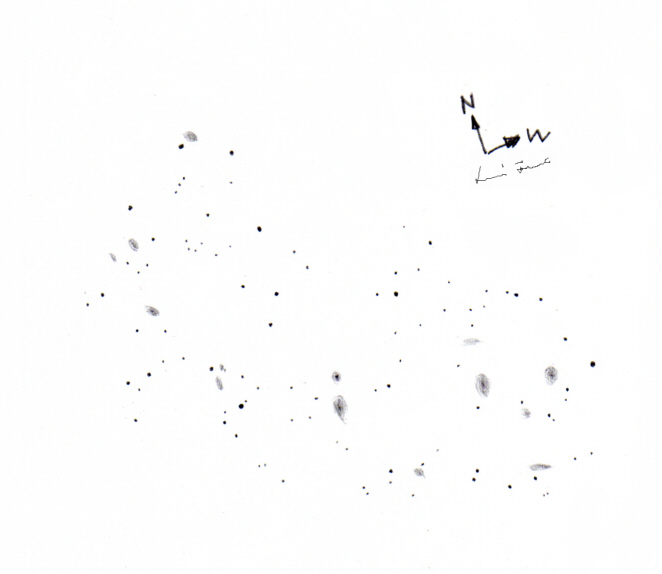
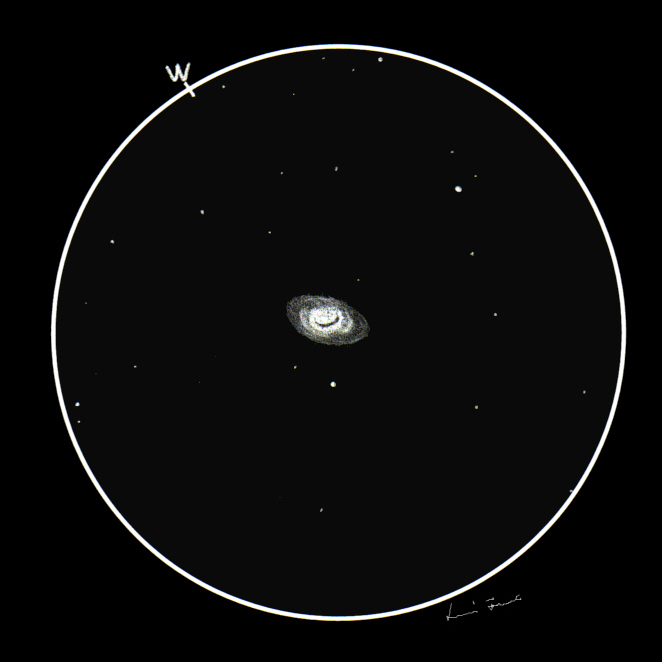
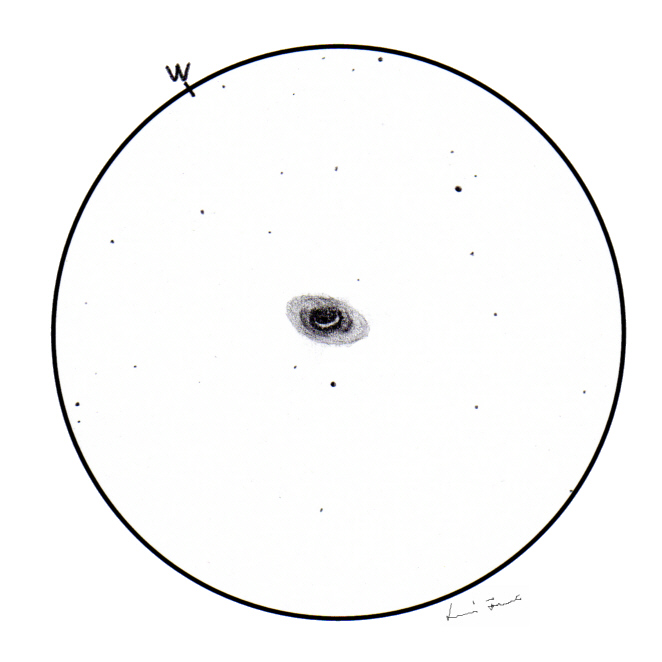
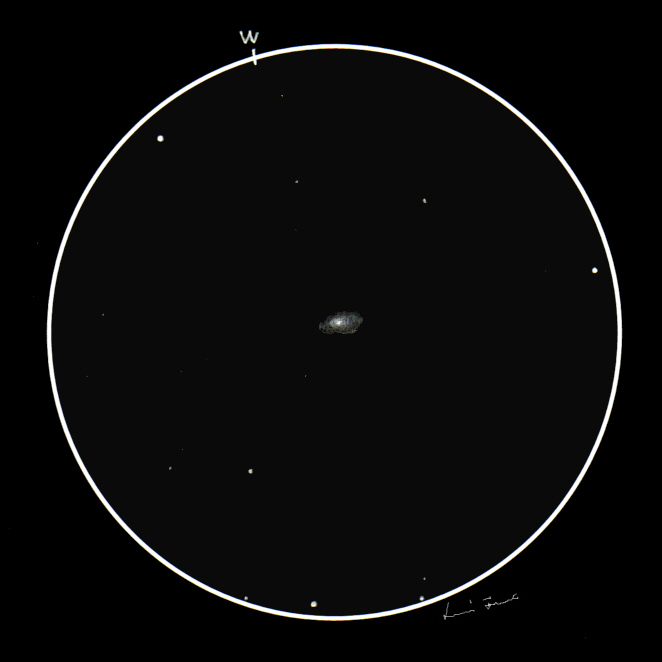
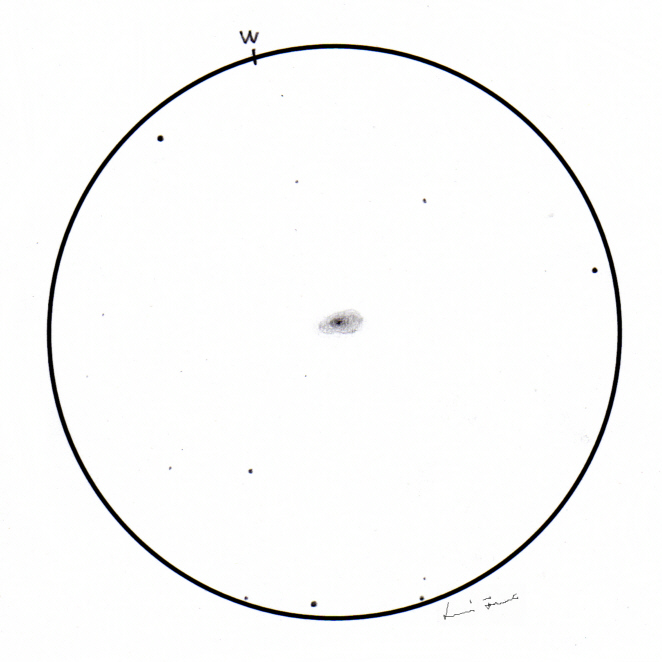
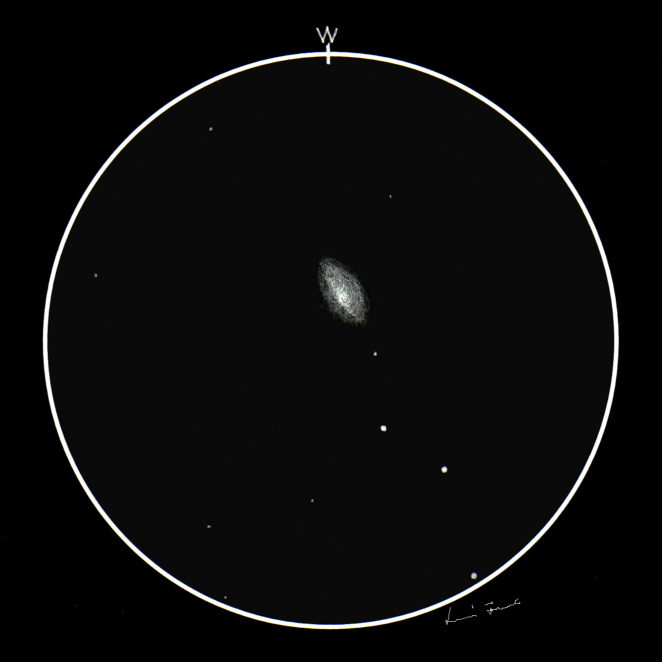
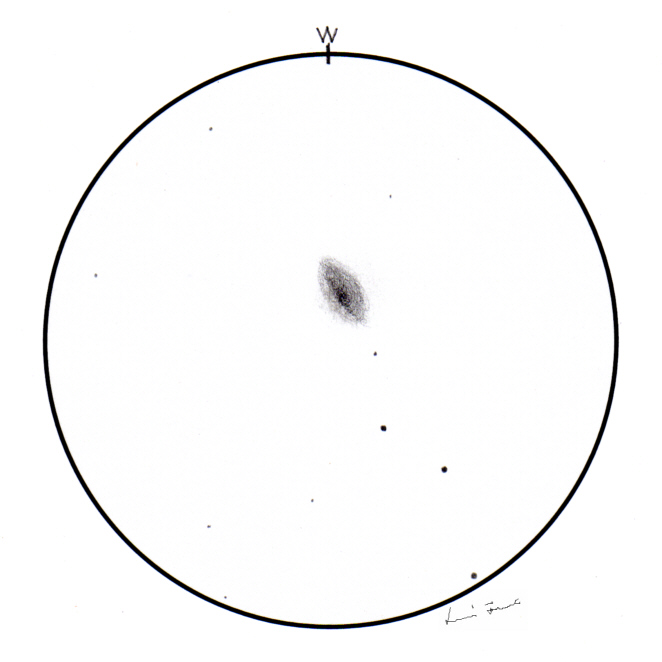
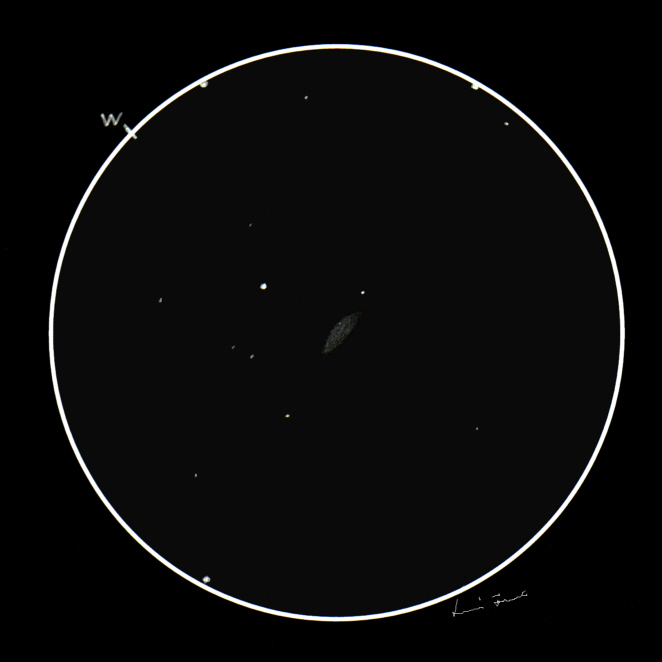
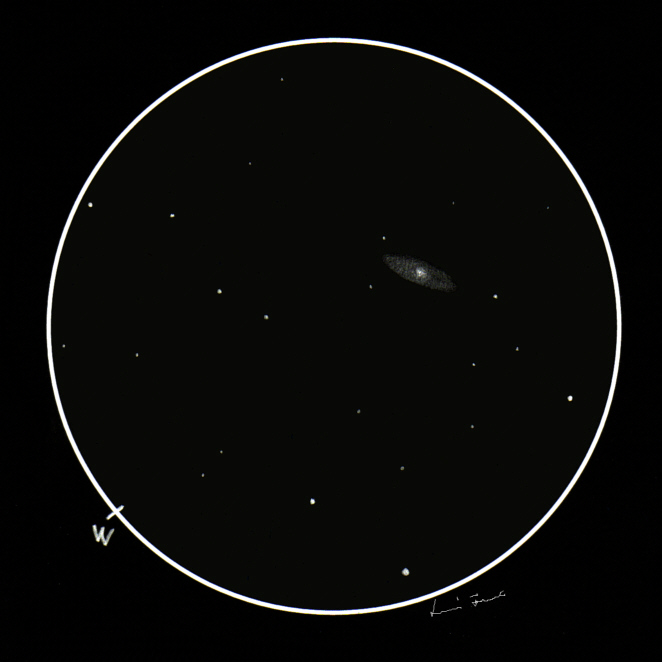
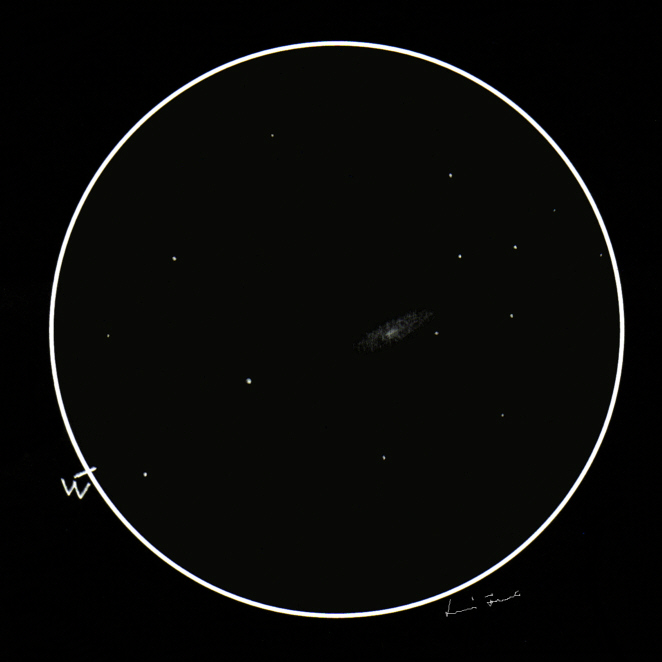
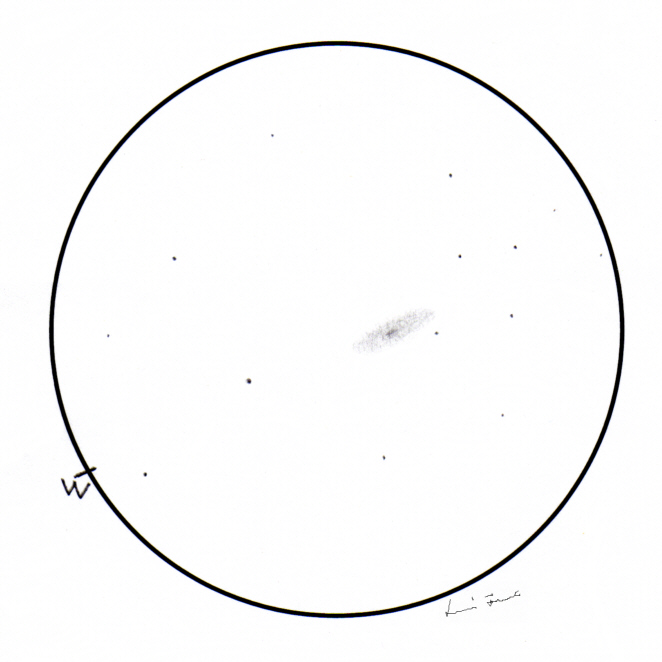
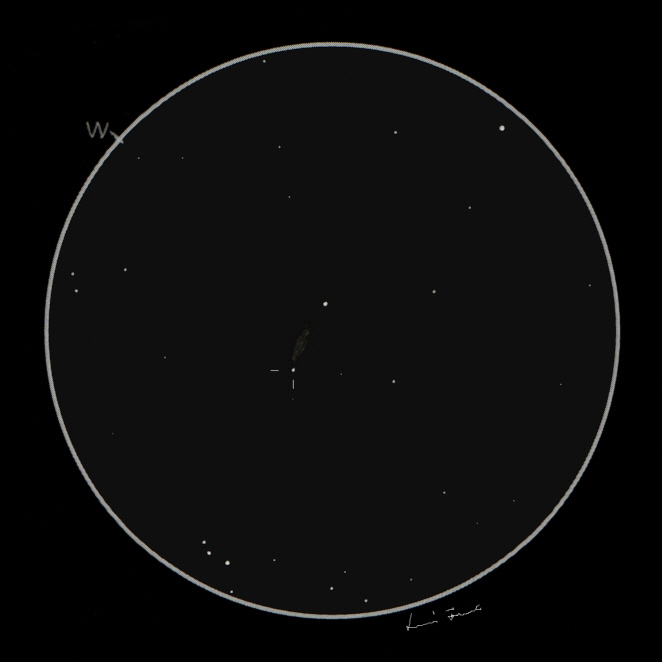
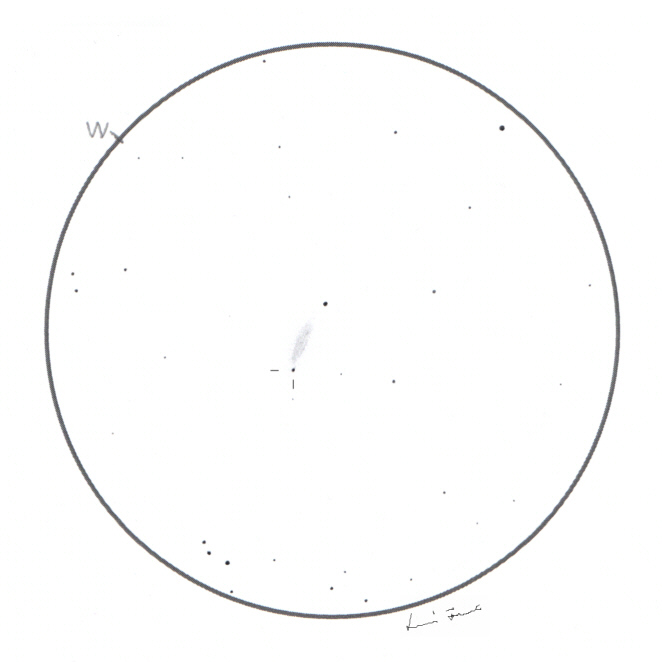
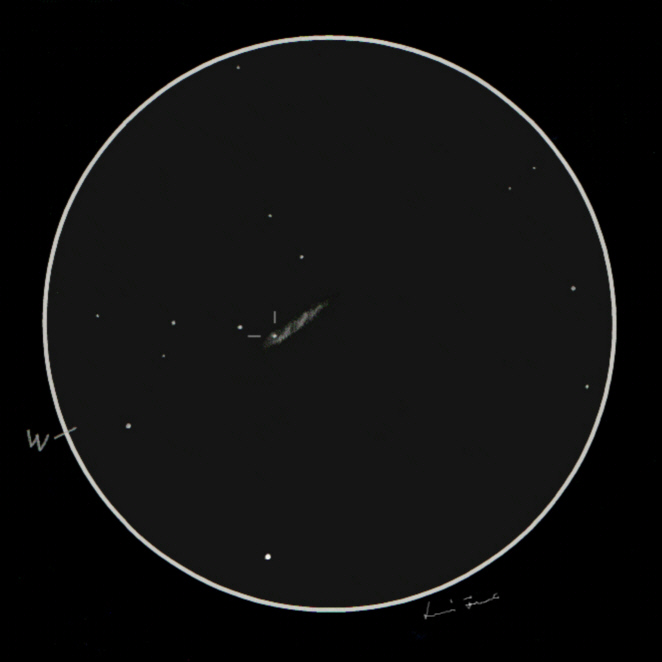
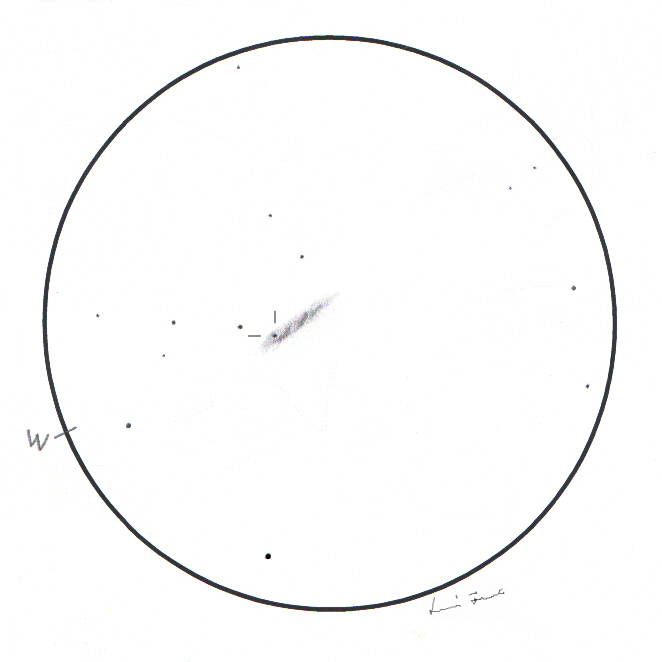
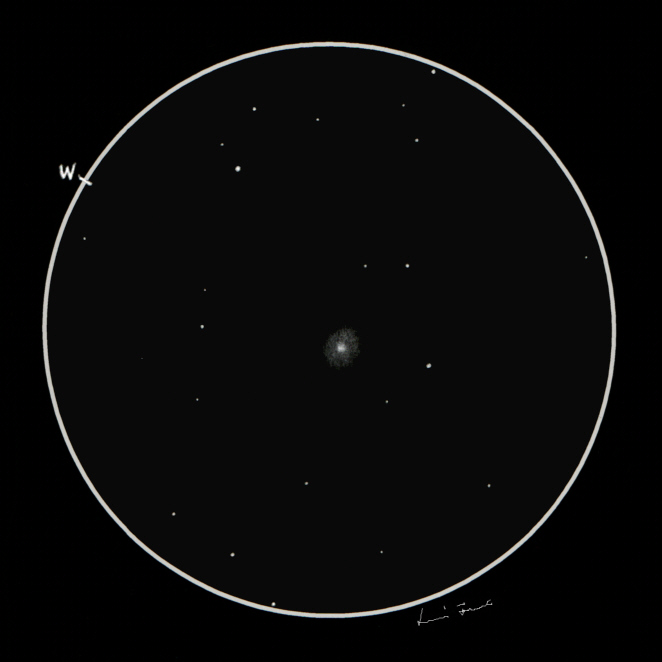
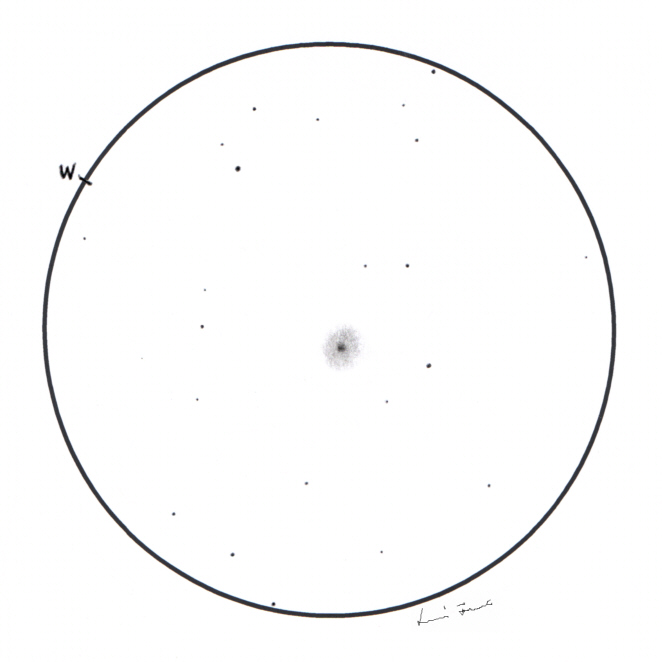
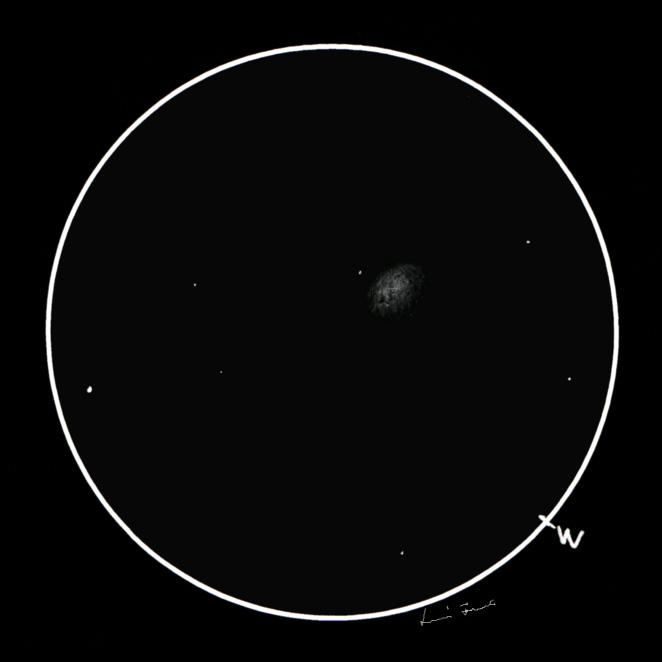
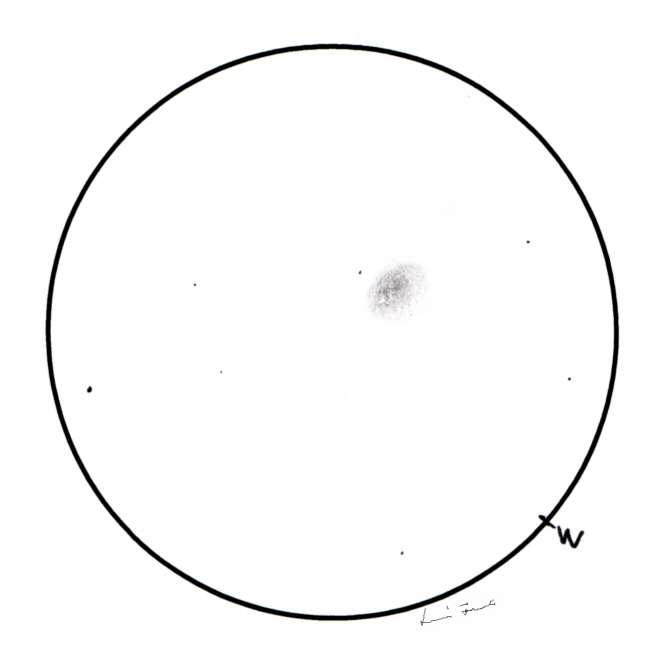
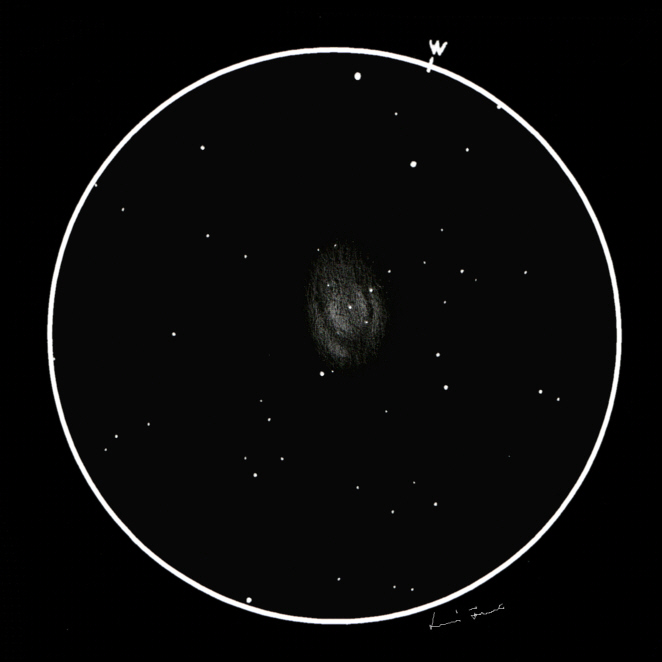
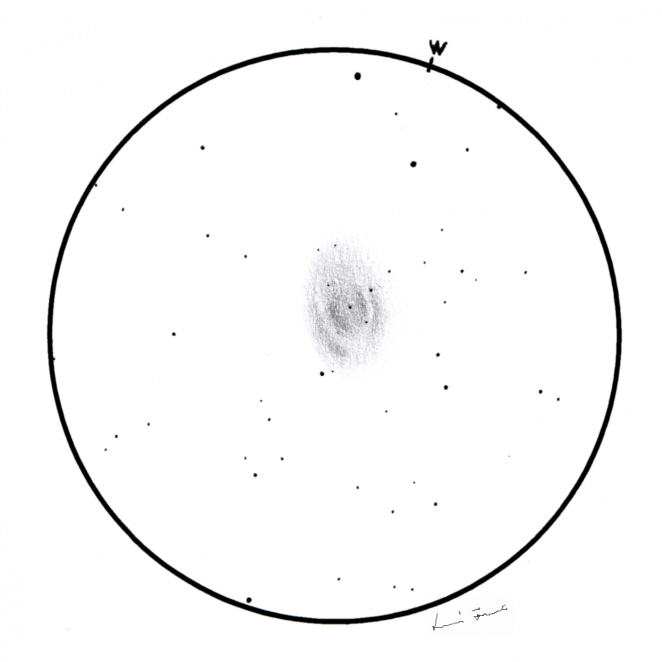
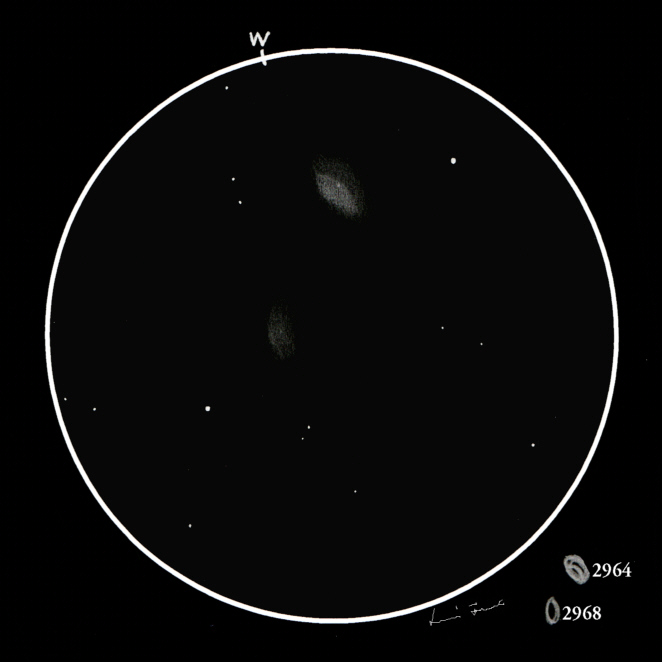
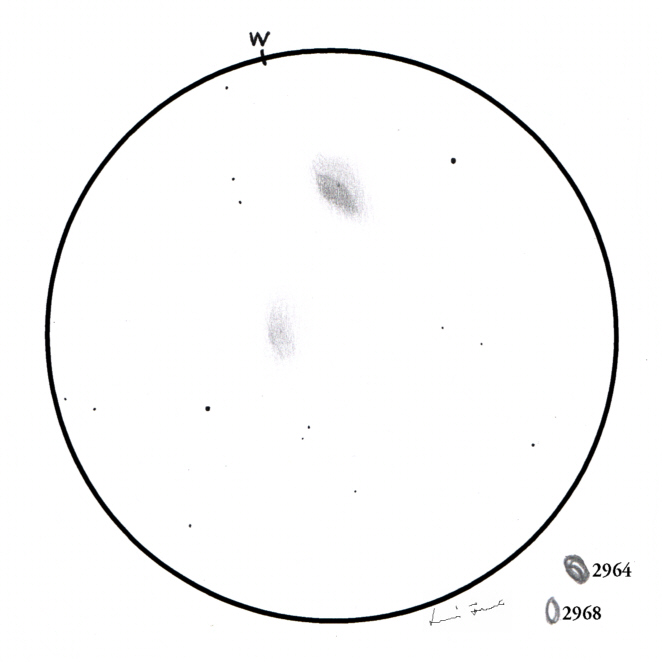
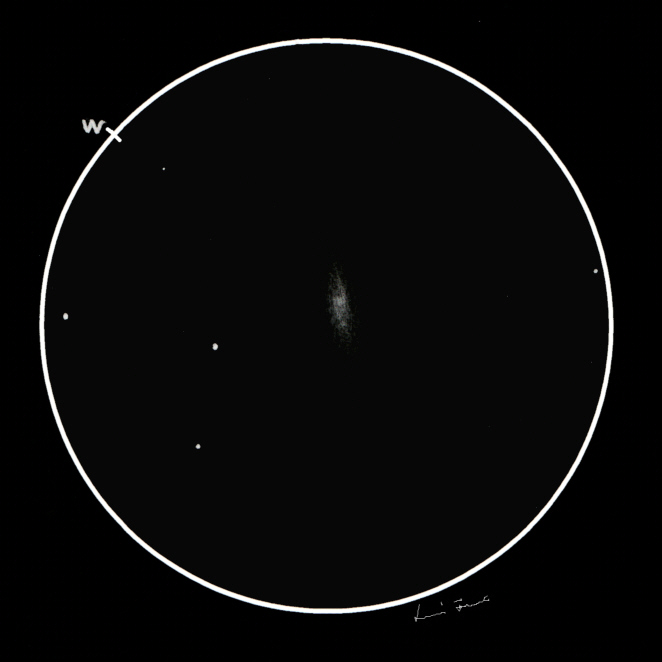
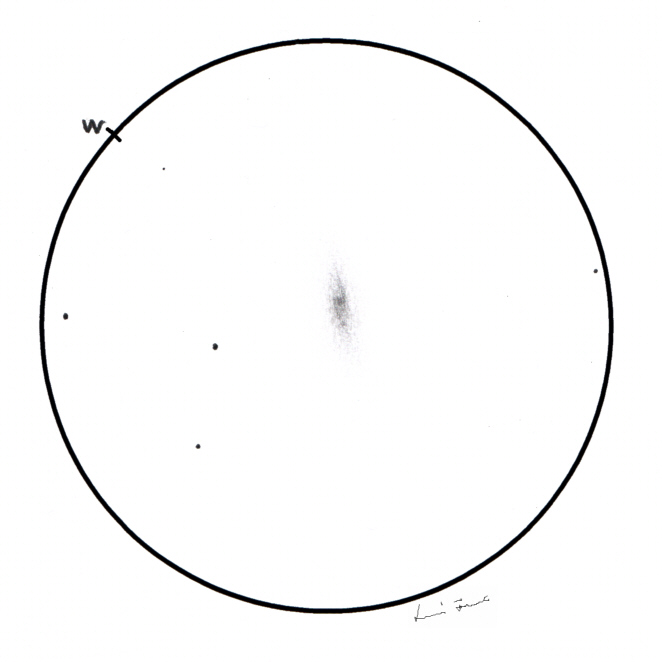
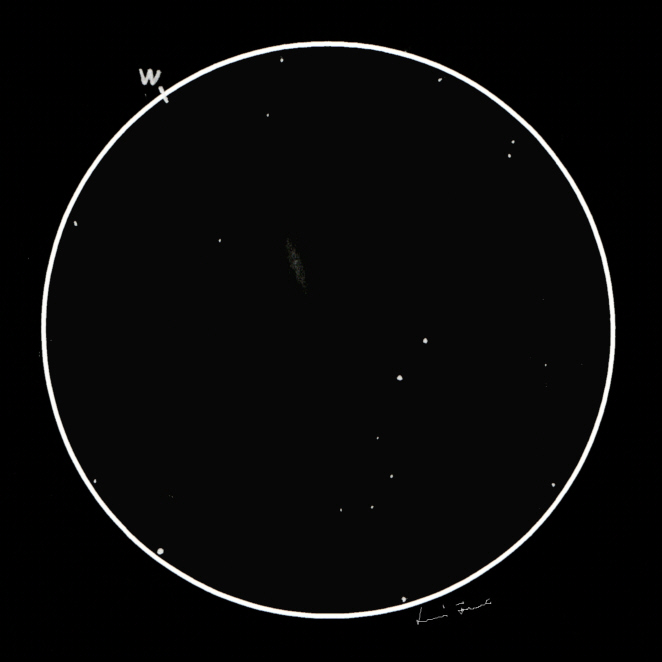
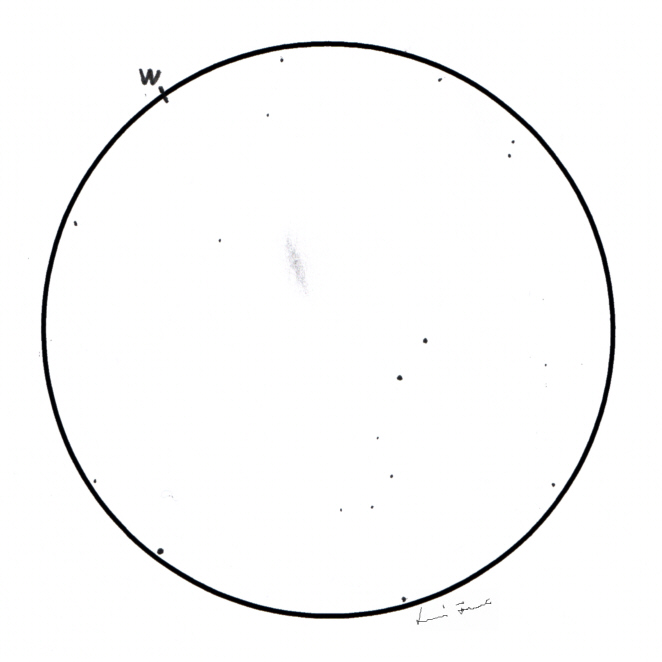
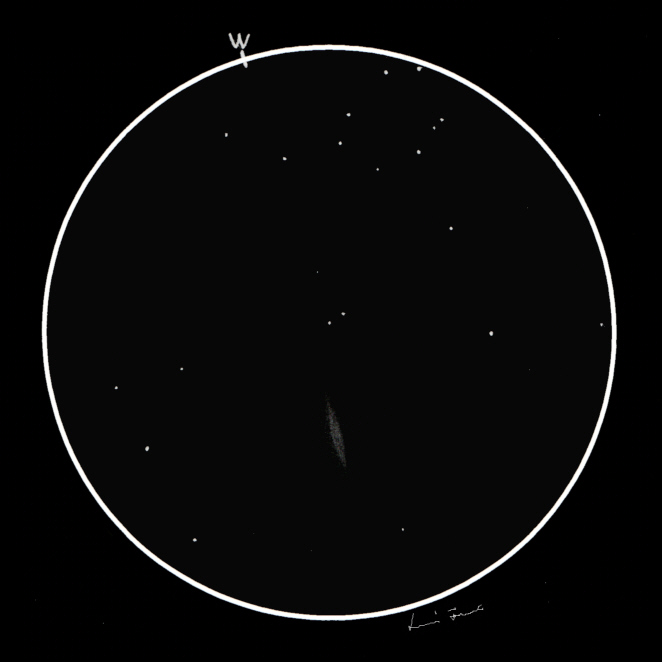
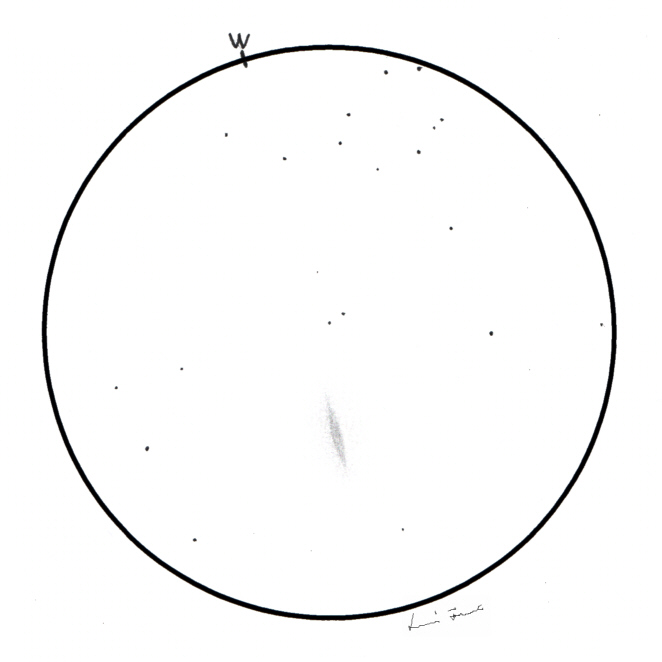
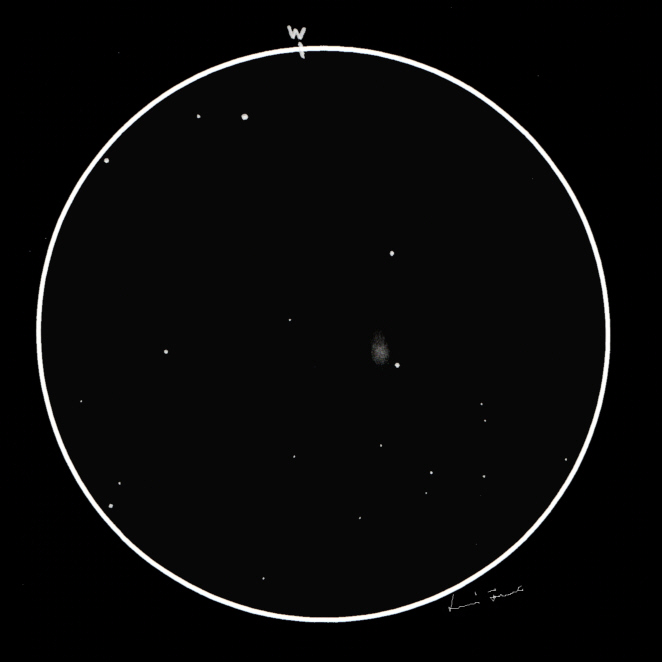
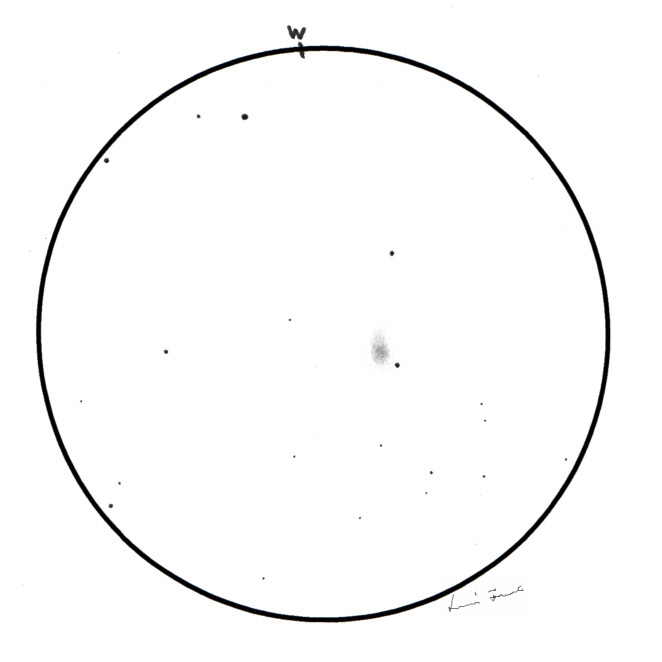
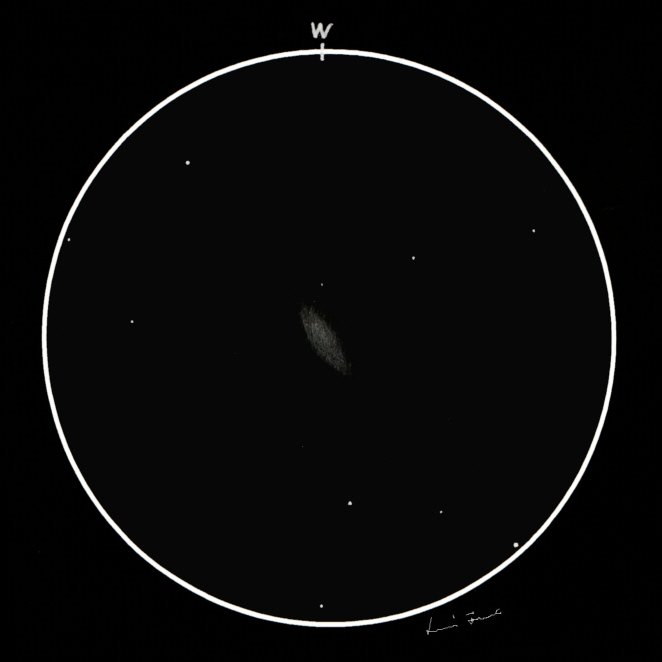
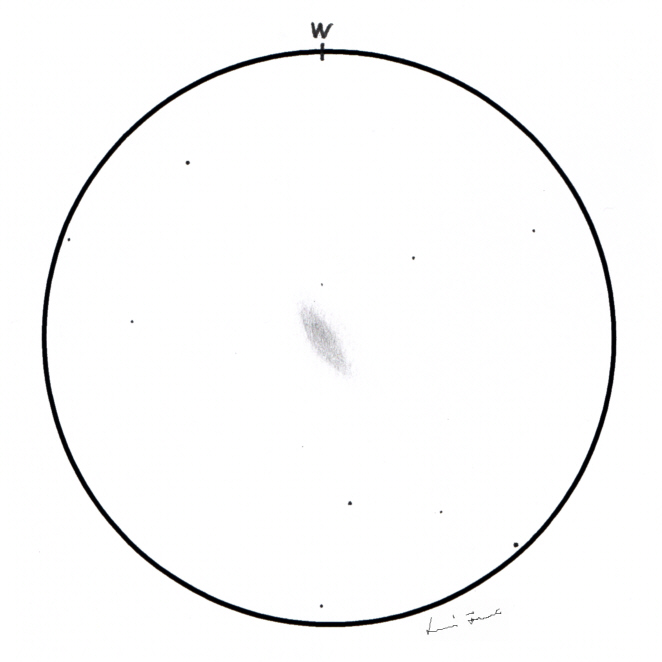
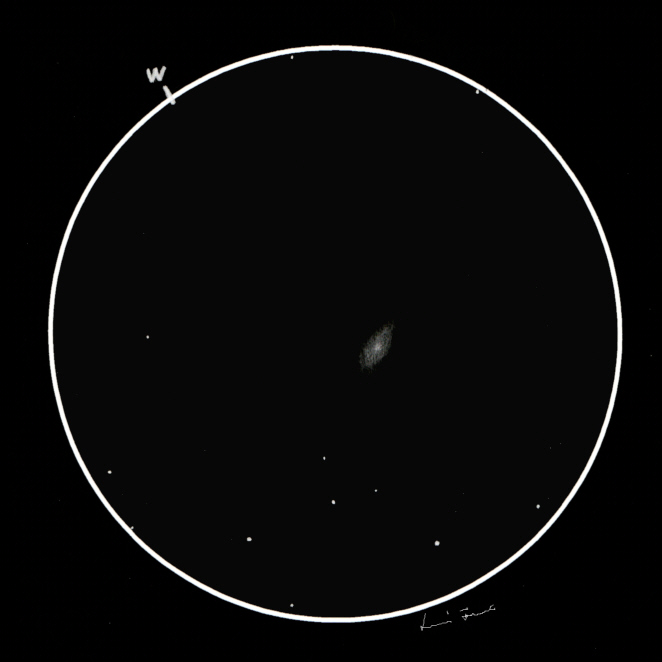
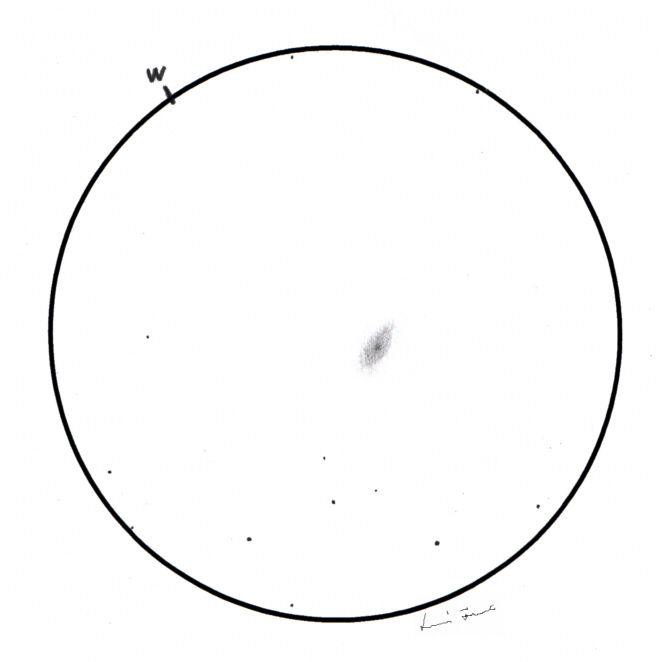
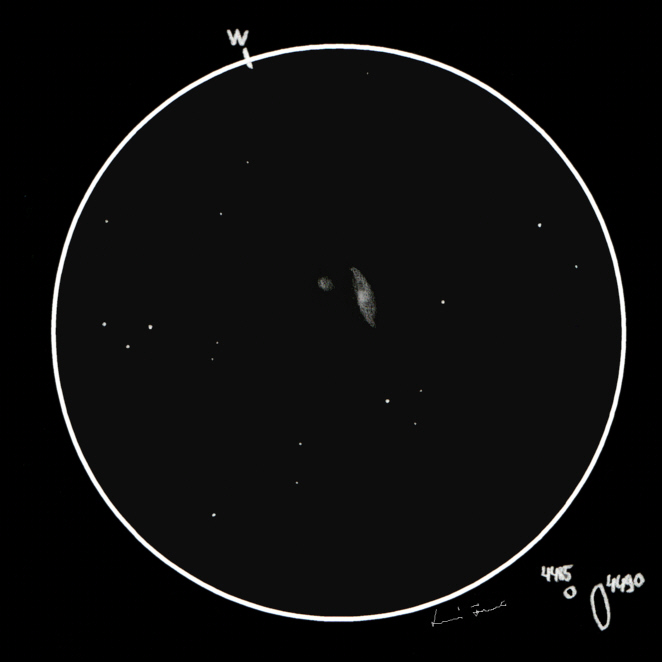
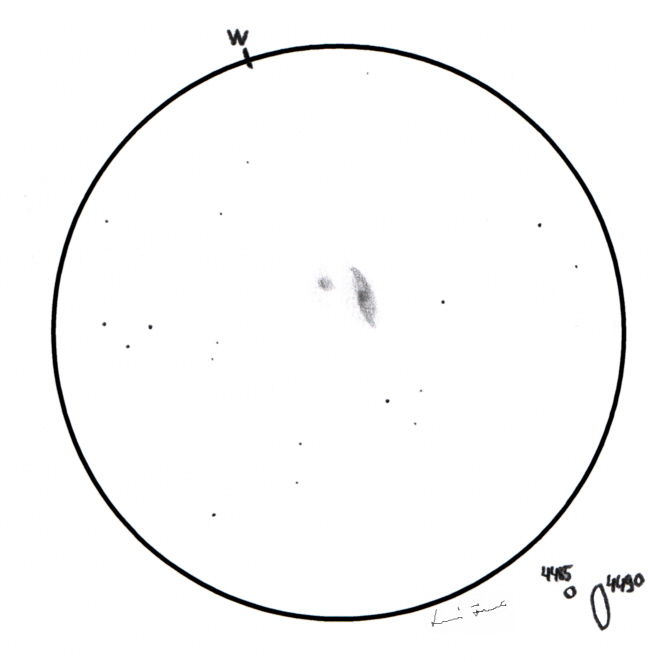
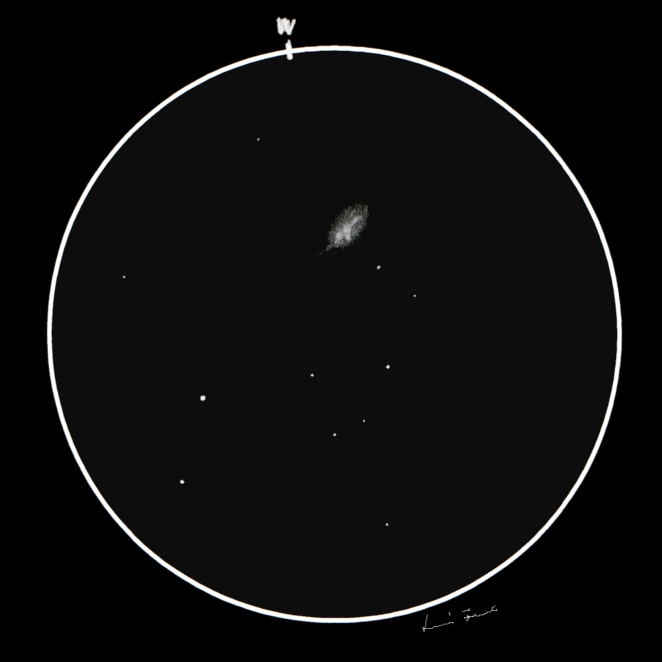
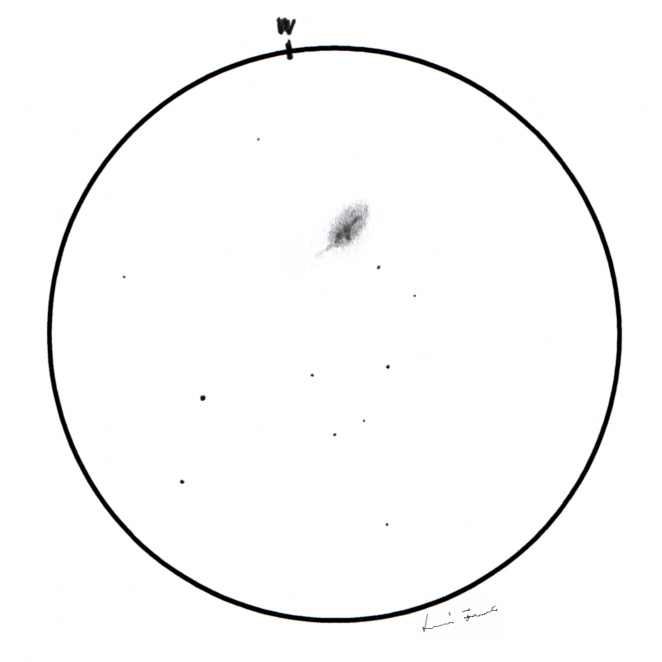
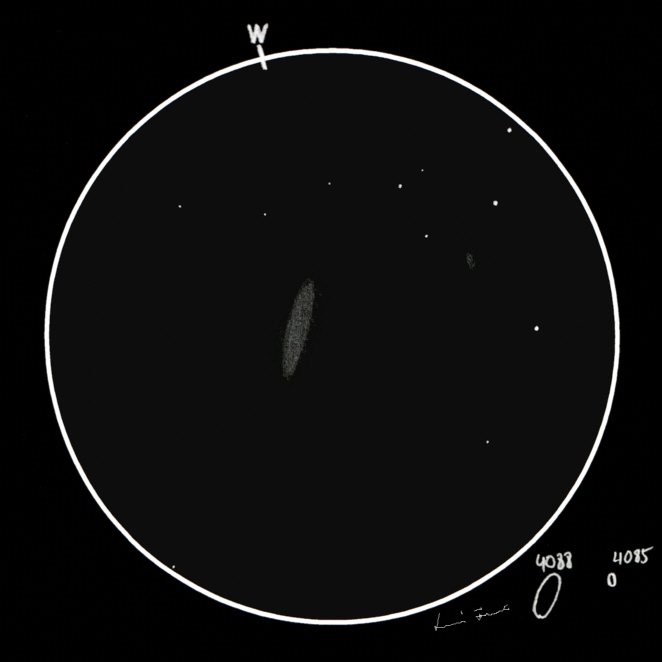
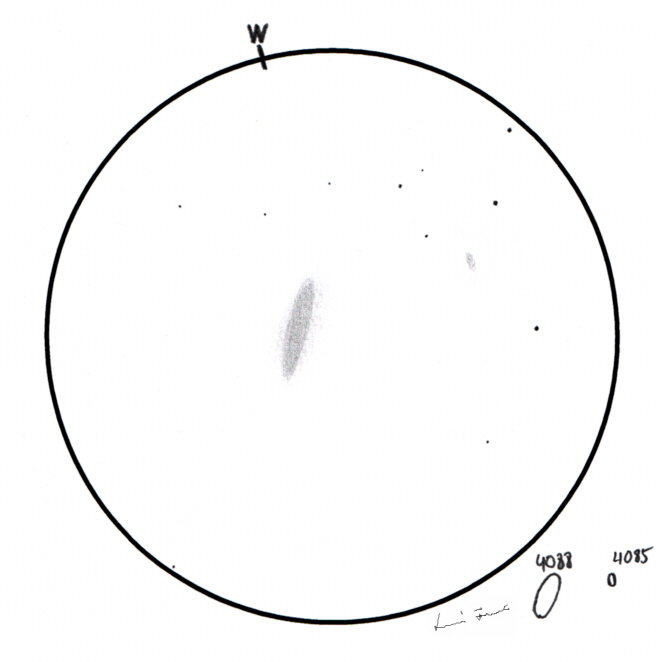
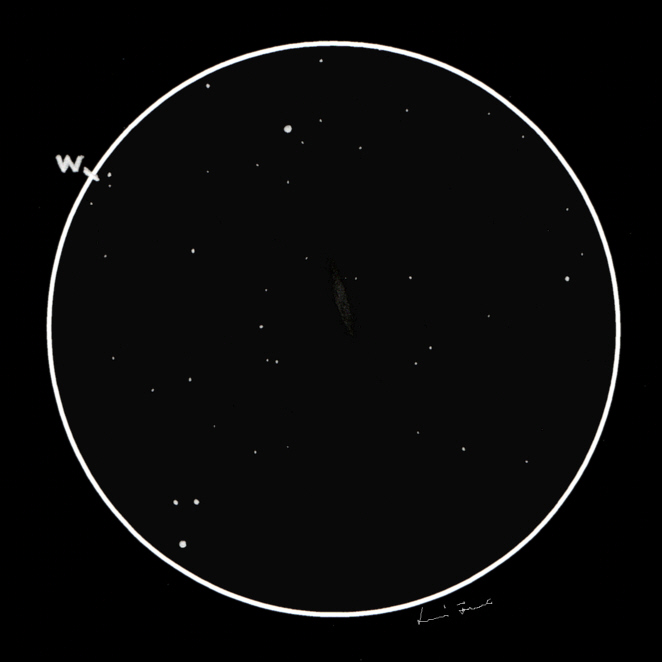
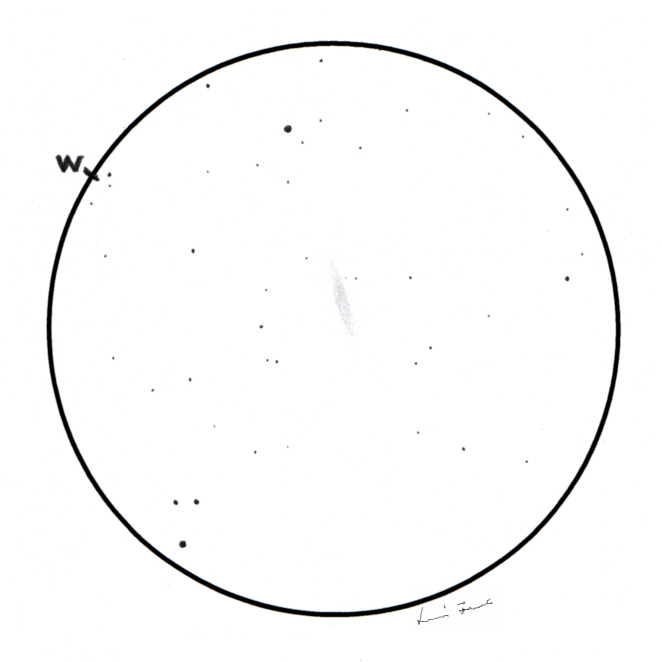
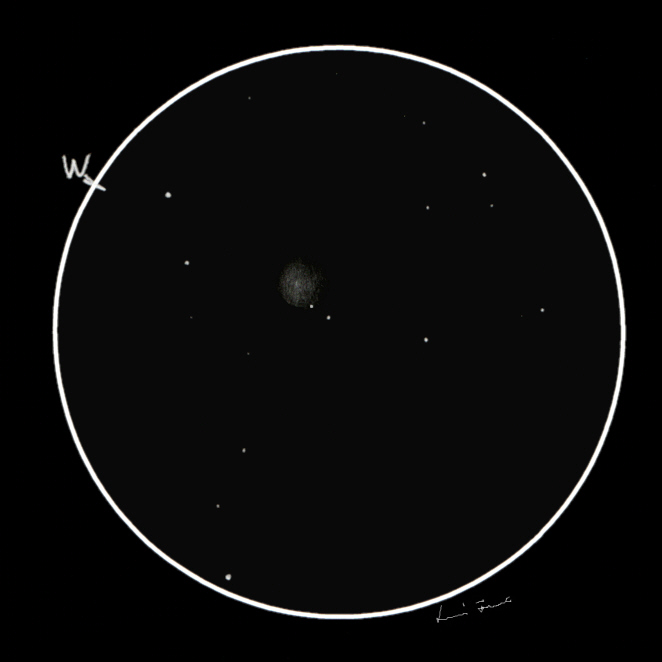
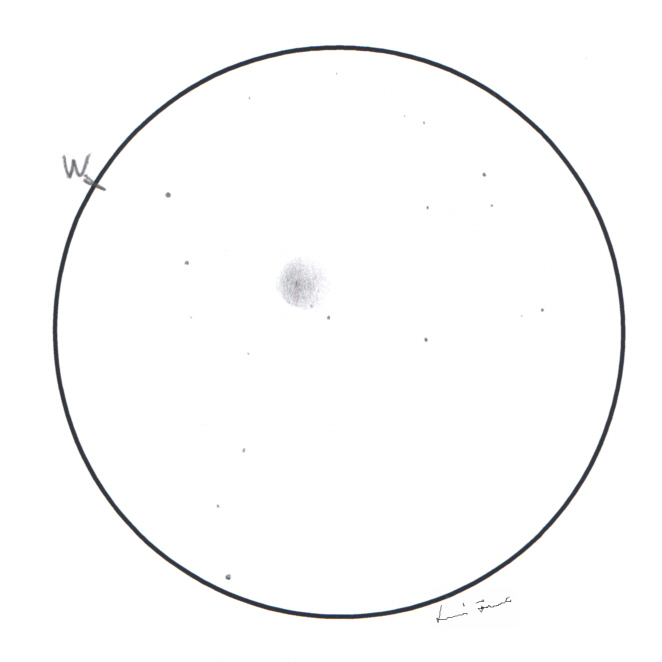
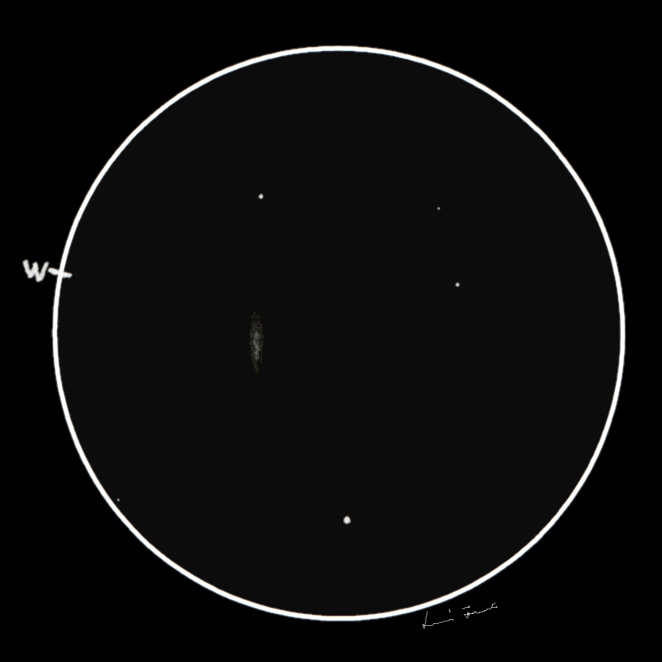
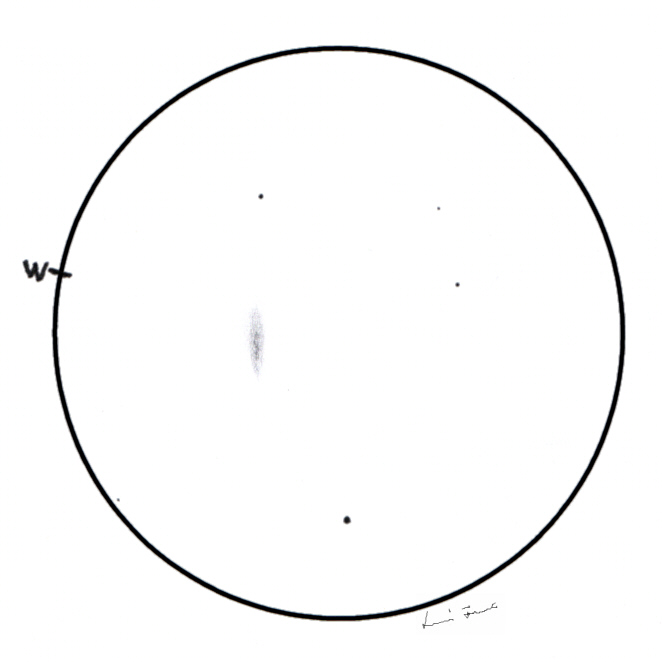
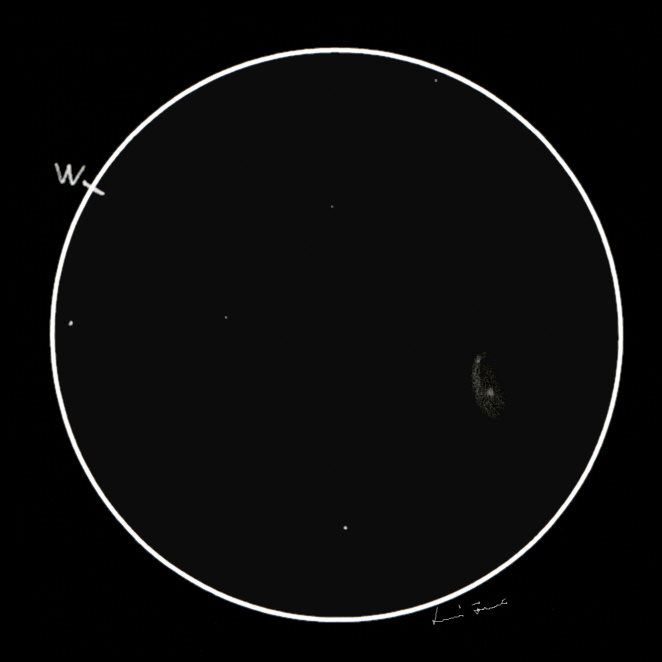
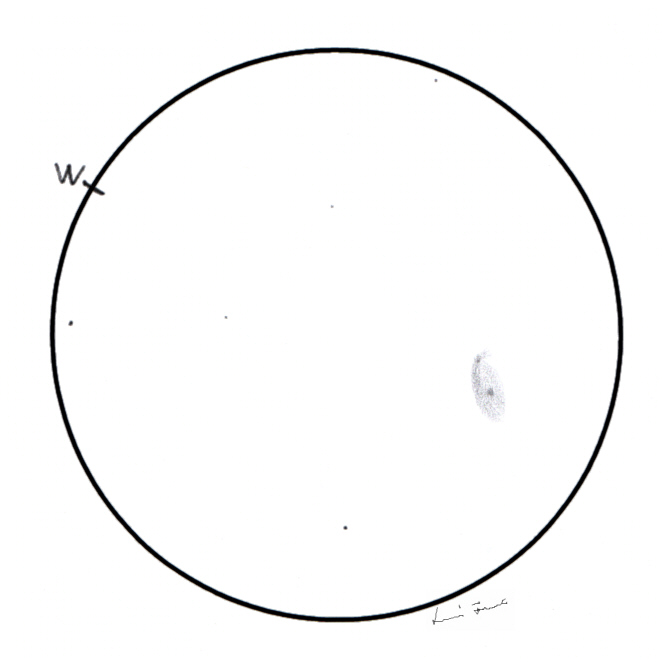
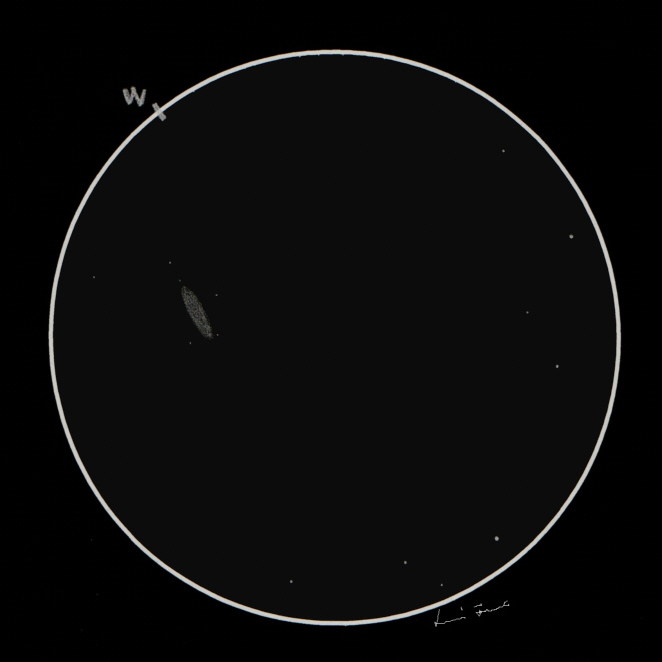
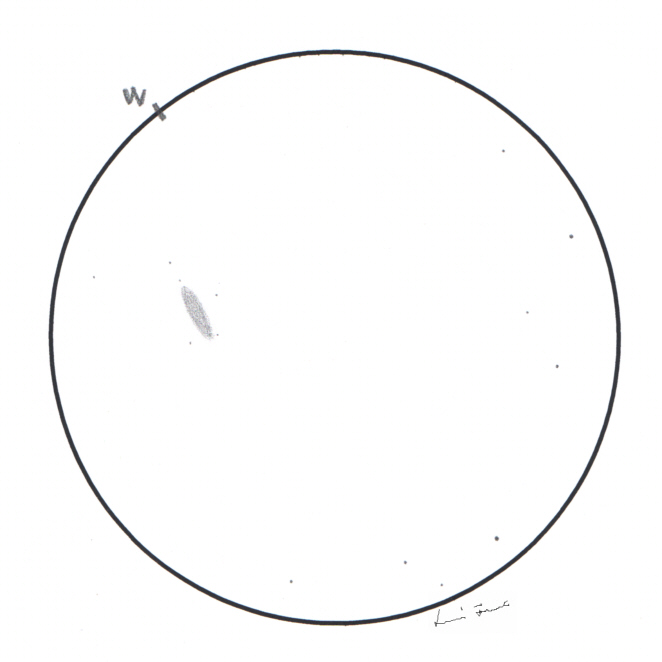
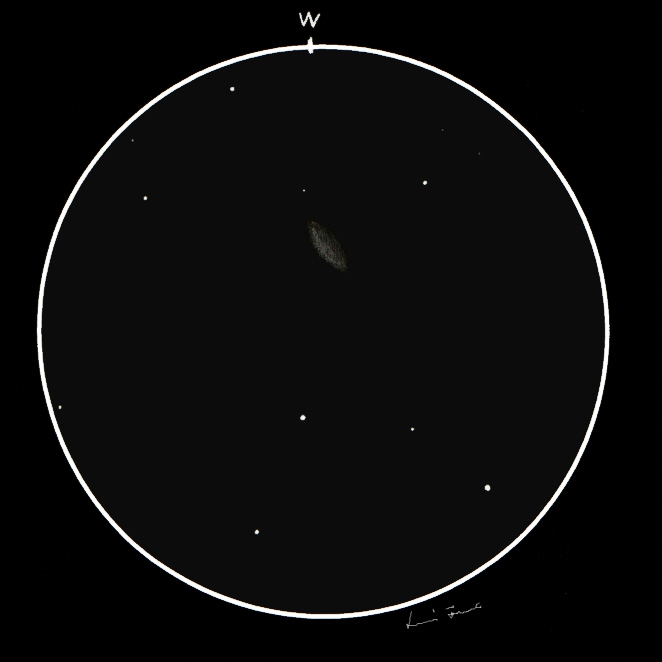
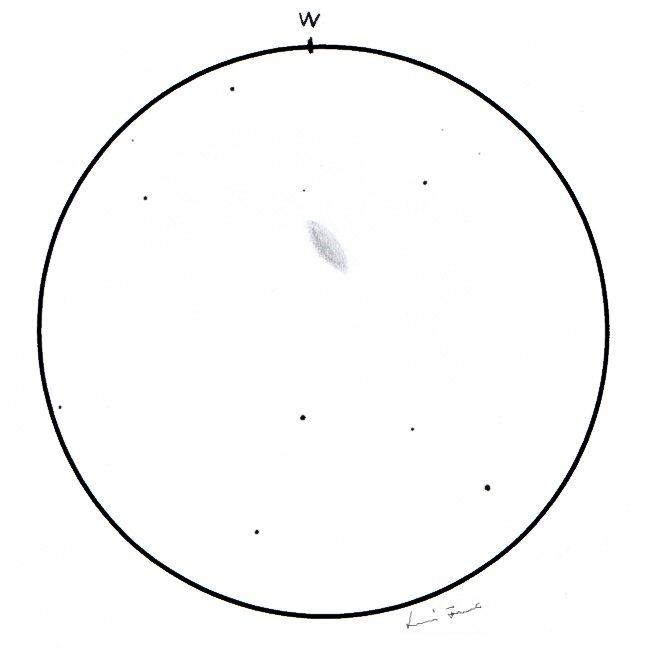
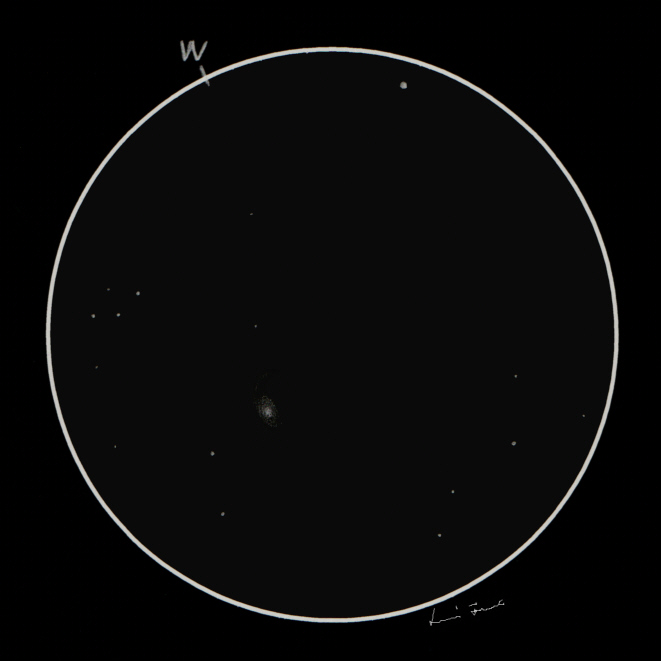
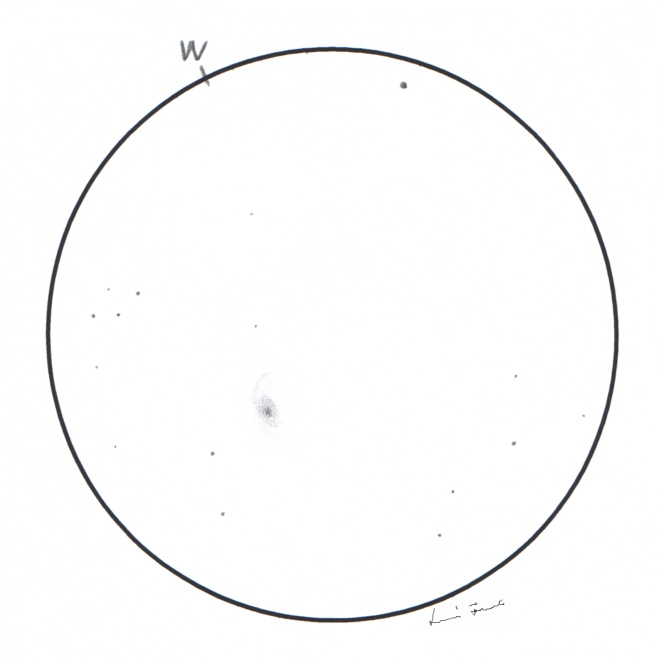
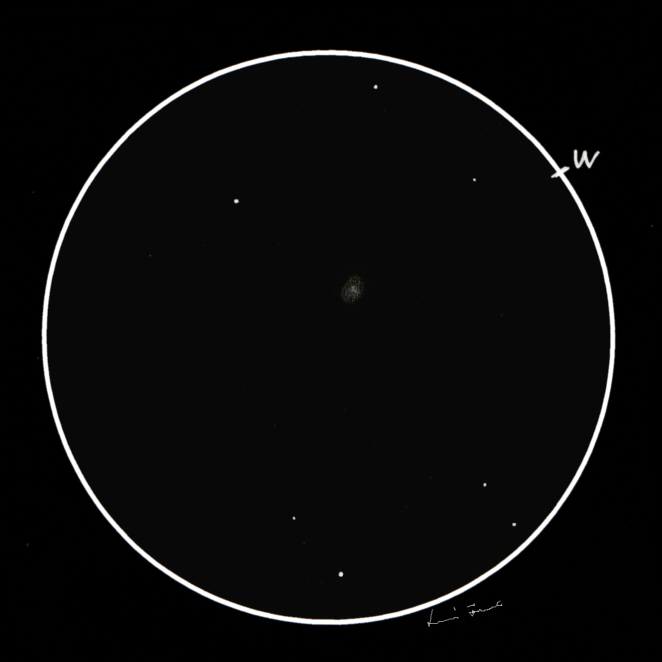
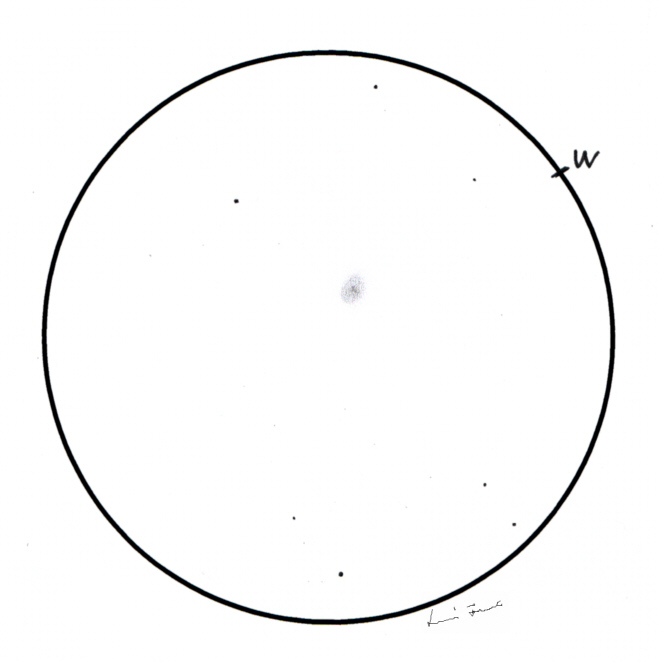
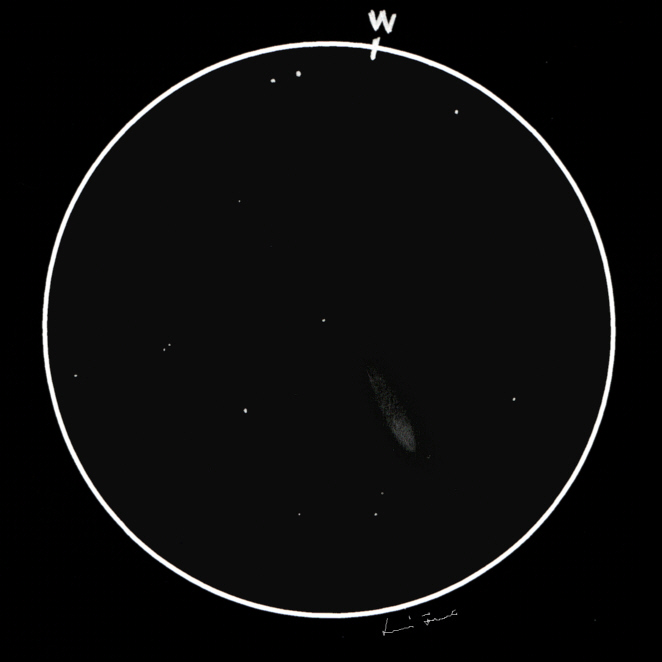
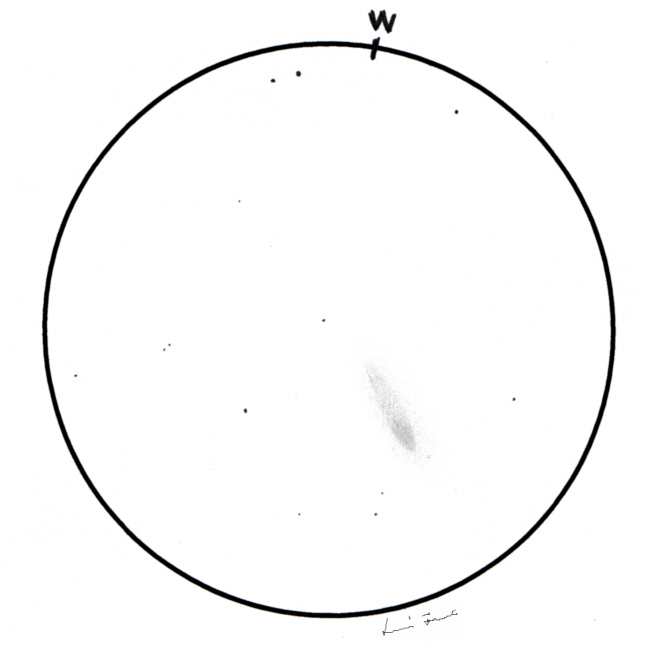
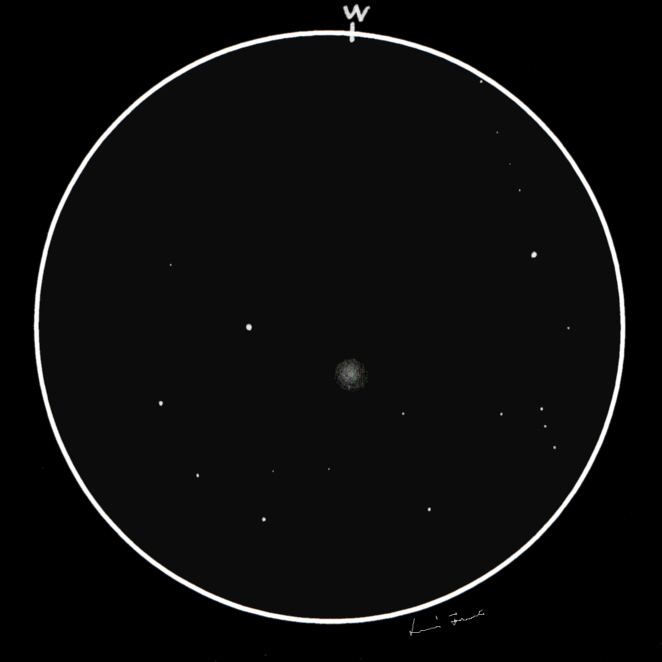
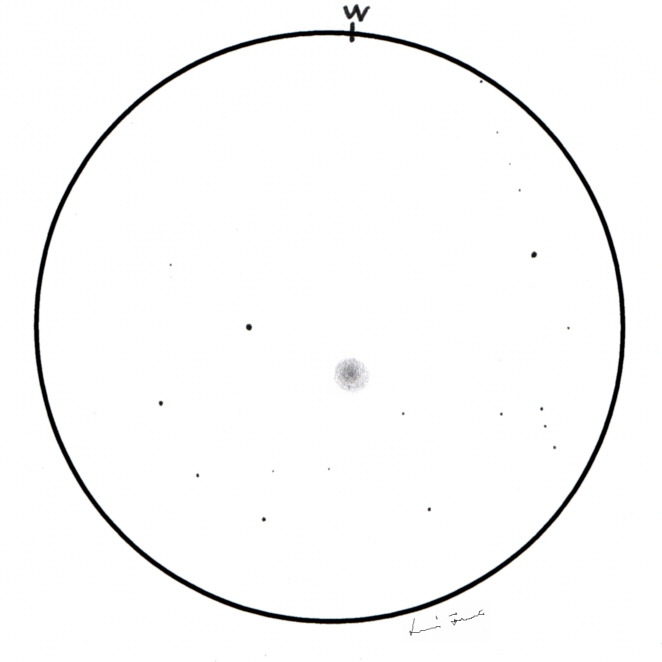
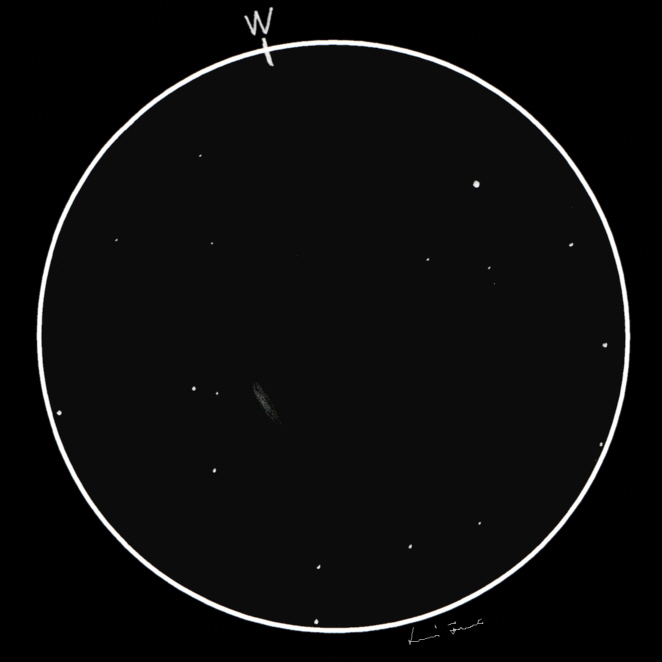
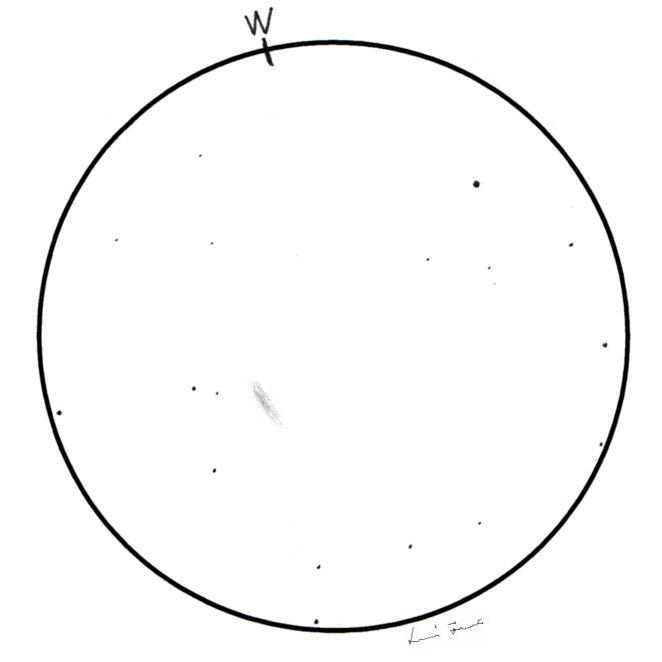
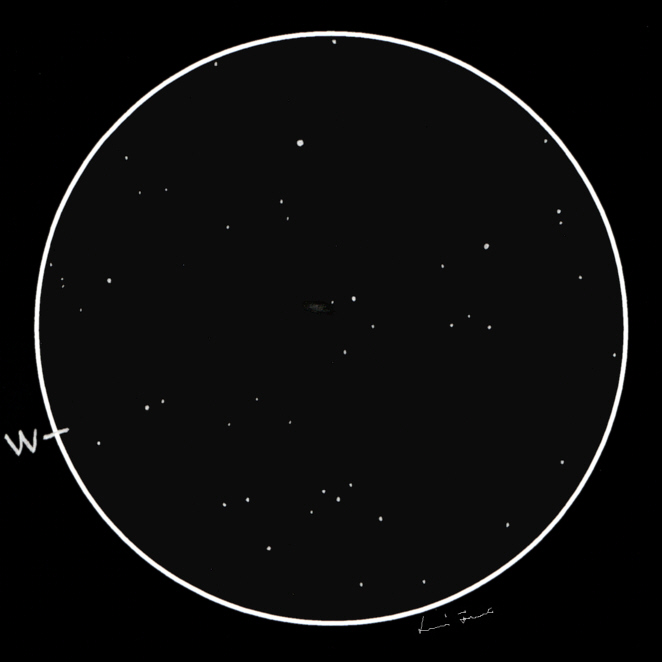
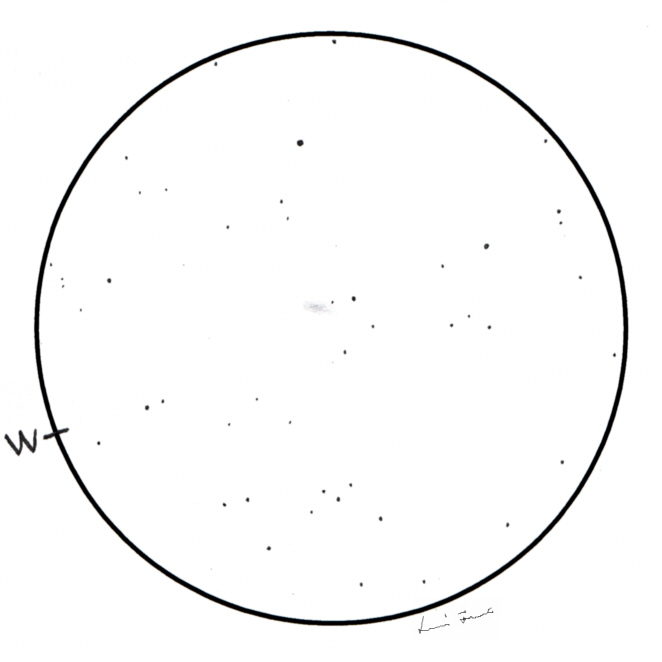
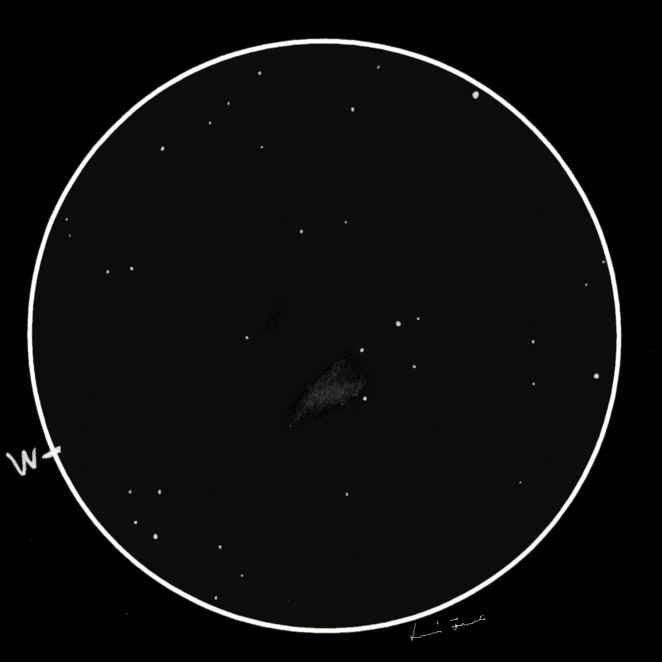
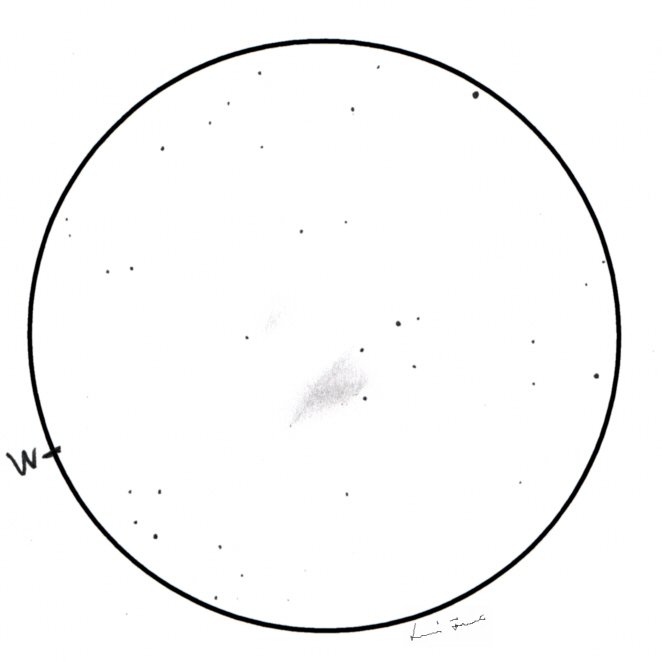
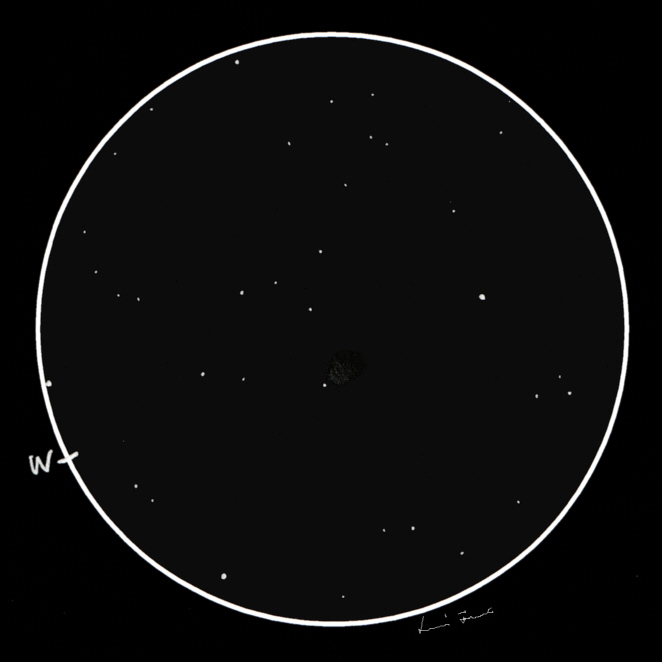
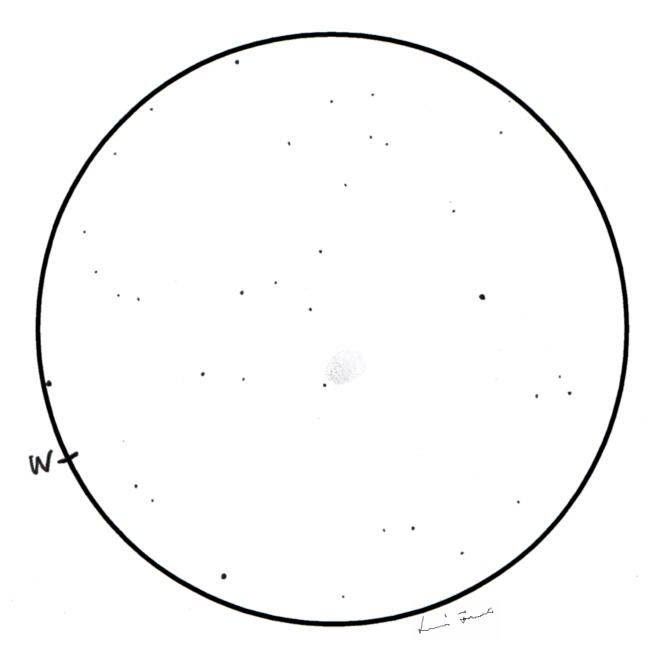
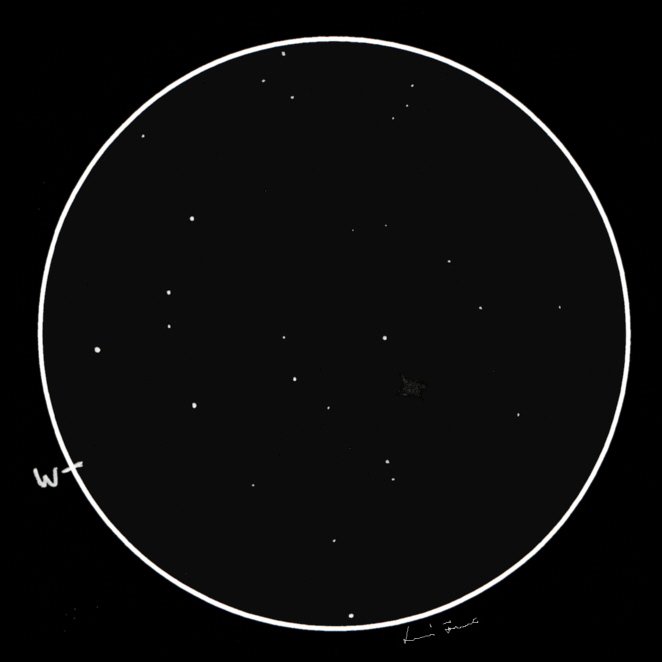
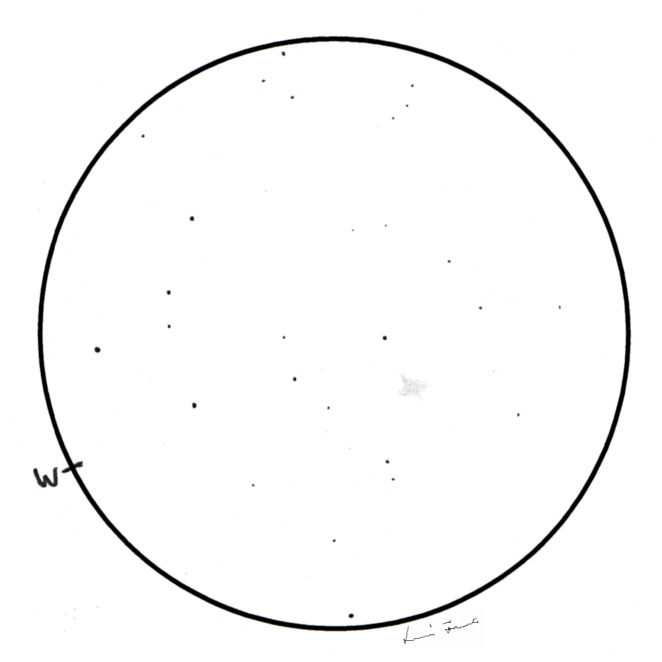
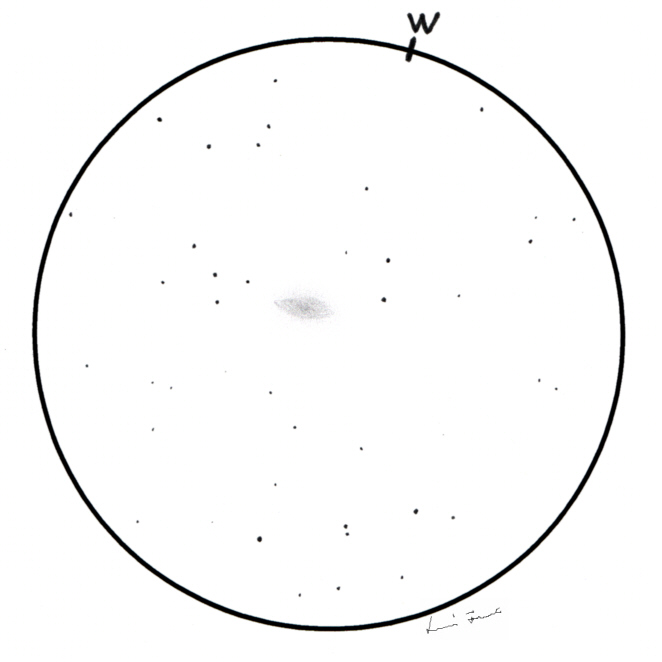
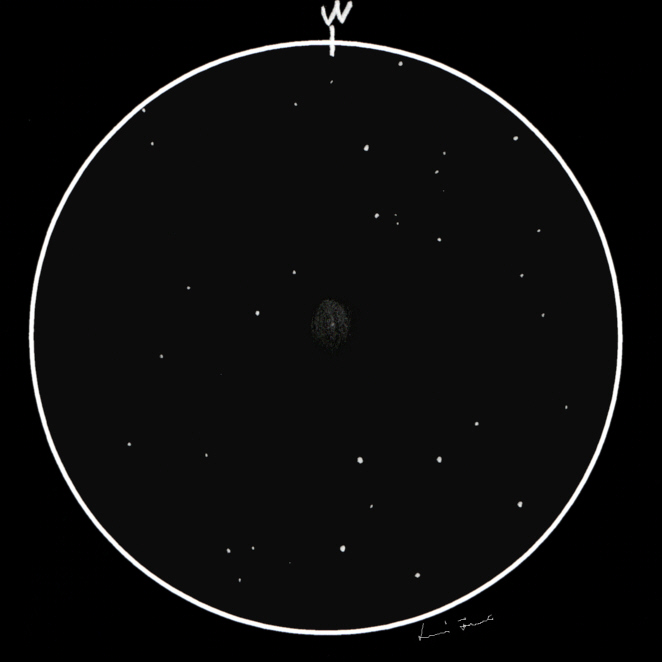
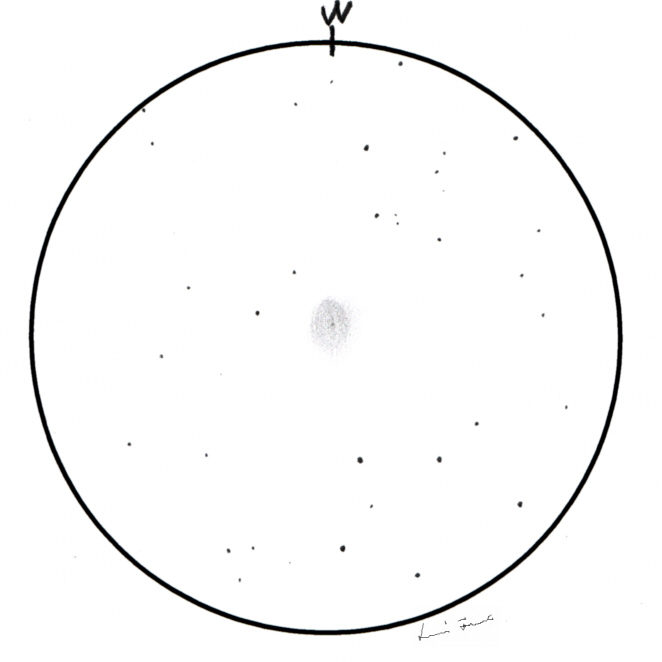
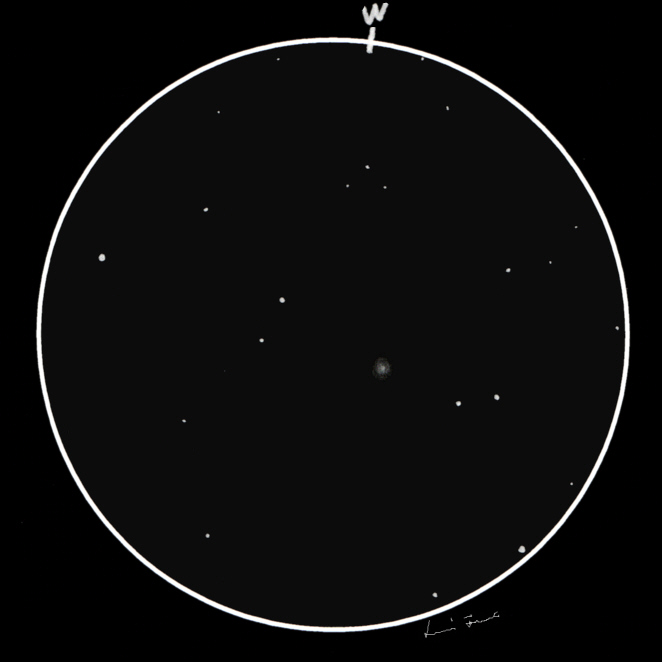
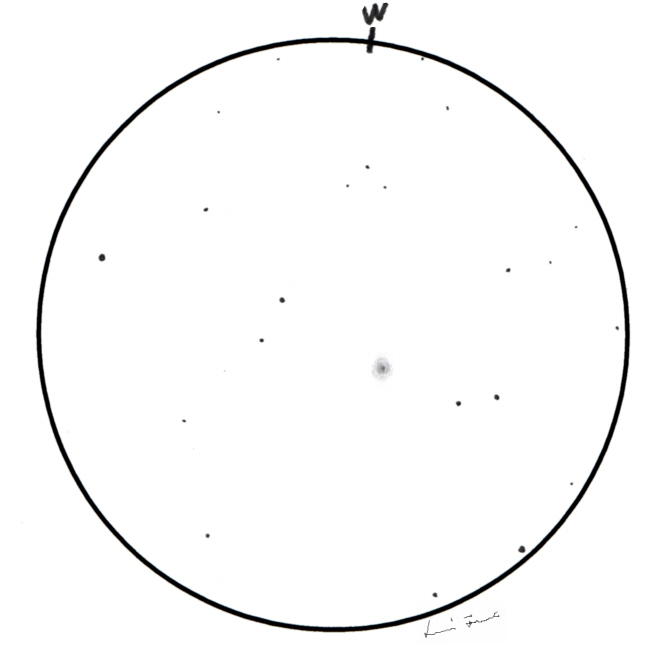
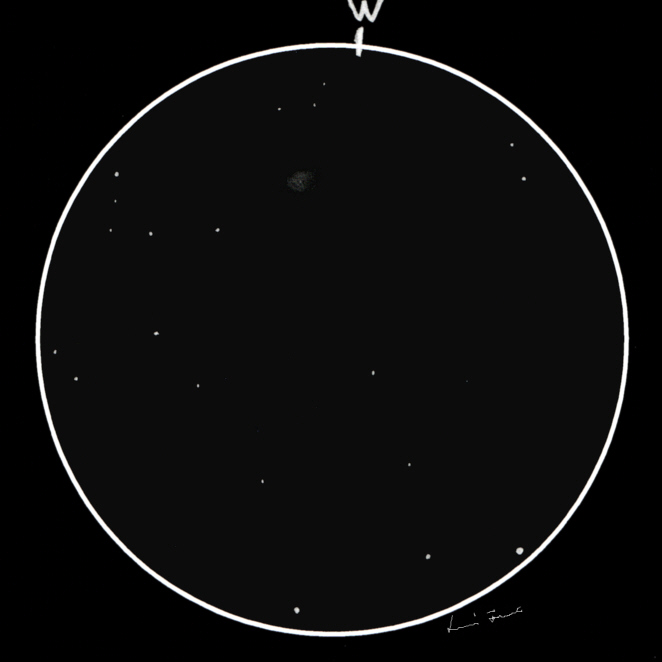
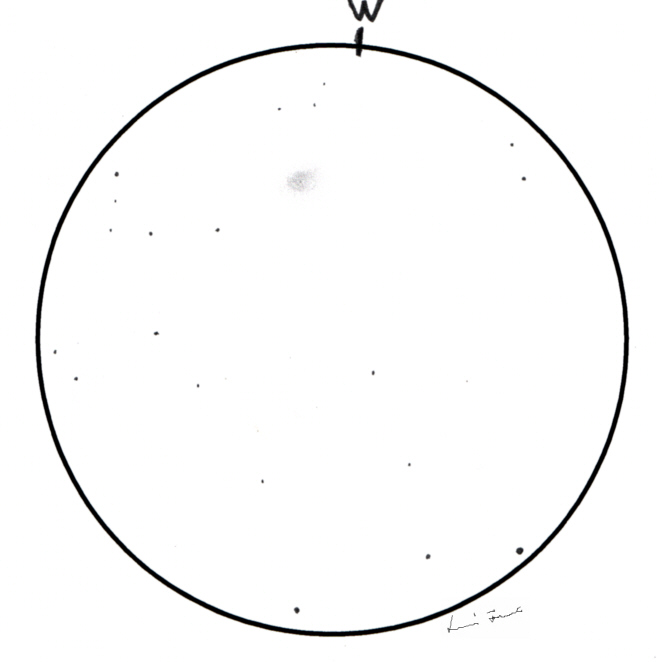
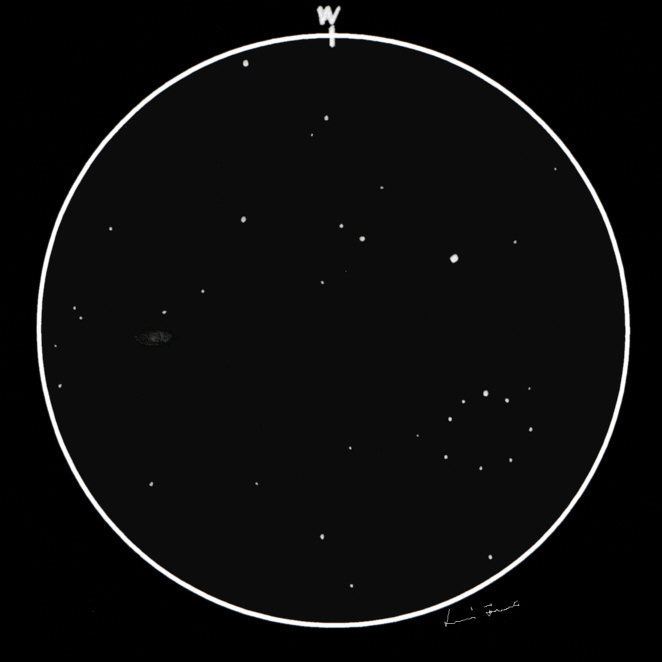
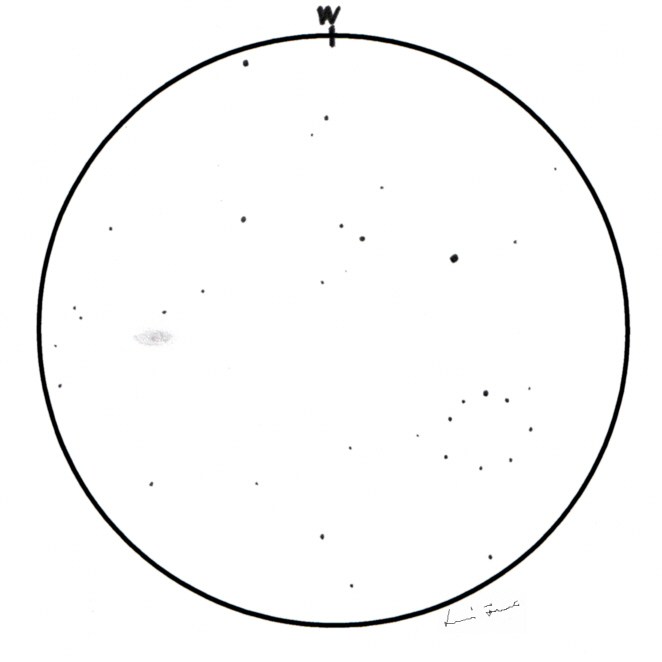
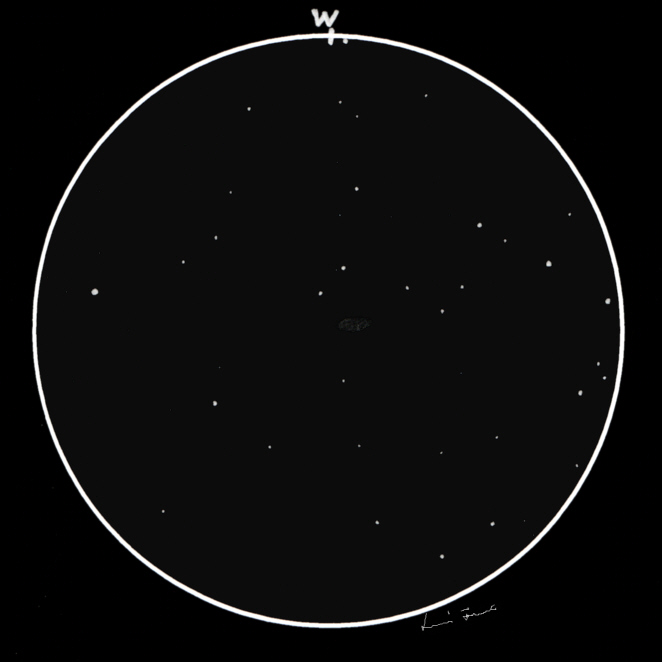
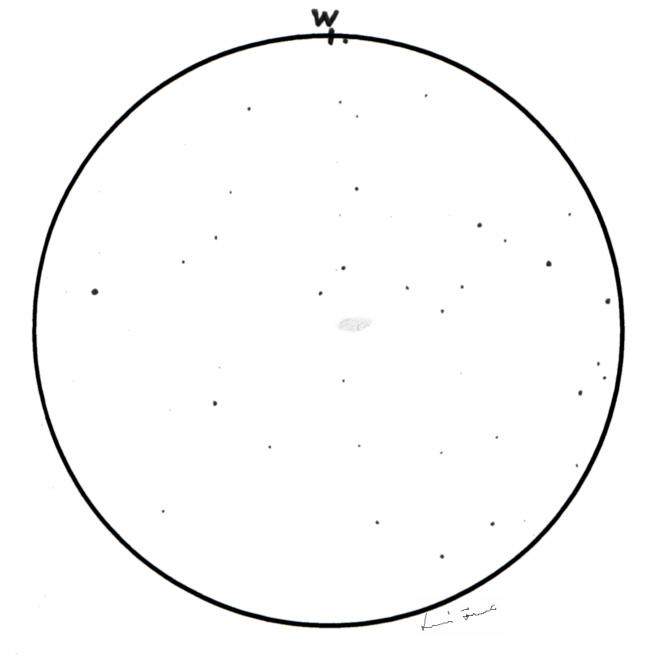
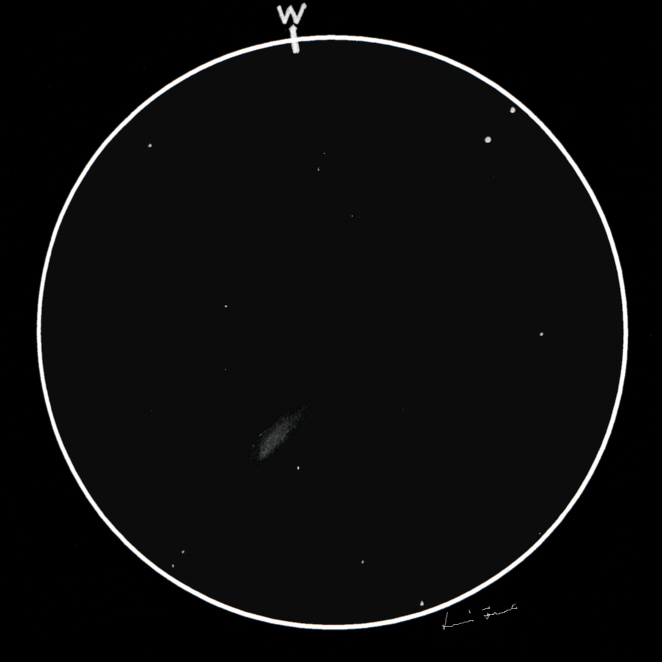
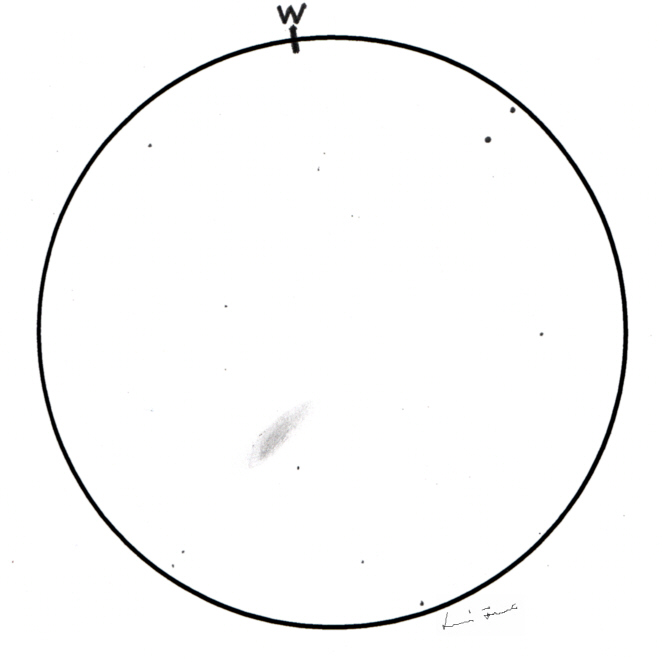
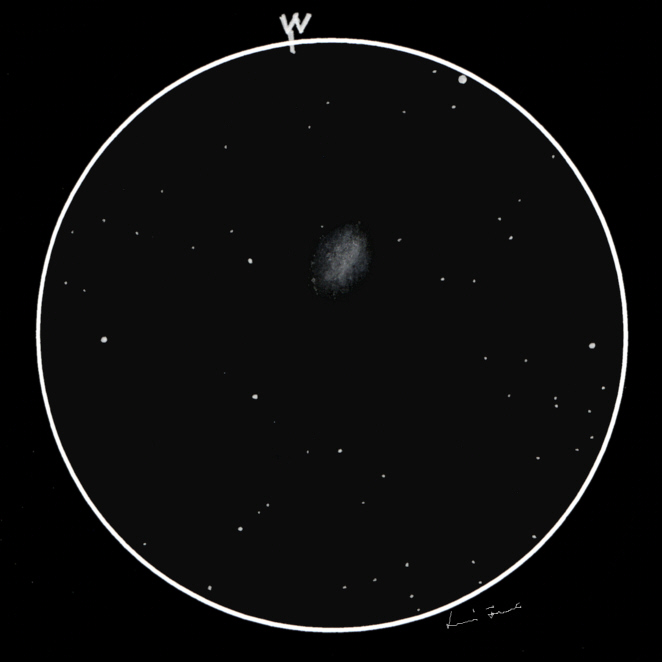
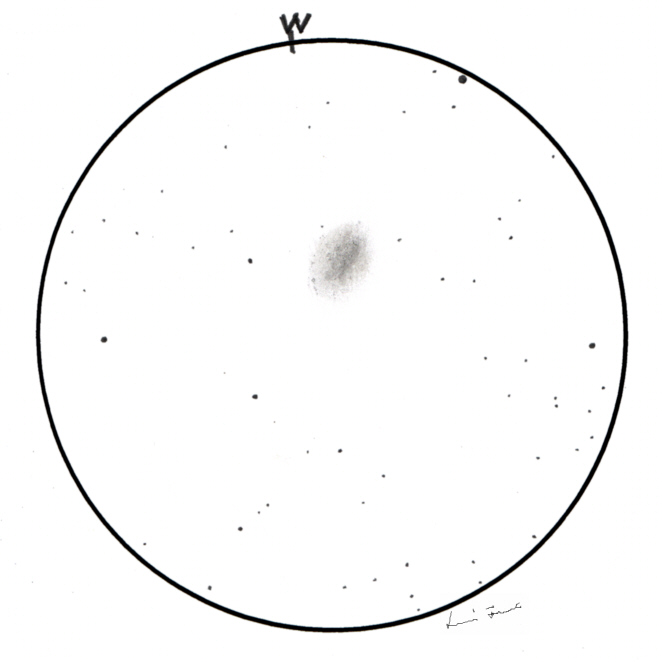
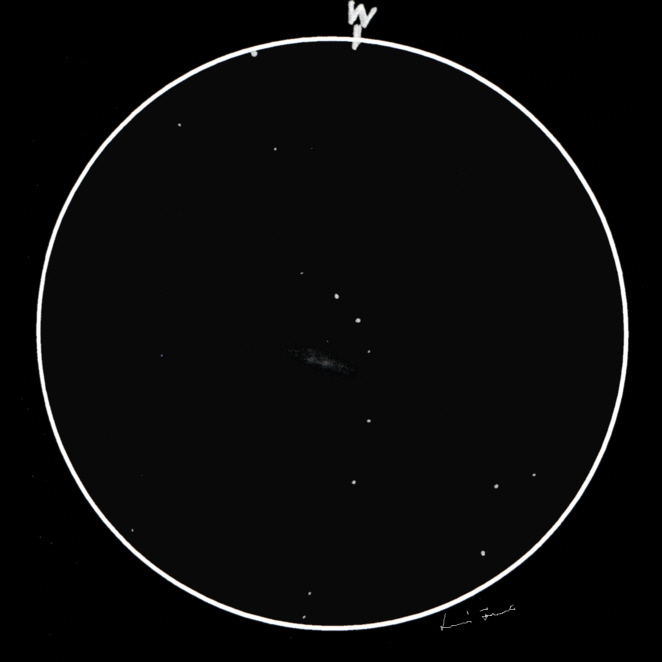
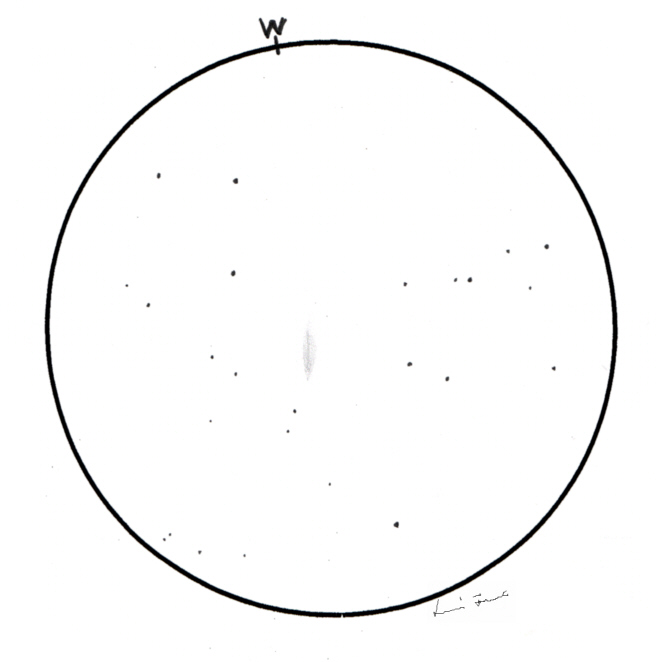
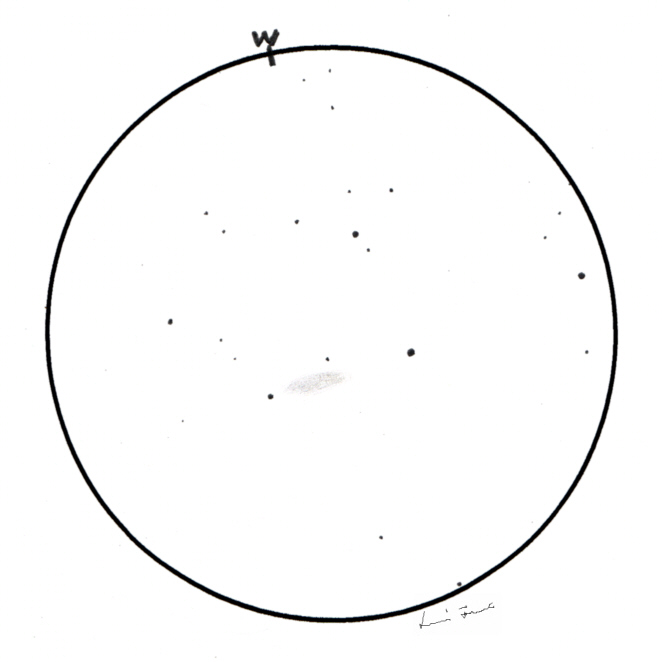
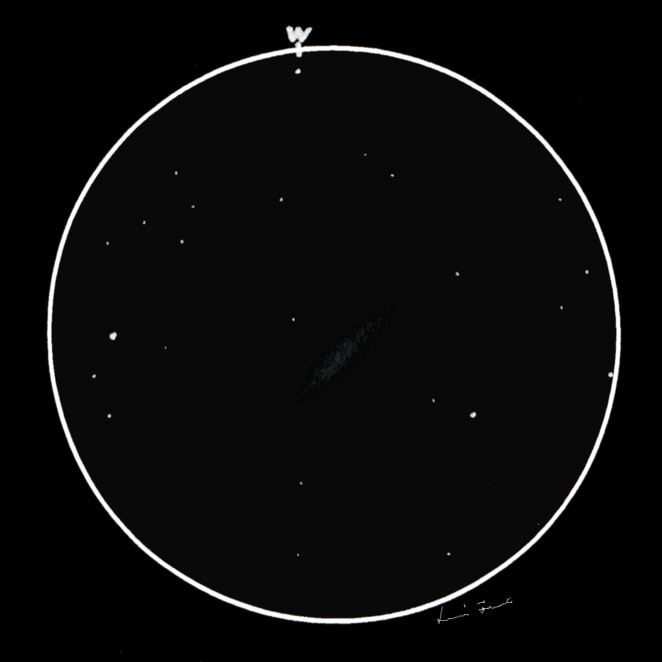
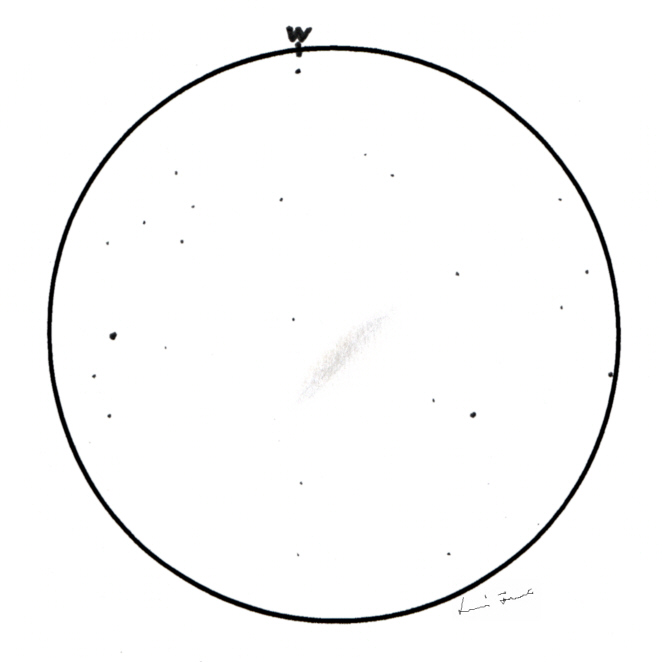
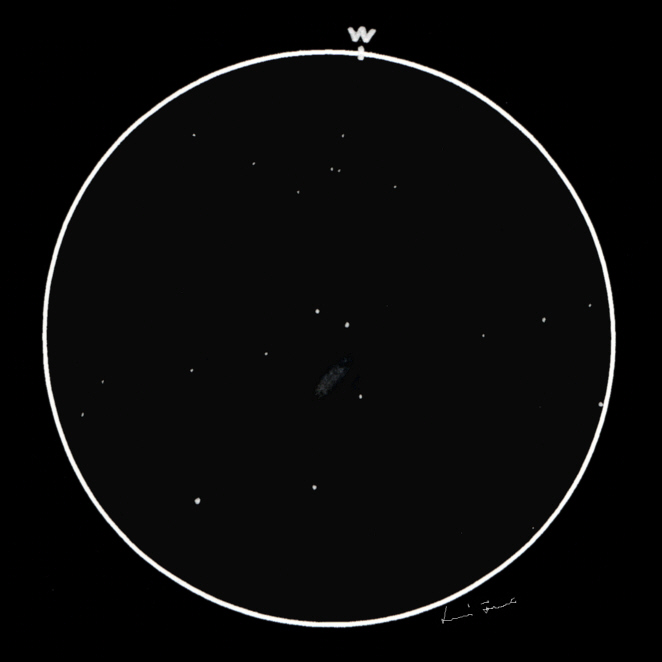
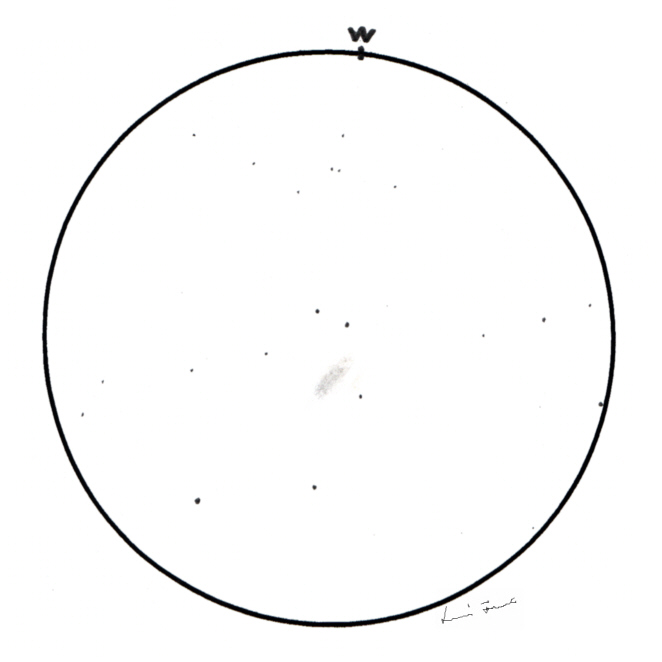
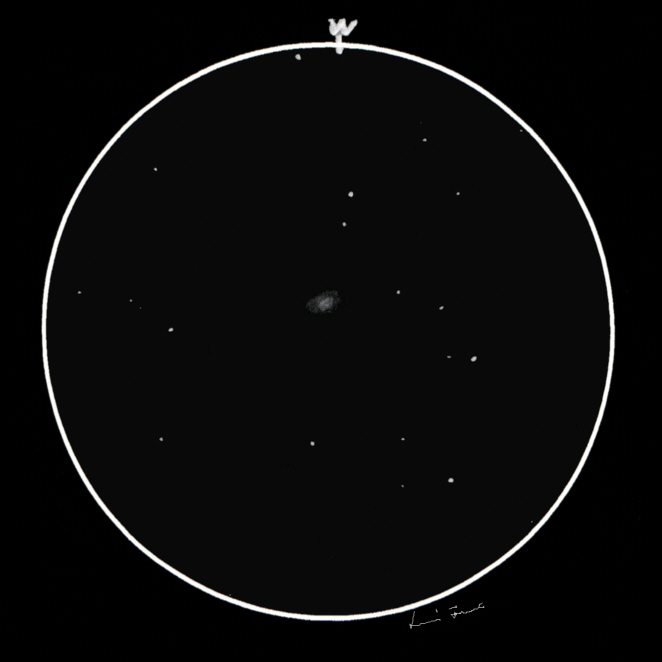
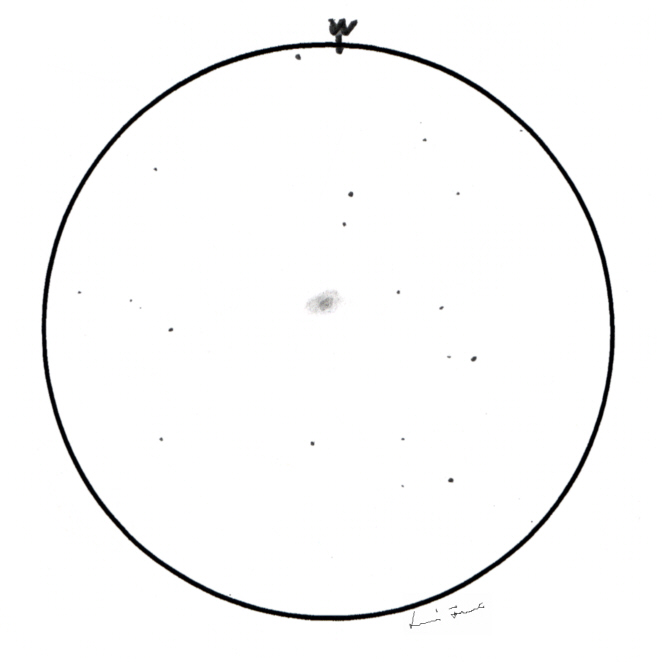
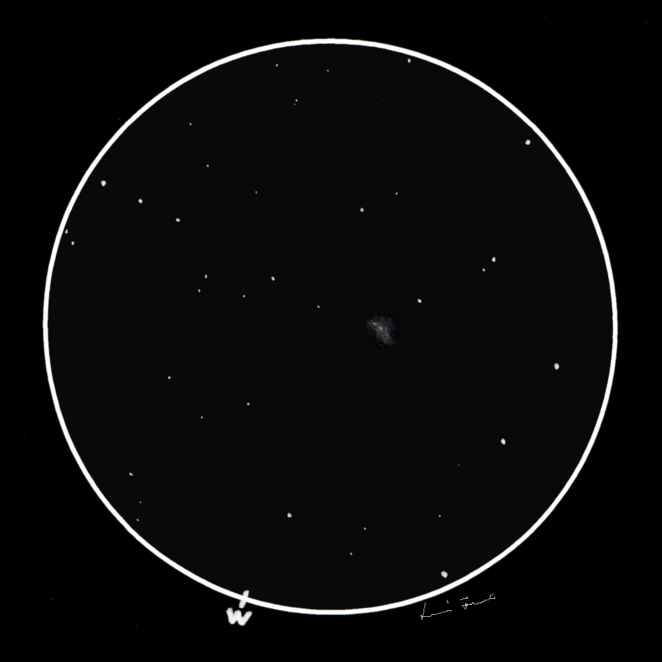
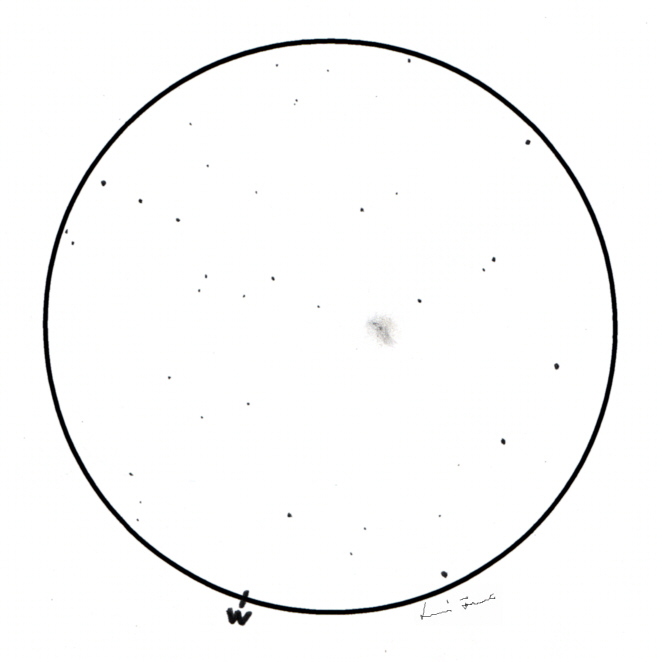
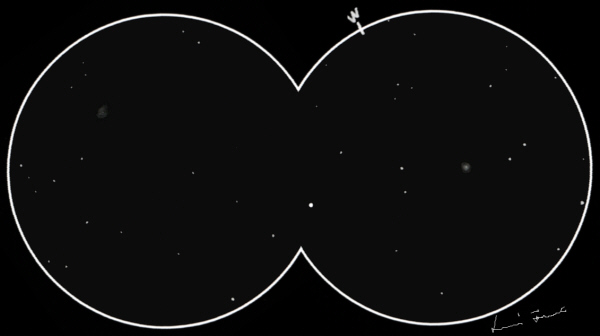
M51 + NGC 5195 (Galaxy)
|
|
Also known as: NGC 5194 + NGC 5195
|
|
Right ascension: 13h 30m
|
Declination: 47° 14'
|
|
Constellation: Canes Venatici
|
|
Date/time: 2008.04.27 21:00 UT
|
|
Equipment: 12" f/5 Newtonian
|
|
FoV: 50'
|
Magnification and filter(s): 71x
|
|
Seeing: 6/10
|
Transparency: 4/5
|
|
Location: Nádasdladány, Hungary
|
|
Observer: Ferenc Lovró
|
Description:
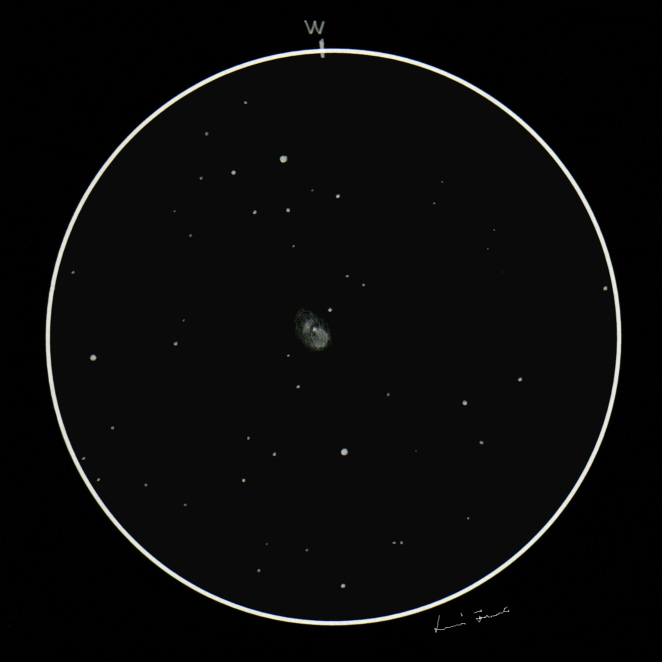
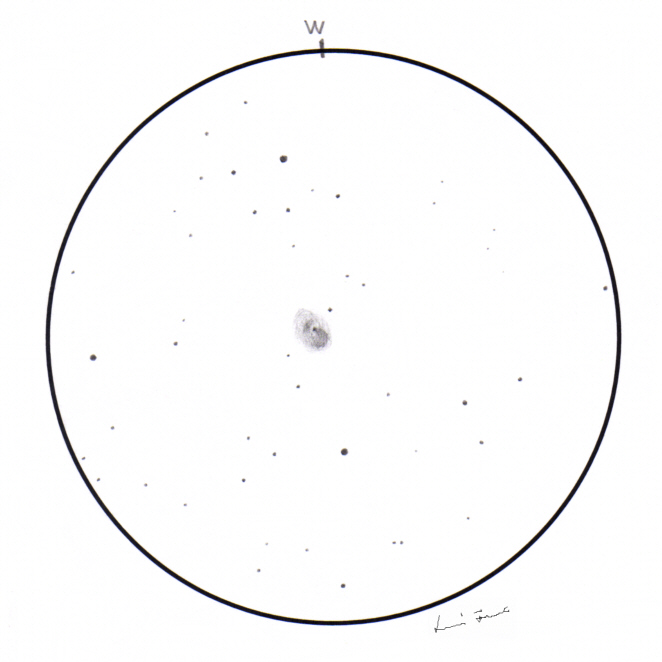
The spiral galaxy of M51, better known as the Whirlpool-galaxy is one of the most famous Messier objects. Thanks to its position and high luminosity, it's a very easy and impressive target. The spiral arms of M51 look beautiful and sharp, and with a little patience you can see even the bridge of matter between it and its interacting companion (NGC 5195), also with direct vision.
|
|
Hi-resolution image: [ reversed sketch | original sketch ]
|
|
|
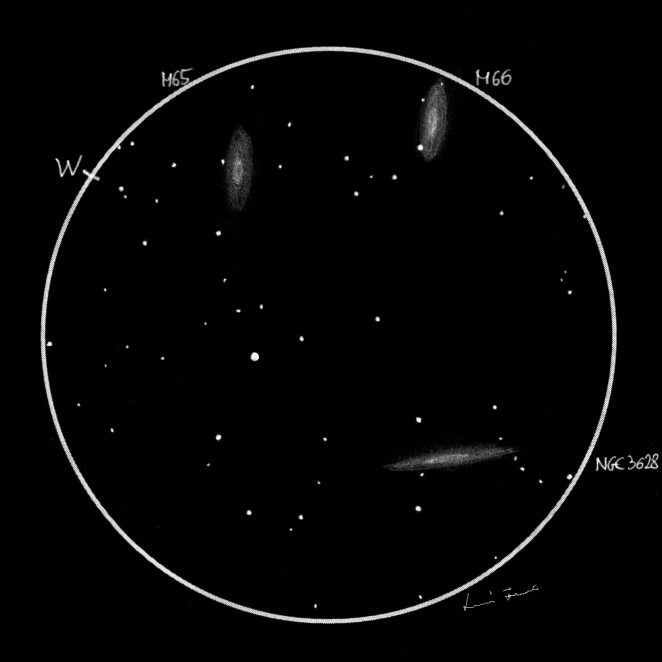
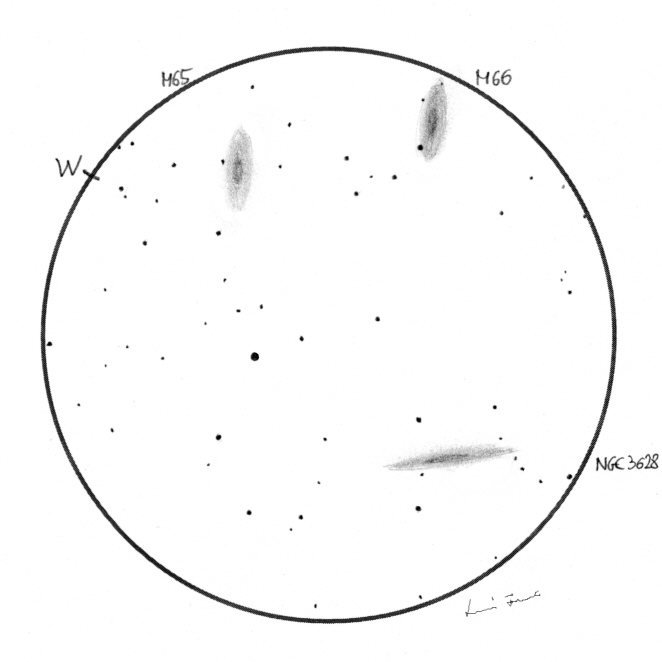
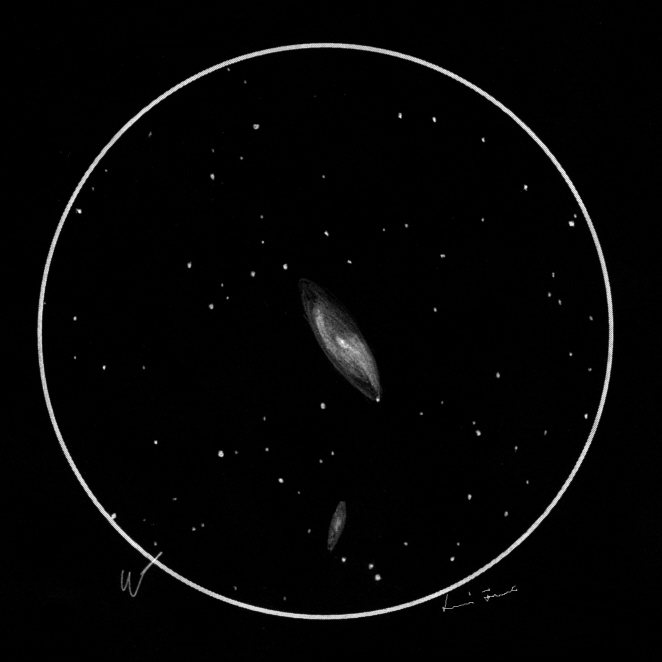
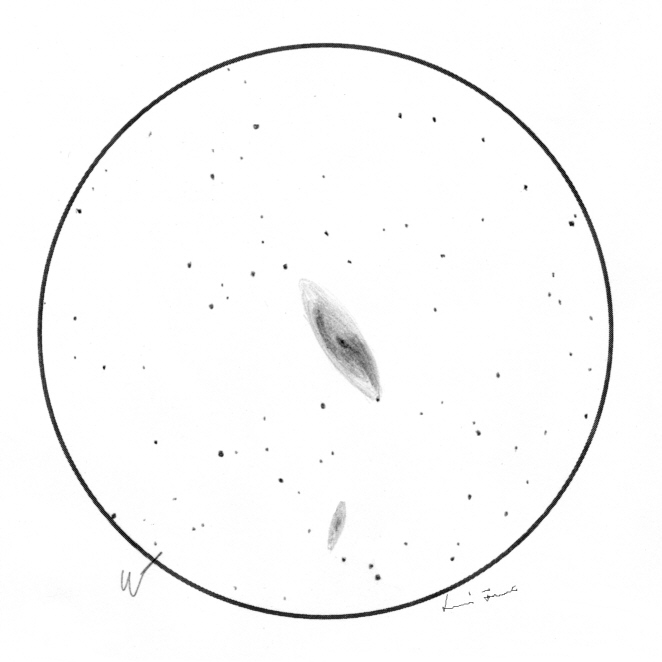
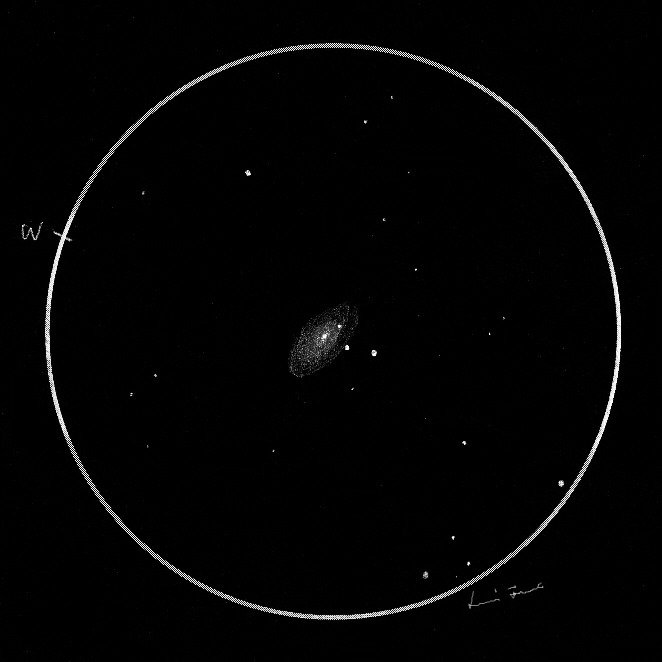
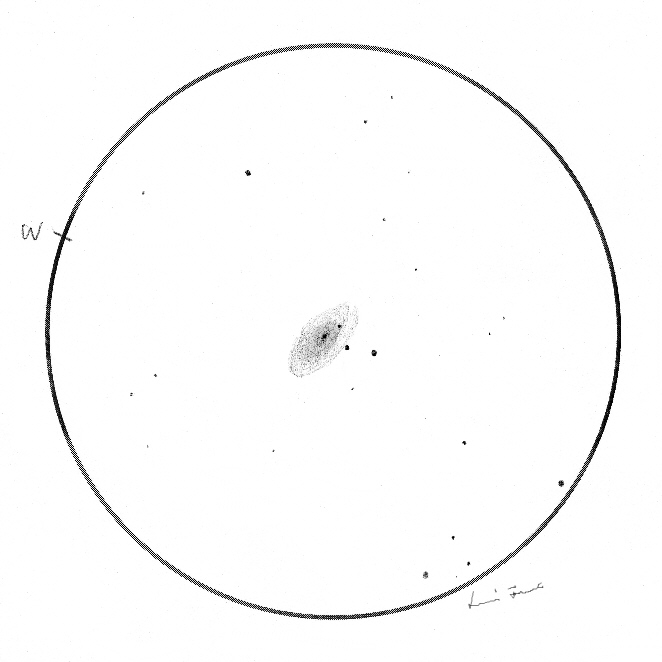
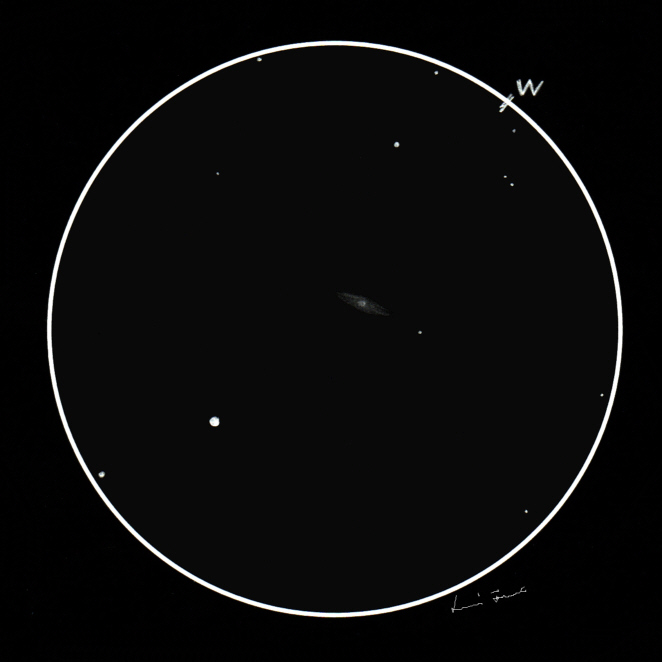
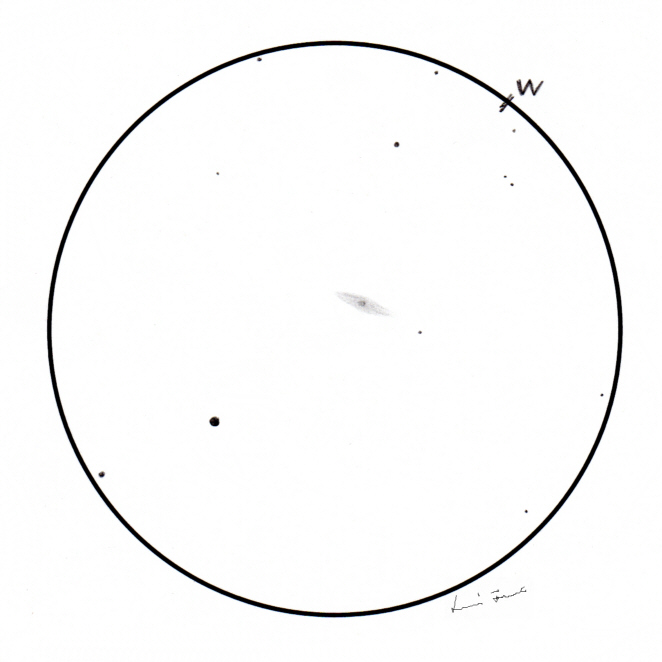
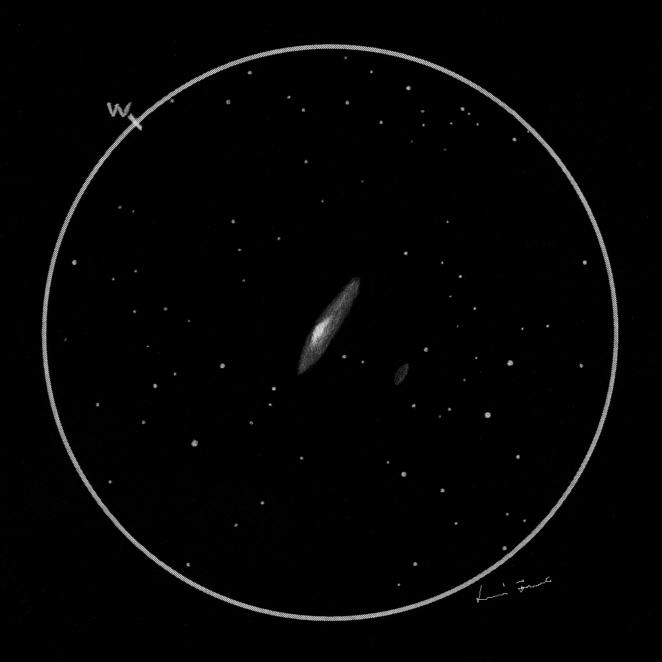
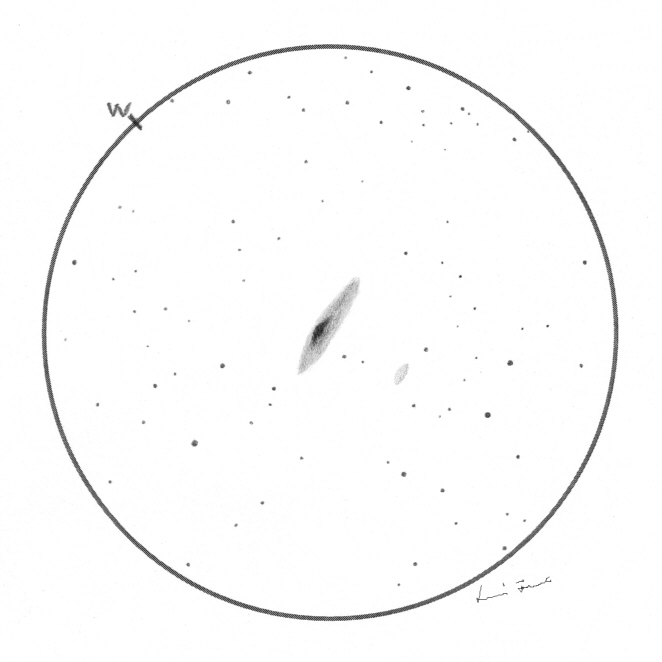
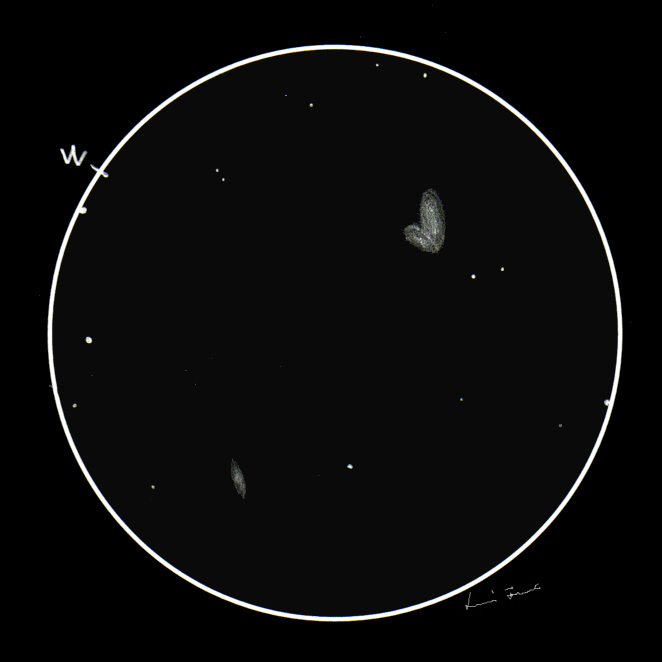
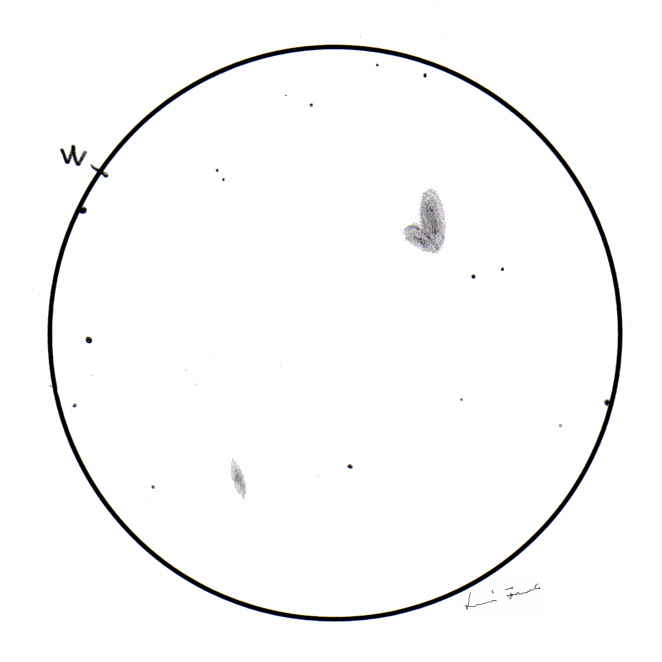
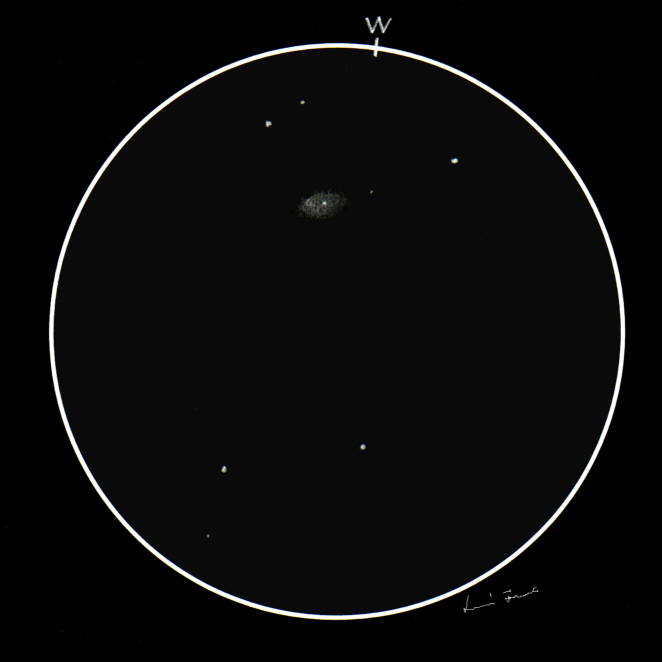
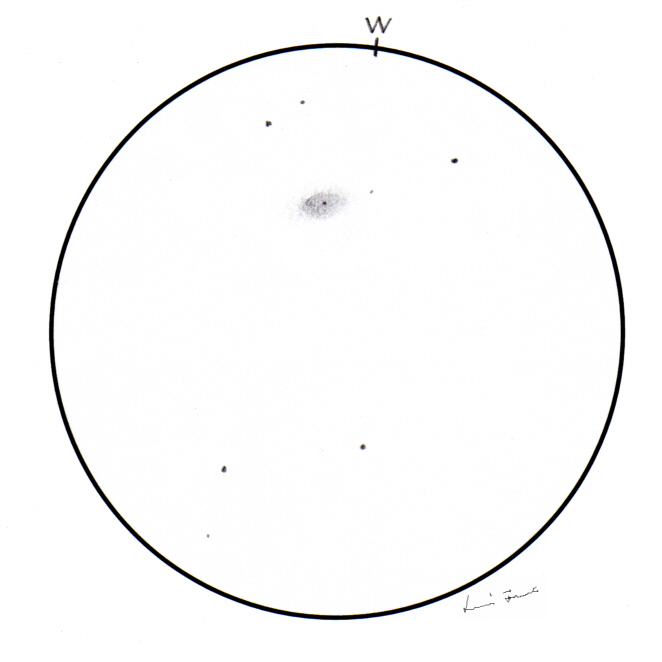
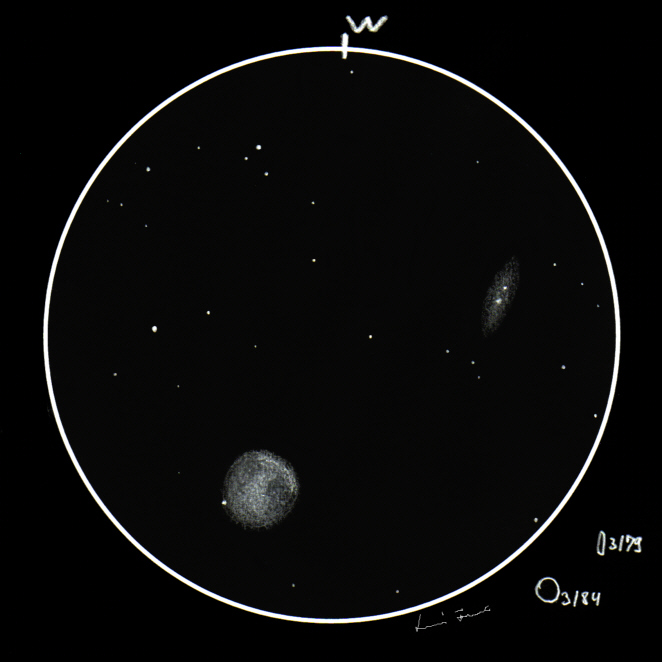
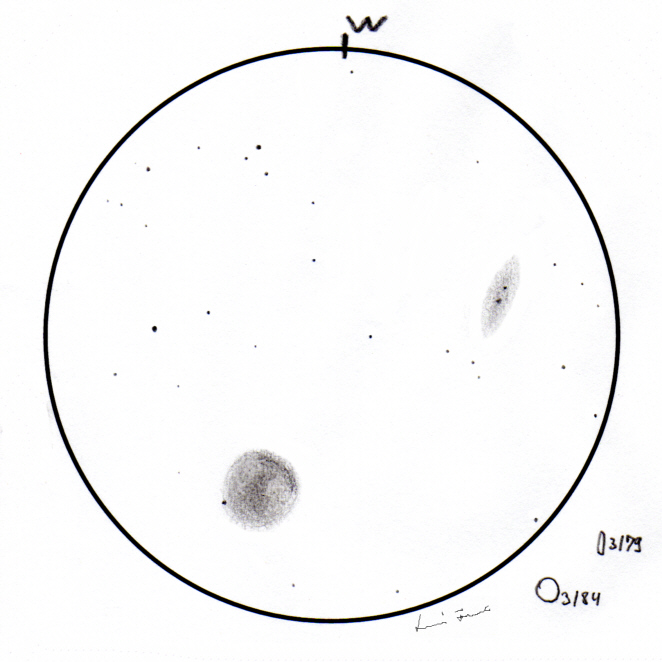
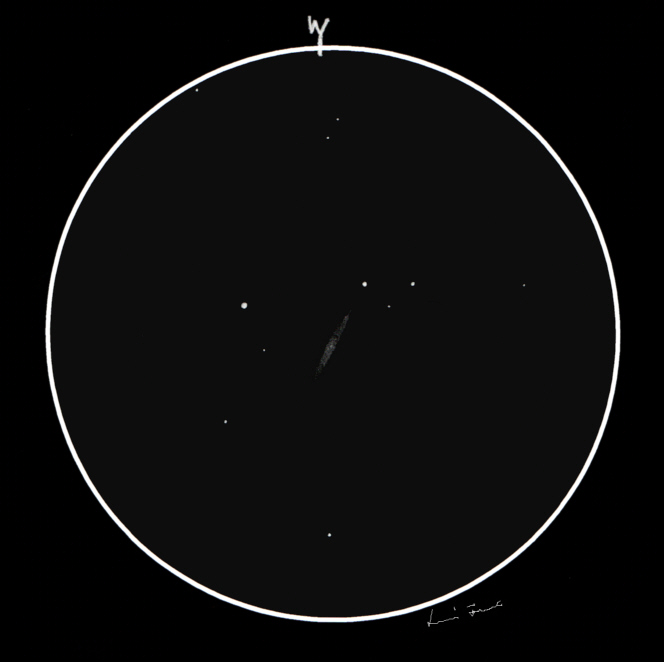
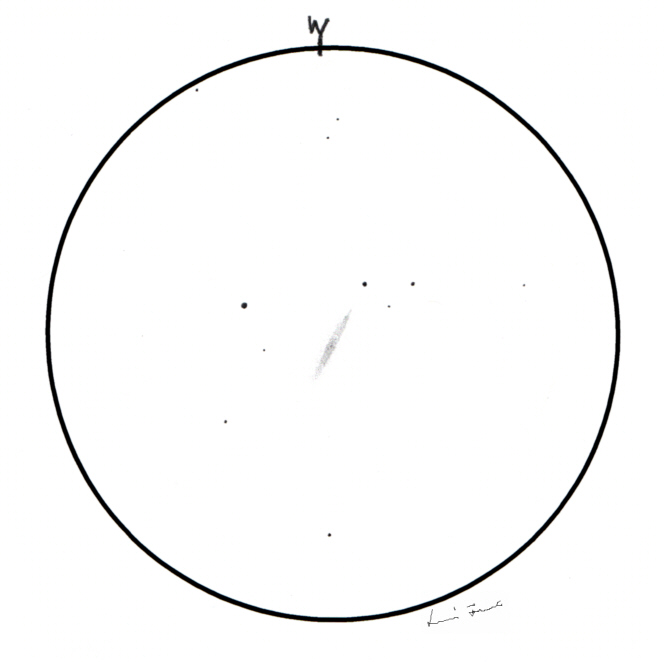
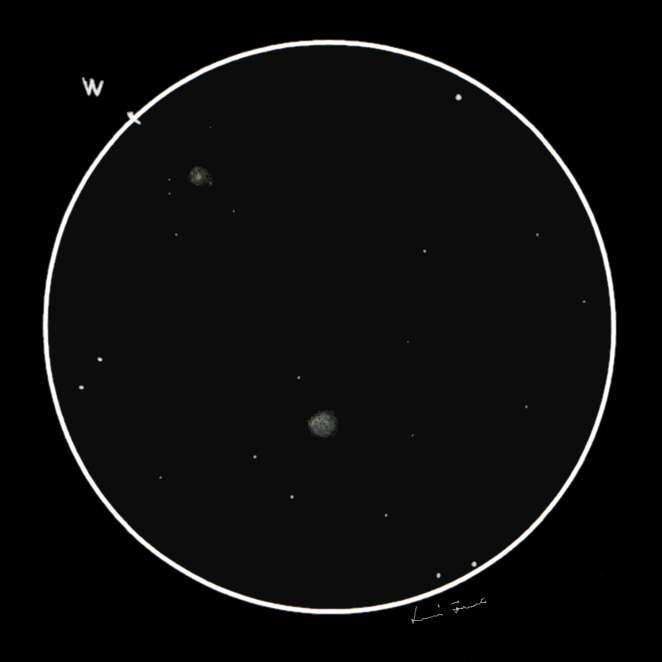
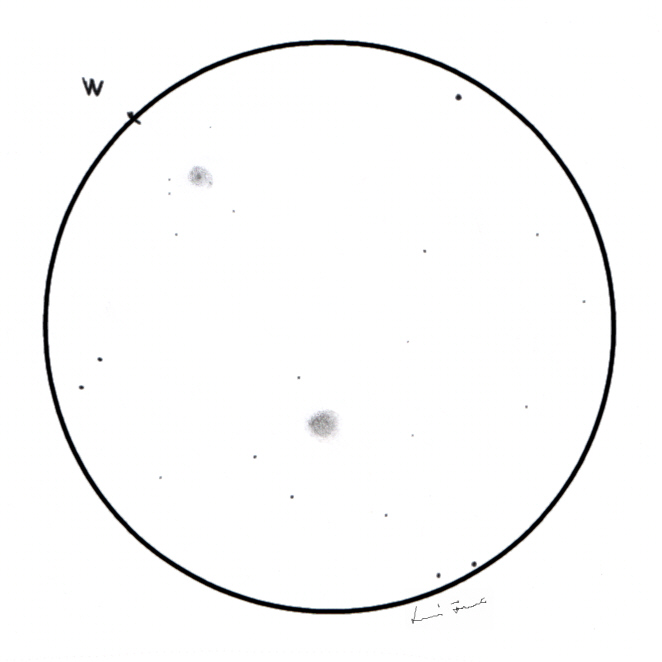
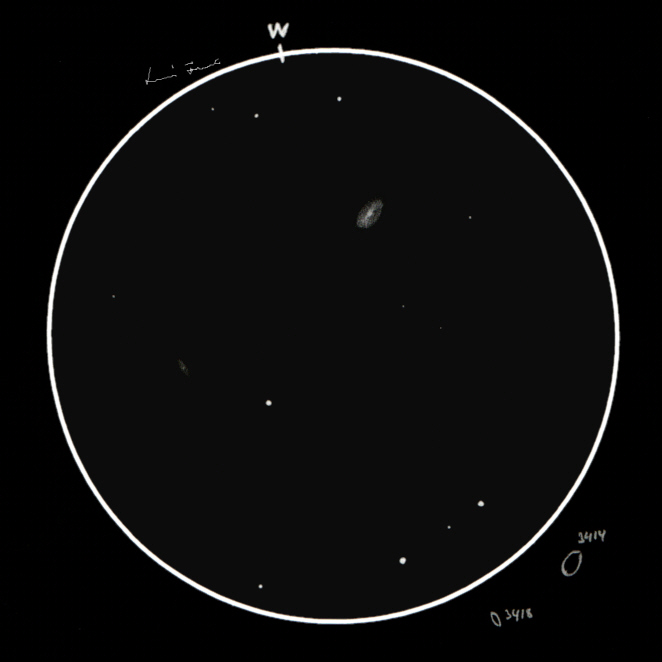
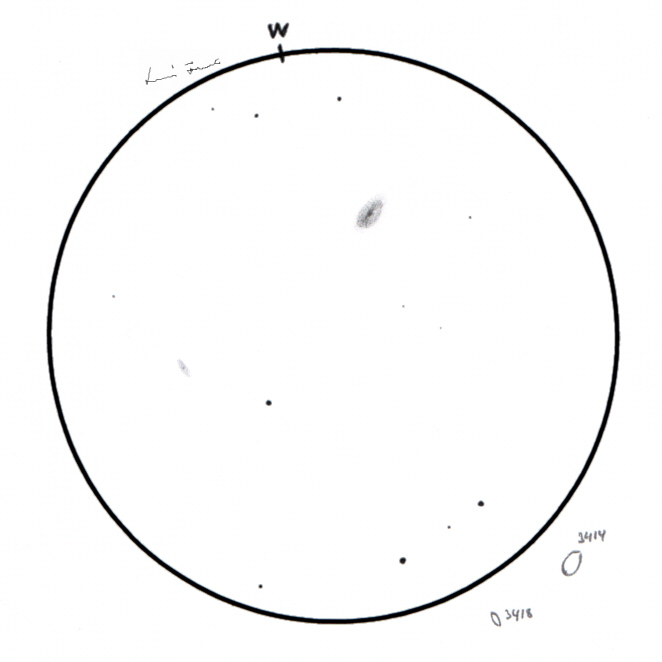
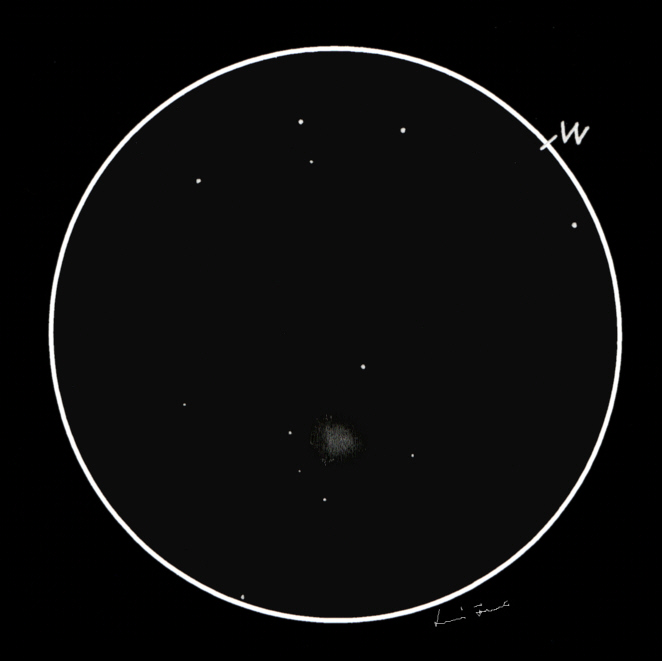
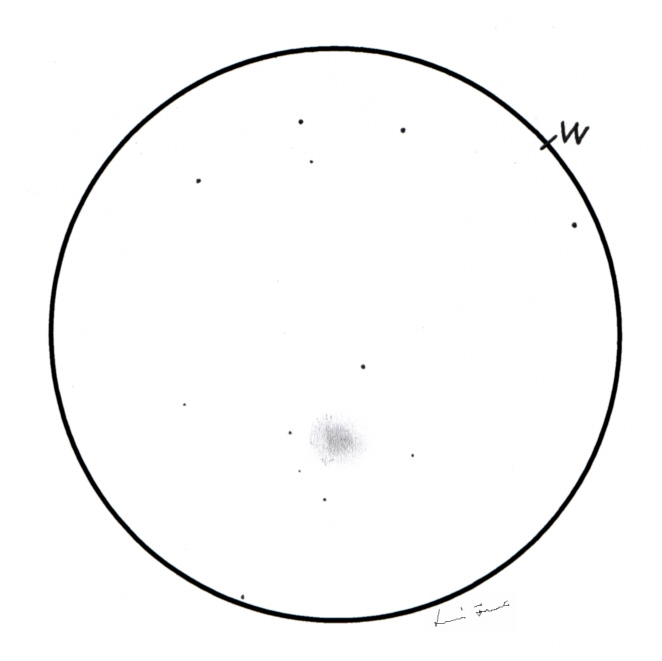
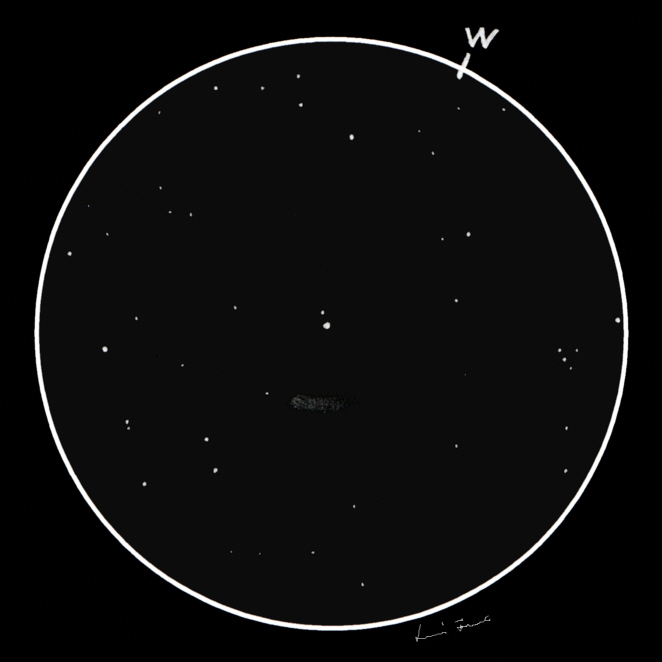
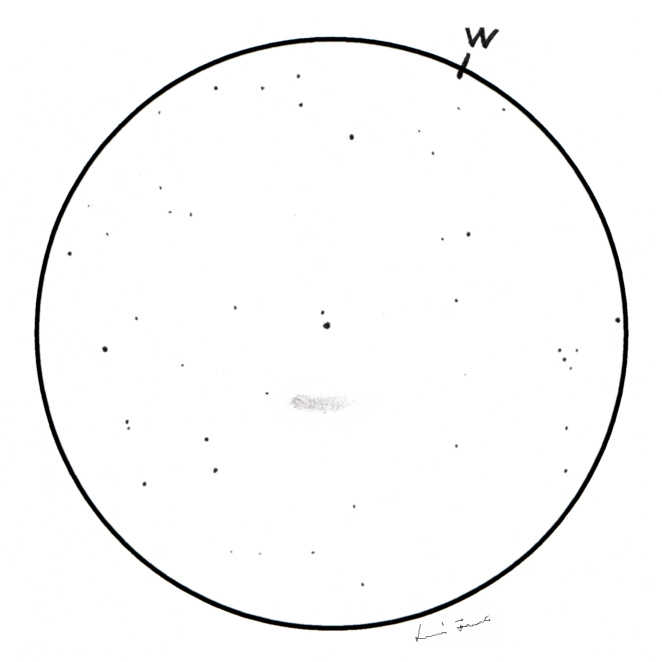
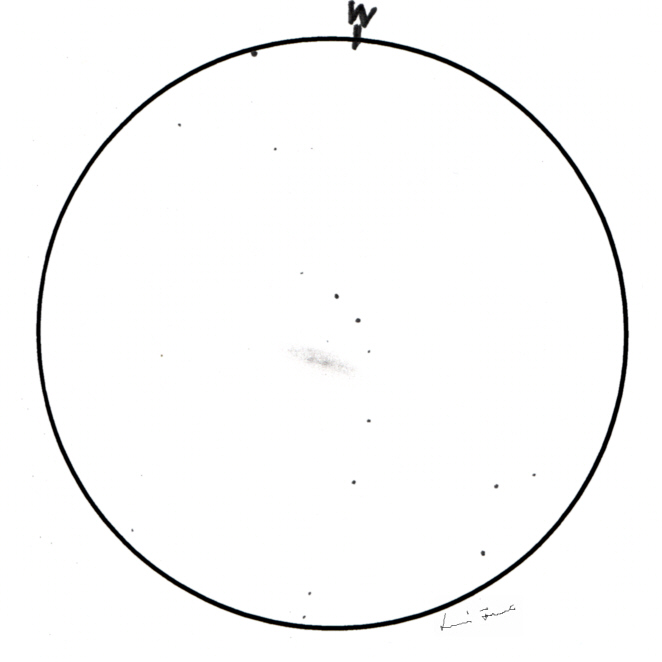
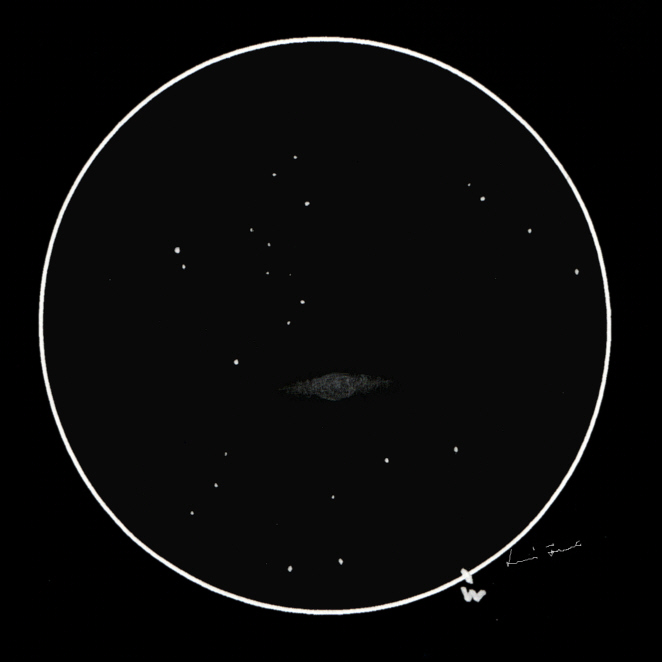
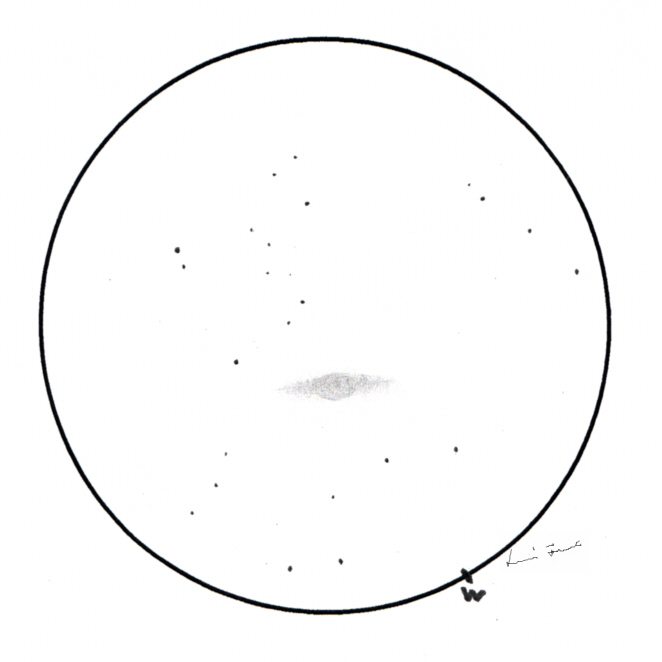
M65 + M66 + NGC 3628 (Galaxy)
|
|
Also known as: Leo trio, NGC 3623 + NGC 3627 + NGC 3628
|
|
Right ascension: 11h 19m
|
Declination: 13° 15'
|
|
Constellation: Leo
|
|
Date/time: 2008.03.31 20:30 UT
|
|
Equipment: 12" f/5 Newtonian
|
|
FoV: 50'
|
Magnification and filter(s): 45x
|
|
Seeing: 6/10
|
Transparency: 4/5
|
|
Location: Nádasdladány, Hungary
|
|
Observer: Ferenc Lovró
|
Description:
This triplet of galaxies always make me smile: I'm calling it a "dumb face" cluster. The M65-66 double is a classic, easy Messier-object: both can be well seen - perhaps the latter having a brighter, almost star-like core region. It's not clear for me why the NGC 3628 was left out of Messier's catalogue: it's not at all a difficult object either. Its brightness is quite close to that of M65 and while wandering around looking for its more famous companions, you may most probably bump into this one also.
|
|
Hi-resolution image: [ reversed sketch | original sketch ]
|
|
|
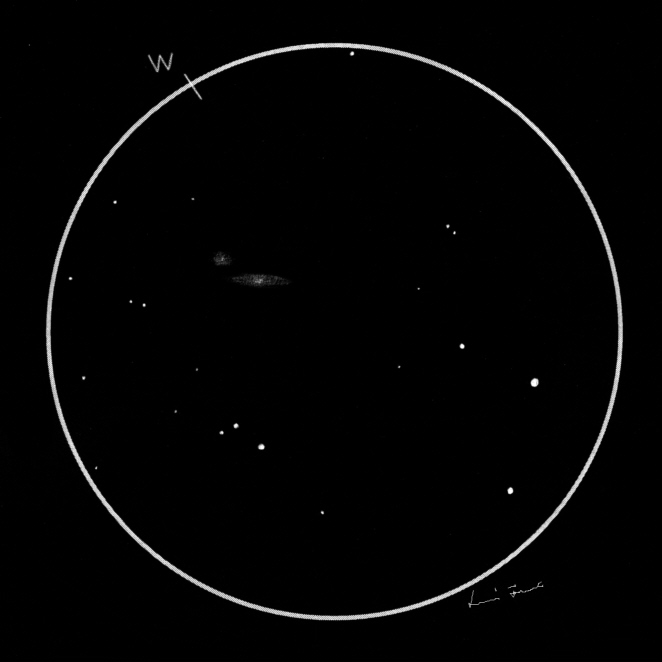
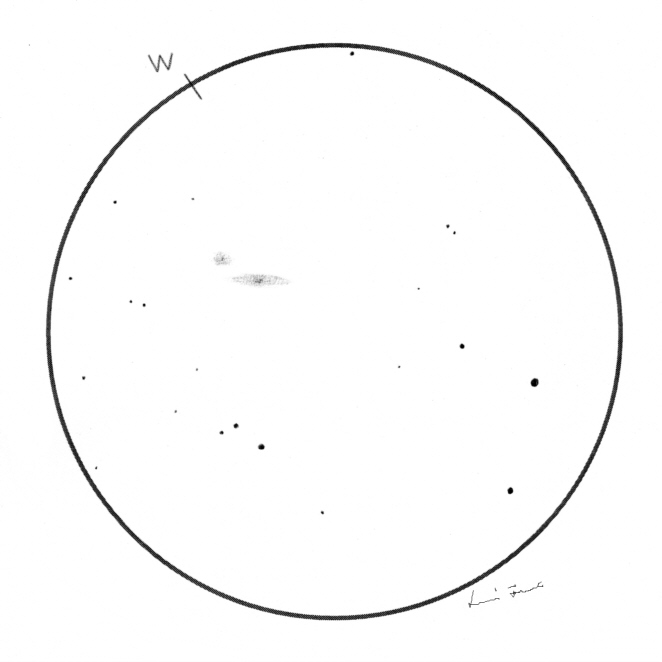
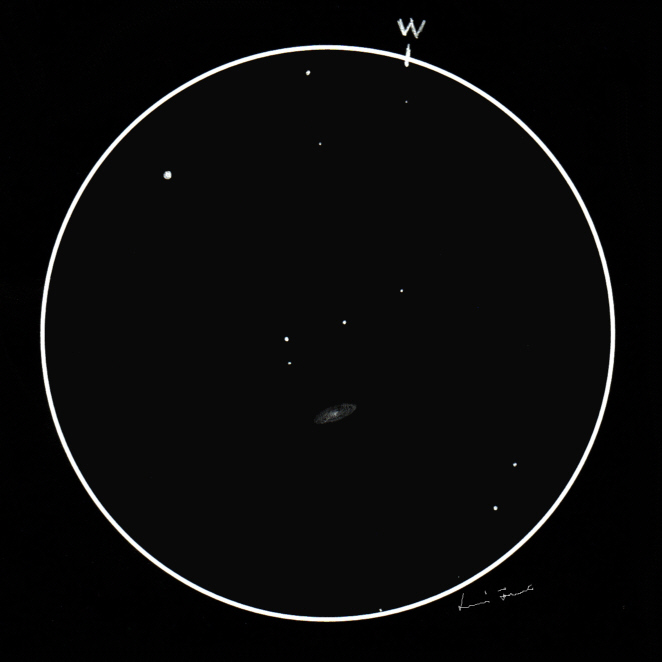
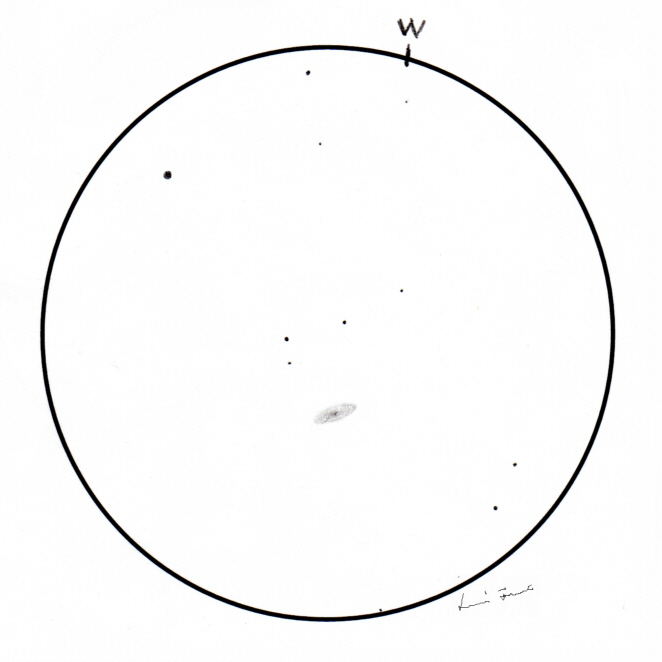
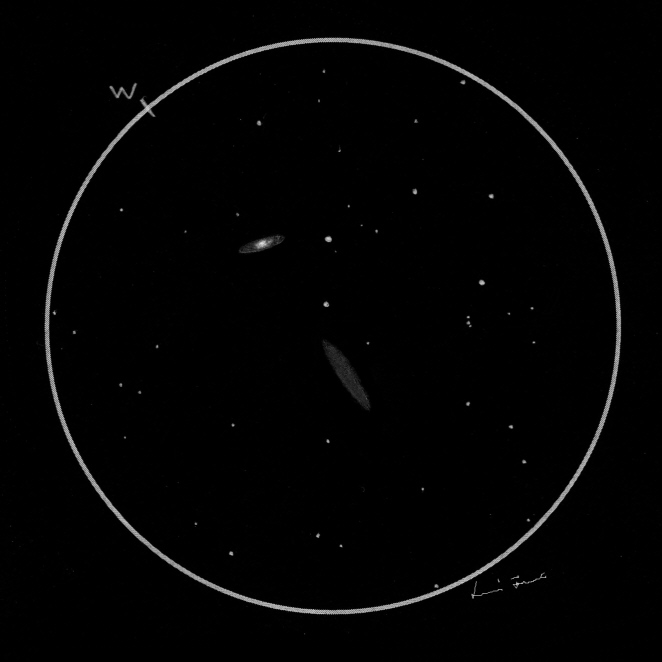
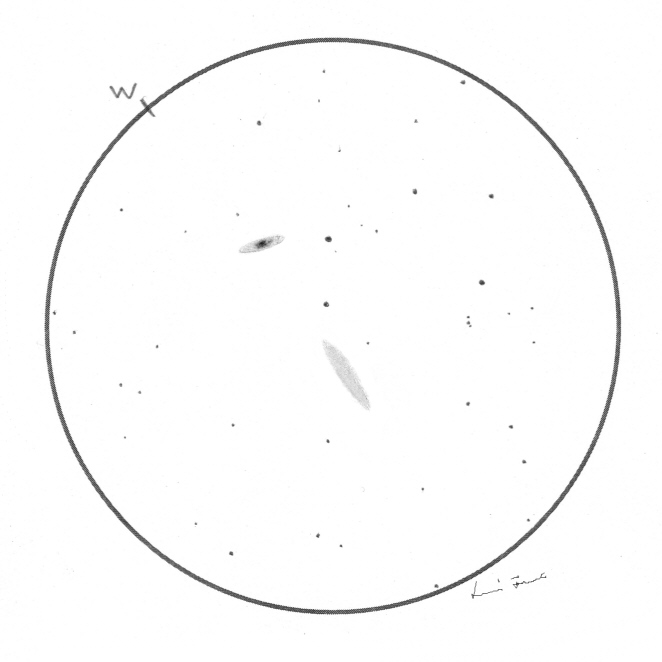
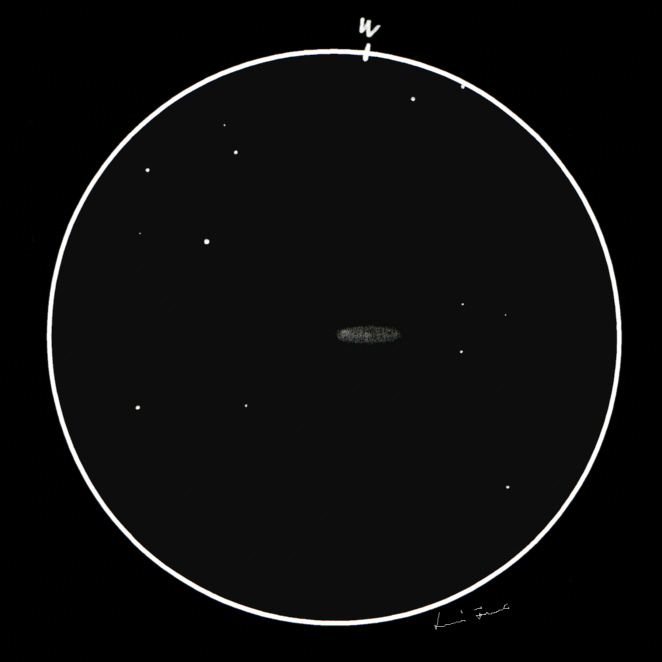
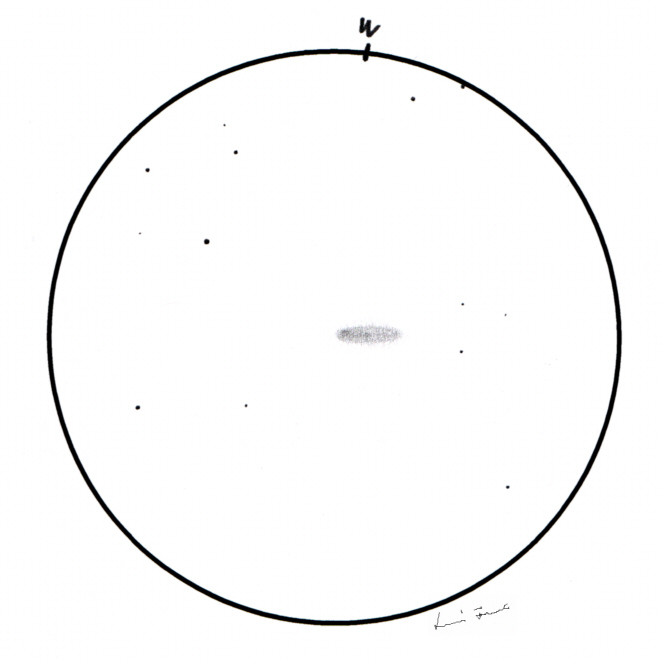
M81 + M82 (Galaxy)
|
|
Also known as: NGC 3031 + NGC 3034
|
|
Right ascension: 9h 56m
|
Declination: 69° 20'
|
|
Constellation: Ursa Major
|
|
Date/time: 2008.03.30 23:00 UT
|
|
Equipment: 12" f/5 Newtonian
|
|
FoV: 52'
|
Magnification and filter(s): 45x
|
|
Seeing: 5/10
|
Transparency: 3/5
|
|
Location: Nádasdladány, Hungary
|
|
Observer: Ferenc Lovró
|
Description:
The famous double galaxy of Ursa Maior is an easy target with any kind of telescope. The brighter M81 spiralgalaxy can be detected even in the finderscope. Its smaller and fainter companion, the irregular M82 is interesting especially when looking at larger magnification levels, with several clearly detectable dense areas. Looks best when having a FoV of at least 1°, as in that case both of the galaxies can be fit into one picture. The nearby NGC 3077 is also worth a look, although it's even smaller and fainter than the M82.
|
|
Hi-resolution image: [ reversed sketch | original sketch ]
|
|
|
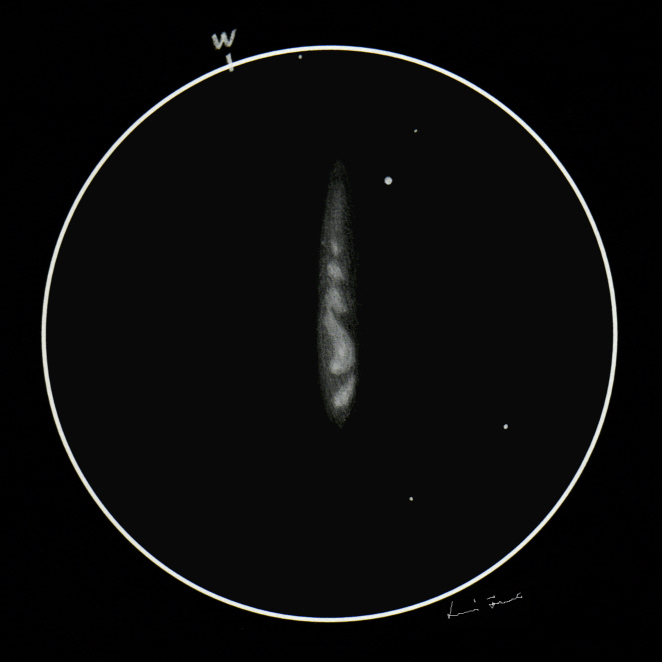
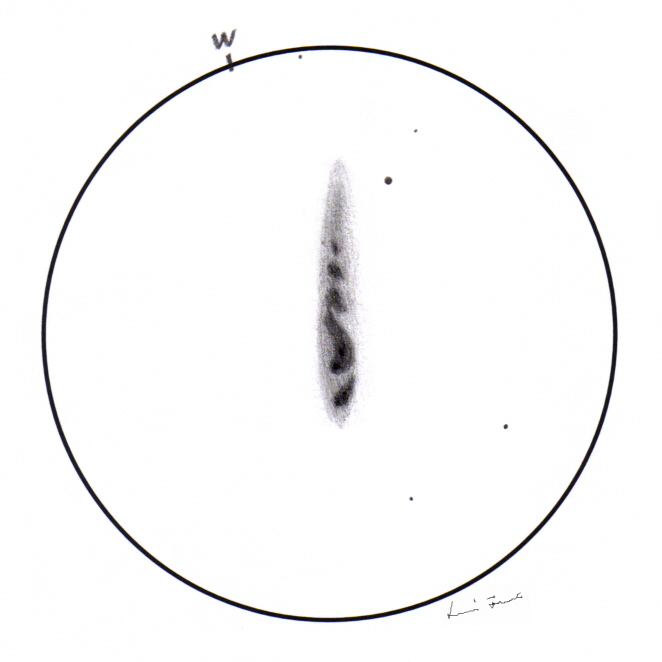
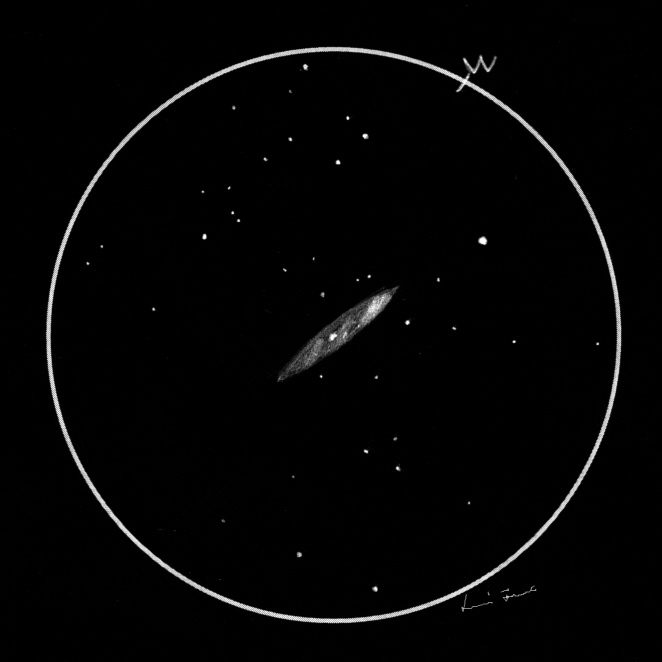
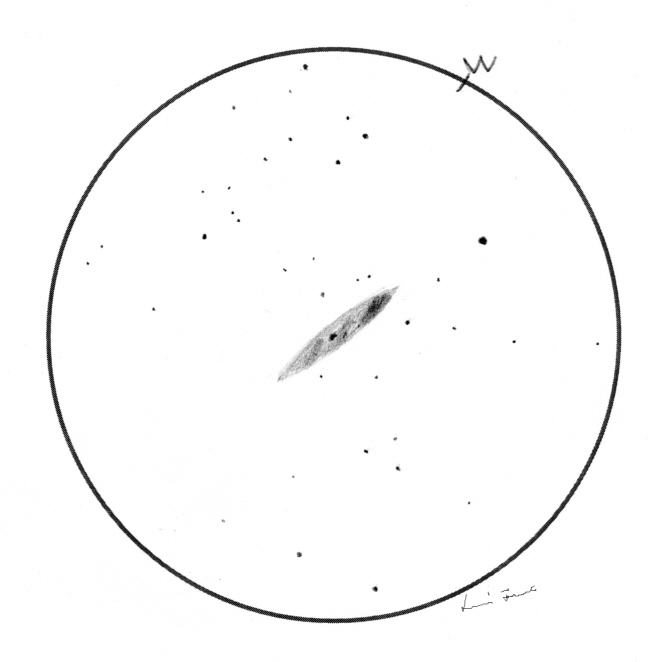
M82 (Galaxy)
|
|
Also known as: Cigar galaxy
|
|
Right ascension: 9h 57m
|
Declination: 69° 38'
|
|
Constellation: Ursa Major
|
|
Date/time: 2011.05.26 23:00 UT
|
|
Equipment: 12" f/5 Newtonian
|
|
FoV: 11'
|
Magnification and filter(s): 300x
|
|
Seeing: 9/10
|
Transparency: 4/5
|
|
Location: Nádasdladány, Hungary
|
|
Observer: Ferenc Lovró
|
Description:
A surprisingly excellent seeing calls for a high-magnification study. As Saturn is just below my horizon, I decide to pick a rather complicated structure: the irregular Cigar galaxy of the UMa constellation. Thanks to the 300x power, the FoV is coal black, the galaxy is so bright that it actually ruins my dark adaptation, faint stars sparkling at the edge of averted vision visibility. Too bad, that the galaxy itself is located on a rather light polluted part of my sky, but it still shows plenty of structures. During the observation, I had my second magneto-acoustic meteor experience in my life: this is the phenomenon when you actually hear a swishing or crackling sound at the same time the meteor flares in the atmosphere. The common part in both cases were that I was standing VERY close to a wire mesh fence, and a <0 mag meteor in the zenith, with a definite ionized tail.
|
|
Hi-resolution image: [ reversed sketch | original sketch ]
|
|
|
M106 + NGC 4248 (Galaxy)
|
|
Also known as: NGC 4258 + NGC 4248
|
|
Right ascension: 12h 19m
|
Declination: 47° 18'
|
|
Constellation: Canes Venatici
|
|
Date/time: 2008.05.02 21:00 UT
|
|
Equipment: 12" f/5 Newtonian
|
|
FoV: 45'
|
Magnification and filter(s): 71x
|
|
Seeing: 4/10
|
Transparency: 4/5
|
|
Location: Nádasdladány, Hungary
|
|
Observer: Ferenc Lovró
|
Description:
Large, spectacular spiral galaxy with a gross magnitude of 8.4, two magnificent arms and a very shiny core. Elongated towards N-S, which is also the direction of the two arms. The Southern arm looks brighter, while the Northern one larger and blurred. Only a quarter degrees away you can find its easily detectable companion, the NGC 4248 (12.5m). If you can see this tiny galaxy, you should take the chance to look around the M106 in a radius of 1-2 degrees, and observe the other members of the galaxy-group named after it. Around half a dozen of the smaller galaxies are brighter than 4248, and only a couple are similar or fainter.
|
|
Hi-resolution image: [ reversed sketch | original sketch ]
|
|
|
M108 (Galaxy)
|
|
Also known as: NGC 3556
|
|
Right ascension: 11h 11m
|
Declination: 55° 40'
|
|
Constellation: Ursa Major
|
|
Date/time: 2008.04.24 21:00 UT
|
|
Equipment: 12" f/5 Newtonian
|
|
FoV: 45'
|
Magnification and filter(s): 71x
|
|
Seeing: 3/10
|
Transparency: 3/5
|
|
Location: Nádasdladány, Hungary
|
|
Observer: Ferenc Lovró
|
Description:
Shiny, elongated galaxy near the famous Owl-nebula. Its core looks almost like a star, I estimate a brightness of around 12m. More dense parts are visible, the most notable is the very shiny area towards the Western end of the galaxy.
|
|
Hi-resolution image: [ reversed sketch | original sketch ]
|
|
|
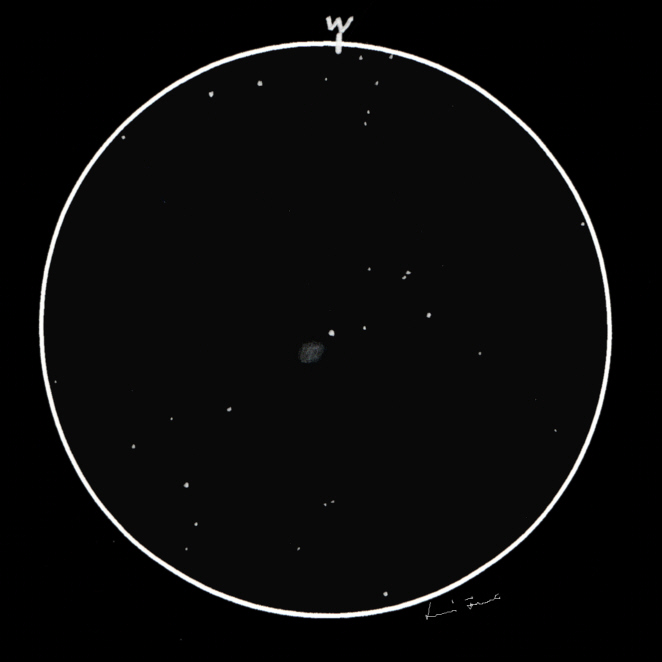
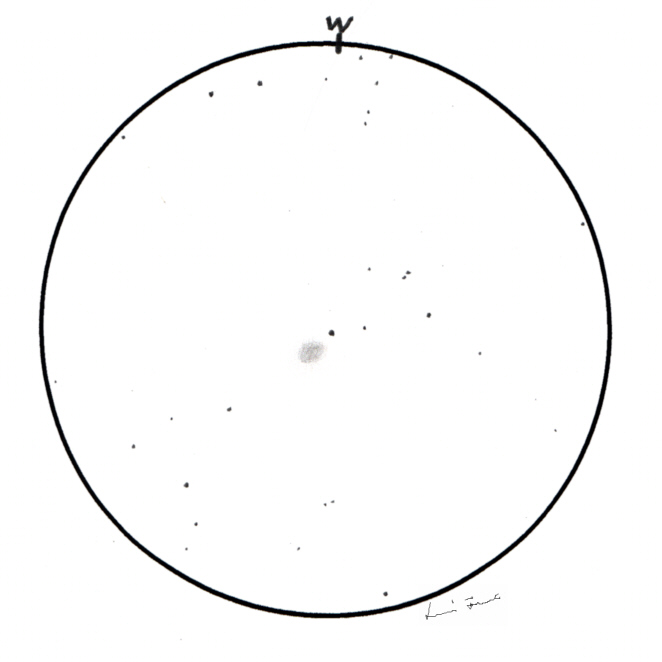
NGC 404 (Galaxy)
|
|
Also known as: Mirach's ghost
|
|
Right ascension: 1h 10m
|
Declination: 36° 46'
|
|
Constellation: Andromeda
|
|
Date/time: 2009.11.23 23:45 UT
|
|
Equipment: 12" f/5 Newtonian
|
|
FoV: 15'
|
Magnification and filter(s): 250x
|
|
Seeing: 7/10
|
Transparency: 4/5
|
|
Location: Nádasdladány, Hungary
|
|
Observer: Ferenc Lovró
|
Description:
This galaxy, also know as Mirach's ghost, not surprisingly is located near the bright star Mirach of the constellation Andromeda. Some have reported difficulties seeing this object, because although it's fairly bright, the glowing of the nearby Mirach easily outshines it. For me, it was visible easily from the start, but after I've increased the magnification to 250x, I was finally able to examine the structure of the galaxy without Mirach in the FoV. You may need eyepieces with good anti-glare coating to disturbing light rays. The galaxy itself is very small, round, with some suspectedly brighter details at its Northern corner, albeit this may be the result of an optical error only. SQM reading: 21.0 m/arcsec2, 9°C.
|
|
Hi-resolution image: [ reversed sketch | original sketch ]
|
|
|
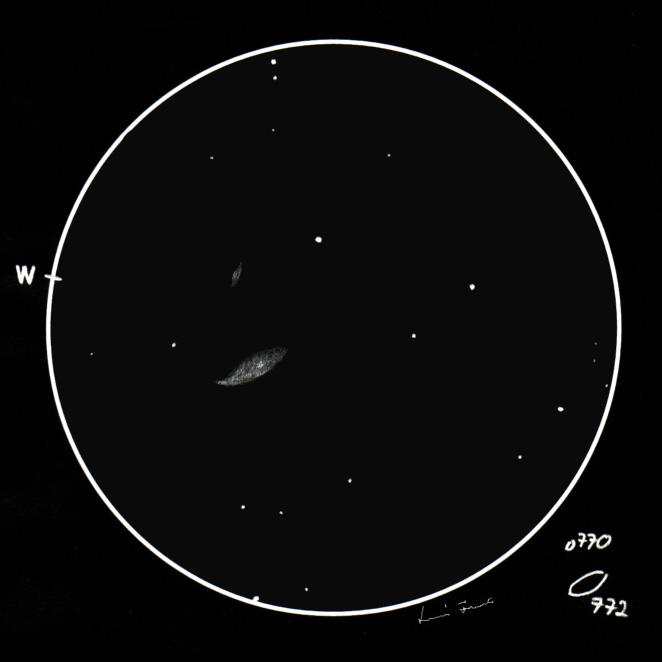
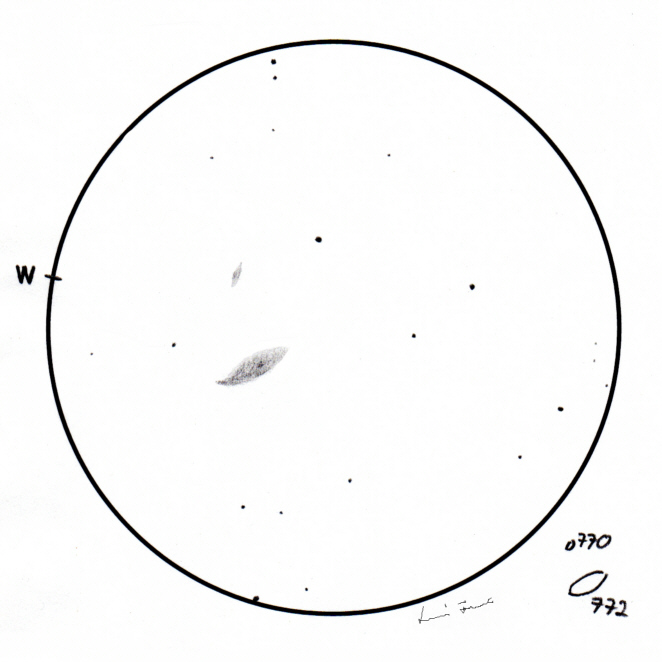
NGC 770 + NGC 772 (Galaxy)
|
|
Right ascension: 2h 0m
|
Declination: 19° 4'
|
|
Constellation: Aries
|
|
Date/time: 2010.10.14 23:00 UT
|
|
Equipment: 12" f/5 Newtonian
|
|
FoV: 24'
|
Magnification and filter(s): 167x
|
|
Seeing: 3/10
|
Transparency: 4/5
|
|
Location: Nádasdladány, Hungary
|
|
Observer: Ferenc Lovró
|
Description:
At first its a rather heavy sight, NGC 772 seem to be spinning around its centre, hard to catch its real shape. Later as my eye gets used to the view, the galaxy settles in its actual form. Suddenly something even fainter appears above NGC 772 to the SW, first as a fuzzy star, then as time goes it starts to grow and become the tiny little galaxy of NGC 770. Near the end of my sketching session NGC 772 starts to show some details: first it seems that it has some dense part to the North. A bit later it turns obvious that it's one large spiral arm. A really challenging pair! SQM reading: 21.12 m/arcsec2, 3°C, light wind, almost dry air.
|
|
Hi-resolution image: [ reversed sketch | original sketch ]
|
|
NGC 1023 (Galaxis) 
|
|
Rektaszcenzió: 2h 41m
|
Deklináció: 39° 7'
|
|
Csillagkép: Perseus
|
|
Dátum/idő: 2010.01.03 19:45 UT
|
|
Műszer: 300/1500 Newton
|
|
Látómező: 11'
|
Nagyítás és szűrő(k): 167x
|
|
Nyugodtság: 7/10
|
Átlátszóság: 2/5
|
|
Helyszín: Nádasdladány, Magyarország
|
|
Észlelő: Ferenc Lovró
|
Leírás:
Mandula formájú mag és ellipszis-szerű alak jellemzi ezt a galaxist, központi területe némileg fényesebb buborékként jelenik meg. 2'x0,5' méretűnek látom, ám a kelő hold jelentősen rontja az égbolt háttérfényességét (fél óra leforgása alatt 19,95m/as^2-ről 19,58m/as^2-re csökkent).
|
|
Nagyfelbontású képek: [ inverz rajz | eredeti rajz ]
|
NGC 1023 (Galaxy) 
|
|
Right ascension: 2h 41m
|
Declination: 39° 7'
|
|
Constellation: Perseus
|
|
Date/time: 2010.01.03 19:45 UT
|
|
Equipment: 12" f/5 Newtonian
|
|
FoV: 11'
|
Magnification and filter(s): 167x
|
|
Seeing: 7/10
|
Transparency: 2/5
|
|
Location: Nádasdladány, Hungary
|
|
Observer: Ferenc Lovró
|
Description:
This galaxy shows an almond-shaped bright core and an ellipse-shaped body, with some brighter bulge around the core as its only special feature. The NELM was quickly getting worse because of the rising Moon, so I'm absolutely sure it would show a much larger size under a truly dark sky, but this time I estimate dimensions of only 2'x0.5'. SQM readings (just to give you an idea how much the Moon adds to light pollution): 19.95m/arcsec2 (Moon slightly below the horizon) down to 19.58m/arcsec2 (Moon slightly over the horizon) just within a 30 minute timeframe.
|
|
Hi-resolution image: [ reversed sketch | original sketch ]
|
|
|
NGC 2549 (Galaxy)
|
|
Right ascension: 8h 20m
|
Declination: 57° 46'
|
|
Constellation: Lynx
|
|
Date/time: 2011.05.02 20:30 UT
|
|
Equipment: 12" f/5 Newtonian
|
|
FoV: 19'
|
Magnification and filter(s): 167x
|
|
Seeing: 4/10
|
Transparency: 3/5
|
|
Location: Nádasdladány, Hungary
|
|
Observer: Ferenc Lovró
|
Description:
Tiny, almond shaped galaxy with a star-like core that has a brightness of about 13m, around this core a brighter oval central bulge is also visible. The galaxy is elongated in the N-S direction, at a ratio of about 1:5. SQM reading: 20.96m/arcsec2, 6°C, humid air - as it was raining all day yesterday.
|
|
Hi-resolution image: [ reversed sketch | original sketch ]
|
|
|
NGC 2648 (Galaxy)
|
|
Right ascension: 8h 43m
|
Declination: 14° 17'
|
|
Constellation: Cancer
|
|
Date/time: 2008.03.30 22:45 UT
|
|
Equipment: 12" f/5 Newtonian
|
|
FoV: 20'
|
Magnification and filter(s): 167x
|
|
Seeing: 5/10
|
Transparency: 3/5
|
|
Location: Nádasdladány, Hungary
|
|
Observer: Ferenc Lovró
|
Description:
This spiral galaxy is one of the brightest galaxies in Cancer, with a luminosity of 11.8-13m according to catalogues, however to me it looks much brighter than this, with an especially easily noticeable bright galactic core. The almond-shaped star city is small, yet an easy target thanks to the three nearby bright stars.
|
|
Hi-resolution image: [ reversed sketch | original sketch ]
|
|
|
NGC 2655 + SN2011B (Galaxy)
|
|
Right ascension: 8h 57m
|
Declination: 78° 11'
|
|
Constellation: Camelopardalis
|
|
Date/time: 2011.01.28 17:30 UT
|
|
Equipment: 12" f/5 Newtonian
|
|
FoV: 25'
|
Magnification and filter(s): 167x
|
|
Seeing: 7/10
|
Transparency: 2/5
|
|
Location: Nádasdladány, Hungary
|
|
Observer: Ferenc Lovró
|
Description:
Unfortunately the galaxy is located on a light polluted portion of the sky, yet it is easily visible with 71x including the suprisingly bright supernova SN2011B to the ESE. I estimate that the brightess of the supernova is around 12.8m, about the same as the star-like core of the galaxy itself. Because of the light pollution, sometimes it looks as if the SN is just outside the galactic plane: this is because I probably see only the internal regions of the GX. SQM reading: 20.53m/arcsec2, high humidity, -7°C.
|
|
Hi-resolution image: [ reversed sketch | original sketch ]
|
|
|
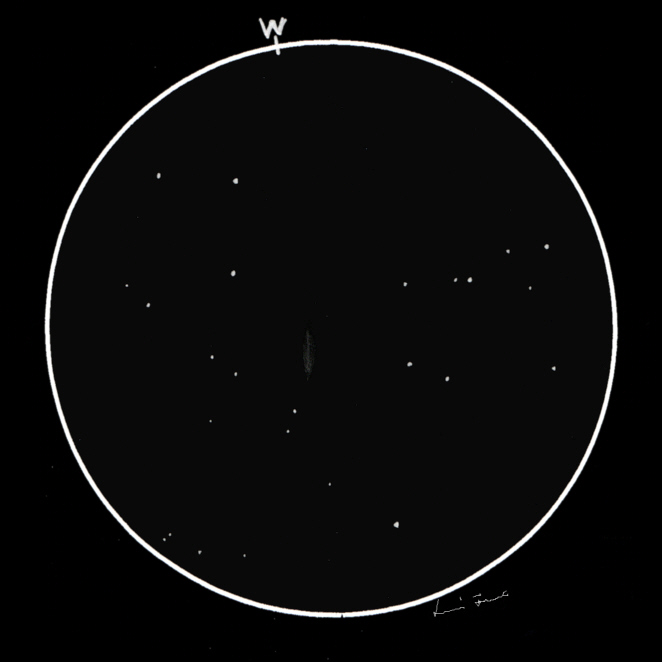
NGC 2683 (Galaxy)
|
|
Right ascension: 8h 53m
|
Declination: 33° 25'
|
|
Constellation: Lynx
|
|
Date/time: 2008.03.30 22:00 UT
|
|
Equipment: 12" f/5 Newtonian
|
|
FoV: 25'
|
Magnification and filter(s): 71x
|
|
Seeing: 5/10
|
Transparency: 3/5
|
|
Location: Nádasdladány, Hungary
|
|
Observer: Ferenc Lovró
|
Description:
This object is also identified as the "UFO galaxy", and resides on the boundary of the constellations Lynx and Cancer. There are no bright stars nearby, which makes finding it a little bit harder, although it has quite a high surface brightness of 9.8 magnitude. The edge-on galaxy of W-E direction has a clearly visible core that seems asymmetric: looks as if it's getting wider Eastward.
|
|
Hi-resolution image: [ reversed sketch | original sketch ]
|
|
|
NGC 2683 (Galaxy)
|
|
Also known as: UFO galaxy
|
|
Right ascension: 8h 53m
|
Declination: 33° 23'
|
|
Constellation: Lynx
|
|
Date/time: 2009.04.25 20:30 UT
|
|
Equipment: 12" f/5 Newtonian
|
|
FoV: 35'
|
Magnification and filter(s): 100x
|
|
Seeing: 4/10
|
Transparency: 3/5
|
|
Location: Nádasdladány, Hungary
|
|
Observer: Ferenc Lovró
|
Description:
The UFO galaxy, take two. I've already sketched this galaxy back in March 30, 2008 (see here), but because of an unfortunate administrational mistake, I've give it another go tonight. :) The UFO shape can hardly be noticed - if this galaxy resembles a UFO, then we could call all edge-on galaxies UFO's. However, the object is very nice, large and very bright, and the star rich environment makes the view even nicer. Its core brightens up slowly, a starlike core can be barely recognized. It looks as if there was a faint arm to the north of the core. Another interesting point is that although the stars are about at the same spot on the two sketches, the West direction indicator is at really different positions. I should check this out later.
|
|
Hi-resolution image: [ reversed sketch | original sketch ]
|
|
|
NGC 3222 + NGC 3226 + NGC 3227 (Galaxy)
|
|
Right ascension: 10h 24m
|
Declination: 19° 51'
|
|
Constellation: Leo
|
|
Date/time: 2009.02.19 23:00 UT
|
|
Equipment: 12" f/5 Newtonian
|
|
FoV: 30'
|
Magnification and filter(s): 167x
|
|
Seeing: 3/10
|
Transparency: 3/5
|
|
Location: Nádasdladány, Hungary
|
|
Observer: Ferenc Lovró
|
Description:
An interesting and very spectacular trio of galaxies in the constellation Leo. NGC 3222: the westernmost member is a really faint slightly elongated galaxy of about 13 magnitudes only. Its core is like a star, with quickly increasing luminosity. To the SW of this I can detect a faint little star in front of the galaxy. NGC 3226 and 3227: spectacular, closely interacting couple, no wonder it was included in Halton Arp's famous catalogue of peculiar galaxies with the number 94. Among them the latter is much brighter and larger with a star-like core which brightens quickly. The 3226 is the opposite of this with a really homogeneous surface and almost no visible core.
|
|
Hi-resolution image: [ reversed sketch | original sketch ]
|
|
|
NGC 3344 (Galaxy)
|
|
Right ascension: 10h 44m
|
Declination: 24° 50'
|
|
Constellation: Leo Minor
|
|
Date/time: 2009.02.19 23:30 UT
|
|
Equipment: 12" f/5 Newtonian
|
|
FoV: 22'
|
Magnification and filter(s): 167x
|
|
Seeing: 3/10
|
Transparency: 2/5
|
|
Location: Nádasdladány, Hungary
|
|
Observer: Ferenc Lovró
|
Description:
Faint but star-like core with a magnitude of about 13.5. The galaxy itself is faint, does not show any structures. This may be because of the terrible atmospheric conditions, as on astrophotographs it shows arms that seem quite an easy catch. These arms can only be suspected because of the slightly elongated ellipse shape, as the galaxy is in fact almost perfectly face-on - this means that the ellipse shape is formed because of the two arms in the N-S directions. An interesting feature is a bright foreground star.
|
|
Hi-resolution image: [ reversed sketch | original sketch ]
|
|
|
NGC 3432 (Galaxy)
|
|
Also known as: Arp 206
|
|
Right ascension: 10h 53m
|
Declination: 36° 37'
|
|
Constellation: Leo Minor
|
|
Date/time: 2009.04.24 20:30 UT
|
|
Equipment: 12" f/5 Newtonian
|
|
FoV: 28'
|
Magnification and filter(s): 100x
|
|
Seeing: 4/10
|
Transparency: 2/5
|
|
Location: Nádasdladány, Hungary
|
|
Observer: Ferenc Lovró
|
Description:
The galaxy is also in Arp's catalogue with number 206 has an interesting bent shape thanks to the nearby interactive galaxy of PGC 32617. Its brightness is defined between 11 and 13.6m according to various sources, I estimate it somewhere closer to 10 magnitudes. Three foreground stars make the view more spectacular.
|
|
Hi-resolution image: [ reversed sketch | original sketch ]
|
|
|
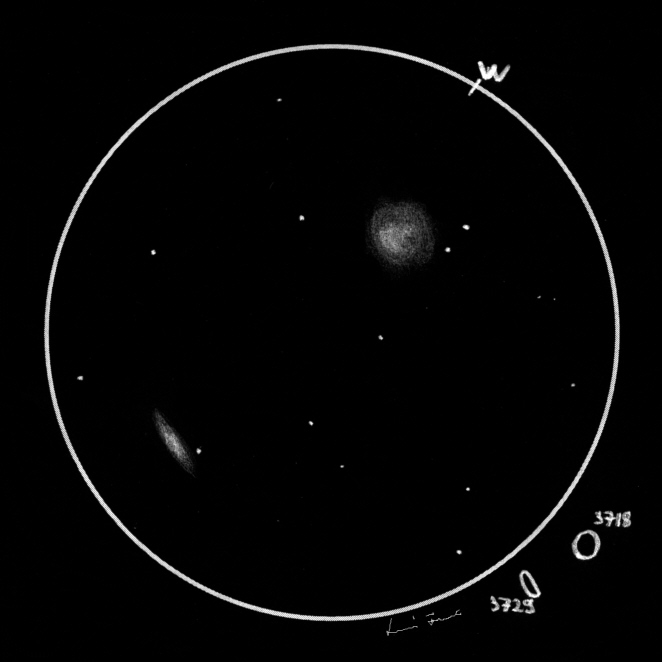
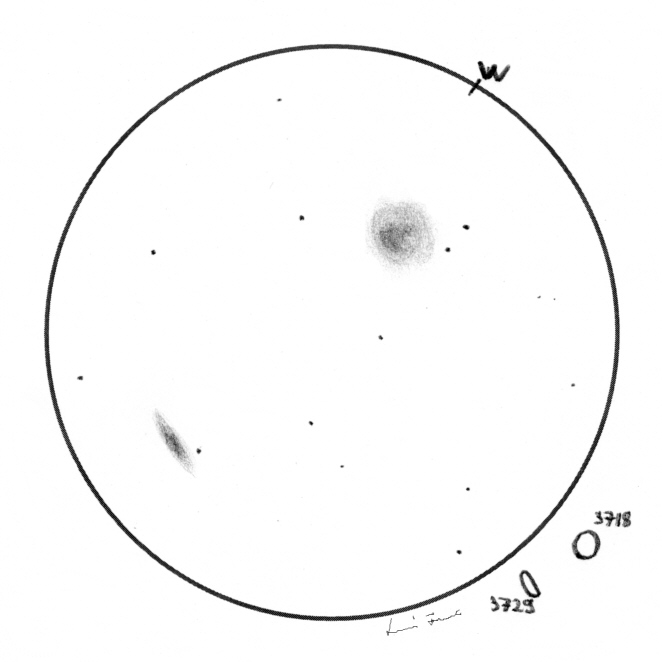
NGC 3718 + NGC 3729 (Galaxy)
|
|
Also known as: Arp 214
|
|
Right ascension: 11h 34m
|
Declination: 53° 2'
|
|
Constellation: Ursa Major
|
|
Date/time: 2009.04.25 22:30 UT
|
|
Equipment: 12" f/5 Newtonian
|
|
FoV: 24'
|
Magnification and filter(s): 167x
|
|
Seeing: 4/10
|
Transparency: 4/5
|
|
Location: Nádasdladány, Hungary
|
|
Observer: Ferenc Lovró
|
Description:
A very spectacular interacting couple in an environment sparsely populated by field stars. NGC 3718 is much larger, a perfectly face-on spiral galaxy, that is also catalogued by Arp with number 214. It feels as if it has a much larger area than what can be detected by direct vision. To the East of the galactic core I notice a brighter arc, however apart from this little detail and the little bit brighter core it has a really homogeneous look. The smaller NGC 3729 shows the typical core area of an edge-on galaxy, however according to astrophotos, what I see is a bit tricky, and the galaxy itself is far from being edge-on.
|
|
Hi-resolution image: [ reversed sketch | original sketch ]
|
|
|
NGC 3738 + 3756 (Galaxy)
|
|
Right ascension: 11h 37m
|
Declination: 54° 24'
|
|
Constellation: Ursa Major
|
|
Date/time: 2011.05.06 21:15 UT
|
|
Equipment: 12" f/5 Newtonian
|
|
FoV: 32'
|
Magnification and filter(s): 100x
|
|
Seeing: 5/10
|
Transparency: 3/5
|
|
Location: Nádasdladány, Hungary
|
|
Observer: Ferenc Lovró
|
Description:
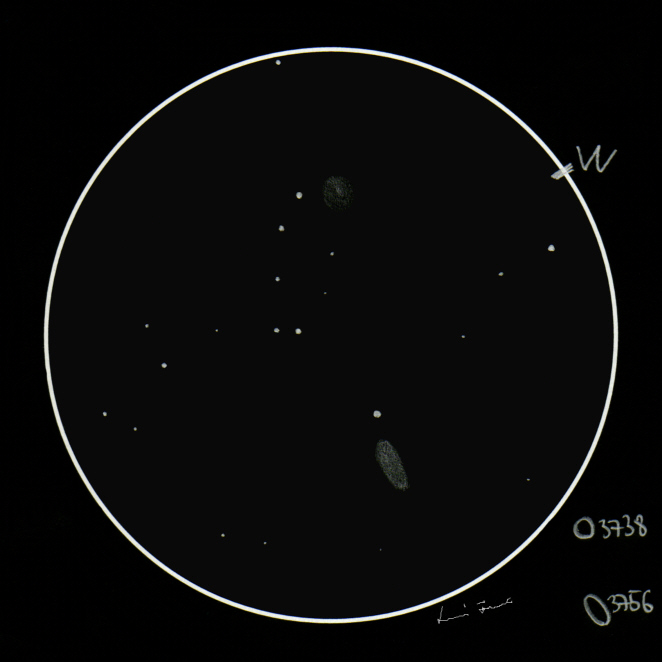
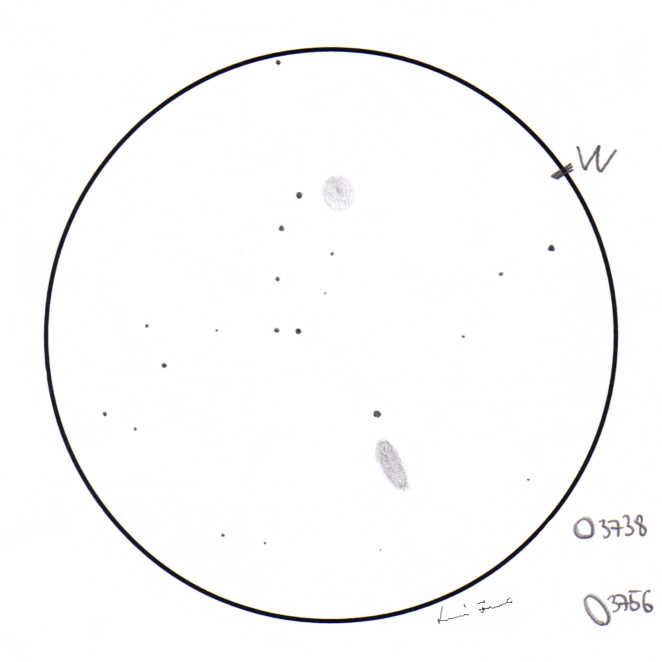
Two bright but small galaxies are visible in the exepiece. Although the catalogues say that the face-on NGC 3738 is is almost 1 magnitude brighter than the nearly edge-on NGC 3756, visually the later one is clearly a lot brighter. The NGC 3738 is barely brightening near its core, and shows no star-like nucleus. The oval shaped NGC 3756 is almost perfectly even in brightness, displays no brighter parts. I notice that it's a bit asymmetric, the Western side of the ellipse is a bit flatter. SQM reading: 21.19,/arcsec2, 0°C (guess we're having a negative temperature record, where's the global warming?).
|
|
Hi-resolution image: [ reversed sketch | original sketch ]
|
|
|
NGC 3938 (Galaxy)
|
|
Right ascension: 11h 53m
|
Declination: 44° 3'
|
|
Constellation: Ursa Major
|
|
Date/time: 2011.05.02 21:15 UT
|
|
Equipment: 12" f/5 Newtonian
|
|
FoV: 42'
|
Magnification and filter(s): 71x
|
|
Seeing: 4/10
|
Transparency: 3/5
|
|
Location: Nádasdladány, Hungary
|
|
Observer: Ferenc Lovró
|
Description:
Large, spectacular galaxy. Perfectly round, shows no sign of a star-like core, although its central region is a bit brighter. It's very faint, but I can observe some brighter details around the core. By checking out photographs today, it's now obvious that these spots are parts of a spiral structure. SQM reading: 21.20m/arcsec2, 5°C, very humid.
|
|
Hi-resolution image: [ reversed sketch | original sketch ]
|
|
|
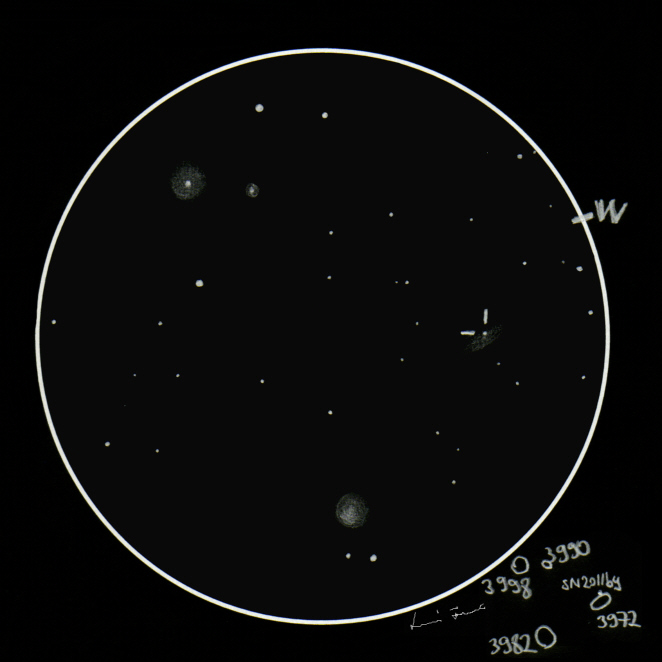
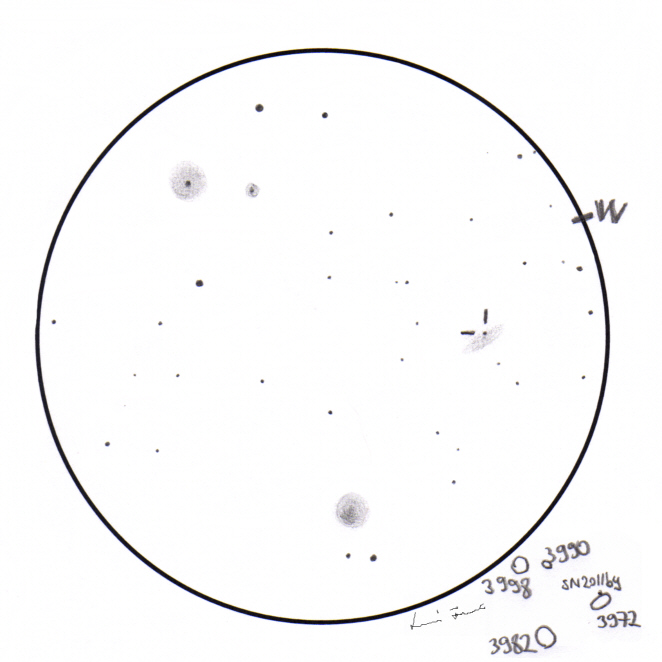
NGC 3972 + NGC 3982 + NGC 3990 + NGC 3998 + SN 2011by (Galaxy)
|
|
Right ascension: 11h 58m
|
Declination: 55° 16'
|
|
Constellation: Ursa Major
|
|
Date/time: 2011.05.06 20:30 UT
|
|
Equipment: 12" f/5 Newtonian
|
|
FoV: 32'
|
Magnification and filter(s): 100x
|
|
Seeing: 4/10
|
Transparency: 3/5
|
|
Location: Nádasdladány, Hungary
|
|
Observer: Ferenc Lovró
|
Description:
My original plan was to observe the supernova SN 2011by, the newest celebrity in the stellar world. However, as it is located in an area full of spectacular galaxies, I decided to sketch the galactic neighborhood too. The supernova itself is very bright, even brighter than what I expected, and compared to the nearby stars, I estimate a brightness of abour 13.2m! It is by far brighter than the surface of the parent galaxy, NGC 3972. The two large face-on galaxies (3998 and 3982) are the brightest in the FoV, the tiny 3990 is only slightly fainter than these, The 3972 is however very faint, and I cannot detect the nearby 3977 at all. Perhaps I should try again on a night with better seeing. SQM: 21.12m/arcsec2, 2°C.
|
|
Hi-resolution image: [ reversed sketch | original sketch ]
|
|
|
NGC 4013 (Galaxy)
|
|
Right ascension: 11h 59m
|
Declination: 43° 53'
|
|
Constellation: Ursa Major
|
|
Date/time: 2011.05.02 21:45 UT
|
|
Equipment: 12" f/5 Newtonian
|
|
FoV: 30'
|
Magnification and filter(s): 100x
|
|
Seeing: 4/10
|
Transparency: 3/5
|
|
Location: Nádasdladány, Hungary
|
|
Observer: Ferenc Lovró
|
Description:
A tiny edge-on galaxy with a fake offcentre star-like core. It's fake, because it is actually a foreground star located in our own galaxy, that looks exactly in that direction. I was very surprised when I first noticed that this galaxy has its core out of its geometrical centre, but later studies revealed the answer for this phenomenon. This little gem is located in a very sparse stellar environment which makes it an extremely difficult target. SQM reading: 21.23m/arcsec2, 5°C, very humid.
|
|
Hi-resolution image: [ reversed sketch | original sketch ]
|
|
|
NGC 4036 + NGC 4041 (Galaxy)
|
|
Right ascension: 12h 2m
|
Declination: 62° 1'
|
|
Constellation: Ursa Major
|
|
Date/time: 2009.04.25 22:15 UT
|
|
Equipment: 12" f/5 Newtonian
|
|
FoV: 28'
|
Magnification and filter(s): 100x
|
|
Seeing: 4/10
|
Transparency: 4/5
|
|
Location: Nádasdladány, Hungary
|
|
Observer: Ferenc Lovró
|
Description:
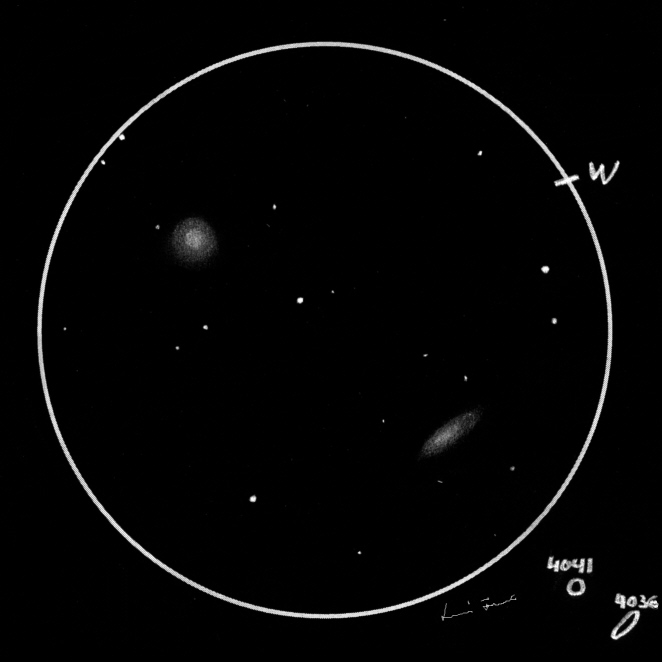
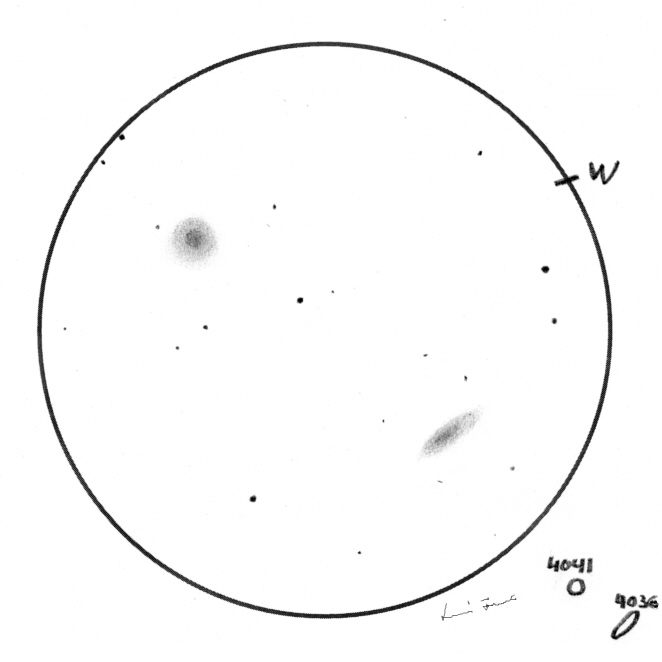
If Ursa Major and galaxies, everybody thinks on M81 + 82. However, this constellation is full of spectacular galactic companions. One of them is this pair: interesting to see two such a different galaxies so close to eachother. NGC 4041 is a faint face-on spiral, NGC 4036 is a brighter edge-on elliptical galaxy. The 4041 is especially spectacular because its core brightens up very quickly, so the entire galaxy reminds me of a cosmic fried egg.
|
|
Hi-resolution image: [ reversed sketch | original sketch ]
|
|
|
NGC 4051 (Galaxy)
|
|
Right ascension: 12h 4m
|
Declination: 44° 28'
|
|
Constellation: Ursa Major
|
|
Date/time: 2011.05.02 22:00 UT
|
|
Equipment: 12" f/5 Newtonian
|
|
FoV: 53'
|
Magnification and filter(s): 71x
|
|
Seeing: 4/10
|
Transparency: 2/5
|
|
Location: Nádasdladány, Hungary
|
|
Observer: Ferenc Lovró
|
Description:
Nice round galaxy, that is a bit faint, but shows some brighter details (which are in fact parts of its spiral arms) around its tiny star-like core. A bit though object, but located in a relatively easy position with some brighter stars nearby. SQM reading: 21.15m/arcsec2, 5°C, extremely humid: by the time I finish this sketch, I can only barely see the Big Dipper anymore.
|
|
Hi-resolution image: [ reversed sketch | original sketch ]
|
|
|
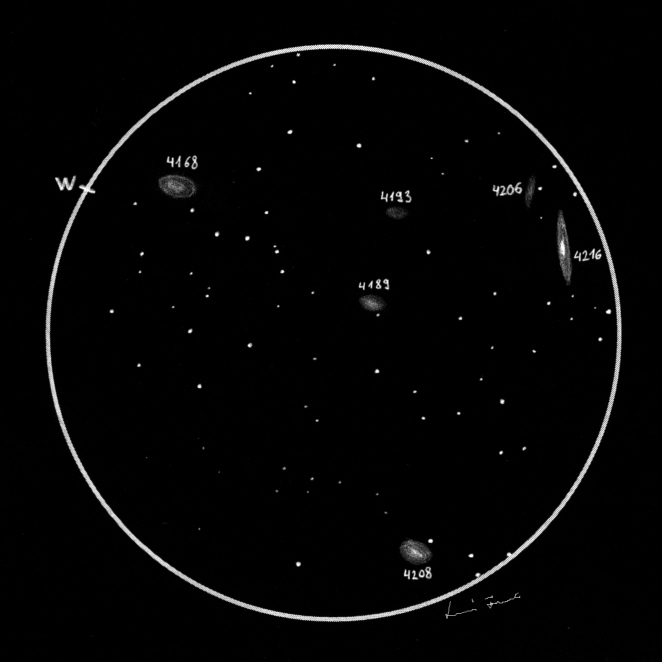
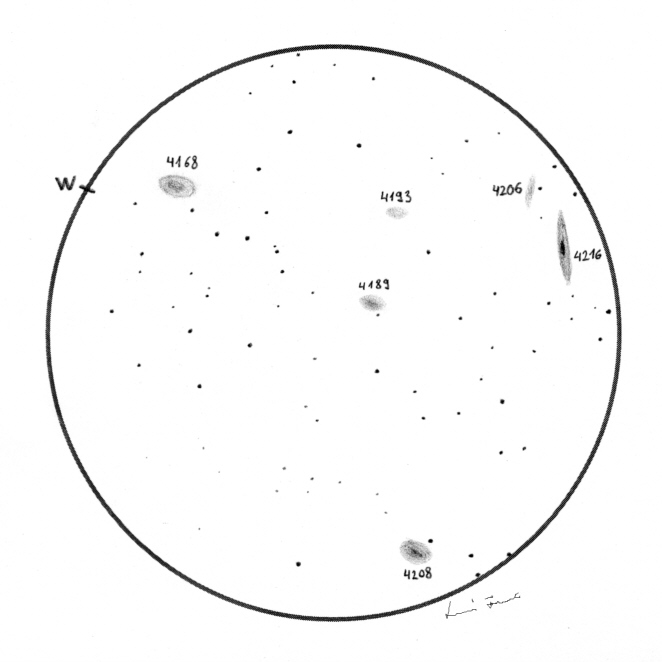
NGC 4168 + NGC 4189 + NGC 4193 + NGC 4206 + NGC 4208 + NGC 4216 (Galaxy)
|
|
Right ascension: 12h 12m
|
Declination: 13° 12'
|
|
Constellation: Coma Berenices
|
|
Date/time: 2008.04.27 20:00 UT
|
|
Equipment: 12" f/5 Newtonian
|
|
FoV: 1° 12'
|
Magnification and filter(s): 45x
|
|
Seeing: 5/10
|
Transparency: 4/5
|
|
Location: Nádasdladány, Hungary
|
|
Observer: Ferenc Lovró
|
Description:
With a little exaggeration, there are more galaxies in the hair of Berenice than stars: wherever you look, the FoV is abound with tiny, faint spots. For me an especially remarkable place is the area bound by NGC 4158, 4216 and 4208. The brightness data of catalogues should be handled with care: almost all of the galaxies are brighter than suggested by the given numbers. The nearly edge-on galaxy of 4216 is the nicest with its brightness of 10m. With a FoV of around 1 degree, 6 beautiful shiny galaxies are glittering together, of which the three brightest must be visible also with smaller scopes.
|
|
Hi-resolution image: [ reversed sketch | original sketch ]
|
|
|
NGC 4244 (Galaxy)
|
|
Also known as: Caldwell C26
|
|
Right ascension: 12h 48m
|
Declination: 37° 45'
|
|
Constellation: Canes Venatici
|
|
Date/time: 2009.05.17 21:15 UT
|
|
Equipment: 12" f/5 Newtonian
|
|
FoV: 33'
|
Magnification and filter(s): 100x
|
|
Seeing: 6/10
|
Transparency: 3/5
|
|
Location: Nádasdladány, Hungary
|
|
Observer: Ferenc Lovró
|
Description:
A large edge-on spiral with intermediate brightness, highly elongated in the NNE-SSW directions near the famous double, Cor Caroli. It does not show much details like arms or dense spots, however its NNE side looks a little bit brighter and wider, which makes the entire galaxy look a bit asymmetrical. I estimate its average brightness at 12 magnitudes maximum, with an apparent size of 13' x 2'.
|
|
Hi-resolution image: [ reversed sketch | original sketch ]
|
|
|
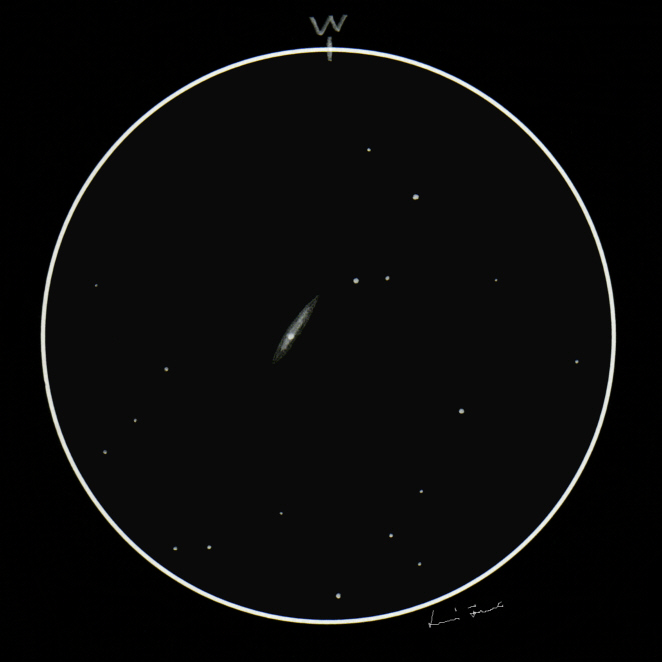
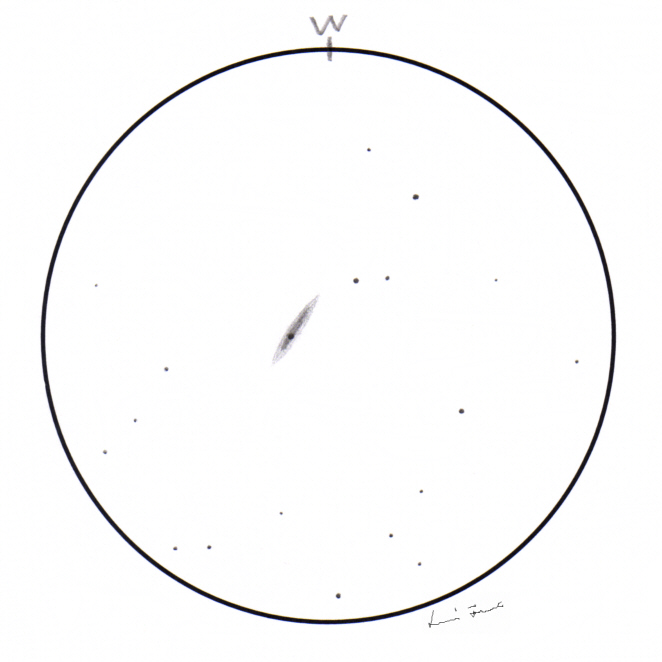
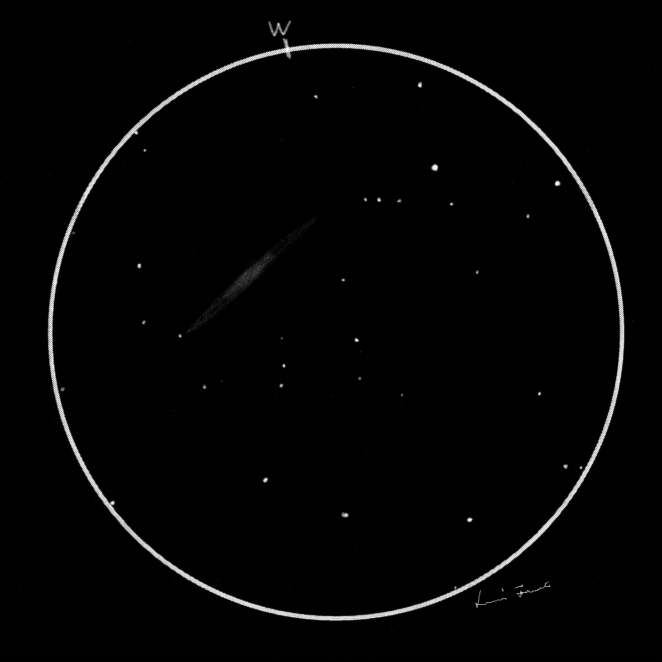
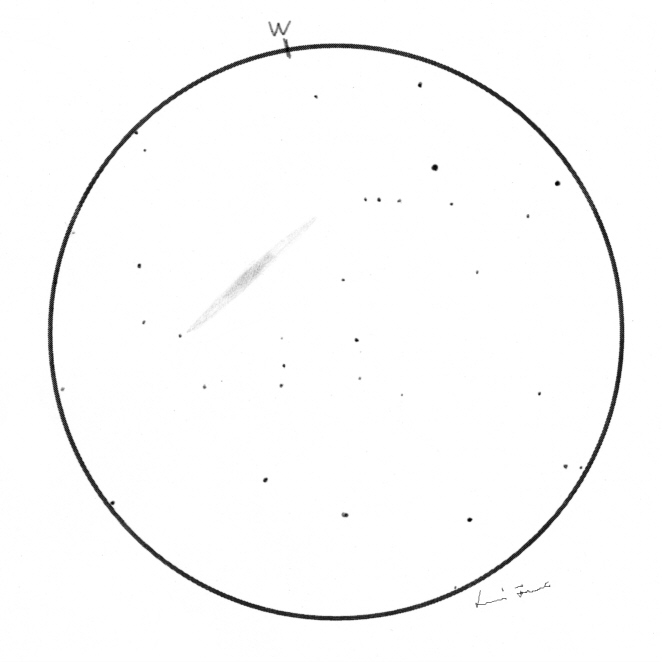
NGC 4565 (Galaxy)
|
|
Also known as: Needle galaxy
|
|
Right ascension: 12h 37m
|
Declination: 25° 56'
|
|
Constellation: Coma Berenices
|
|
Date/time: 2009.04.24 21:00 UT
|
|
Equipment: 12" f/5 Newtonian
|
|
FoV: 28'
|
Magnification and filter(s): 100x
|
|
Seeing: 4/10
|
Transparency: 2/5
|
|
Location: Nádasdladány, Hungary
|
|
Observer: Ferenc Lovró
|
Description:
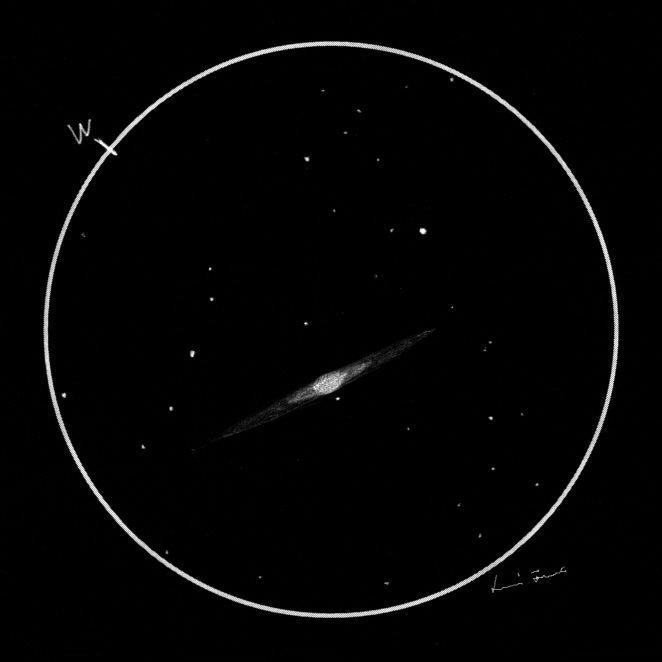
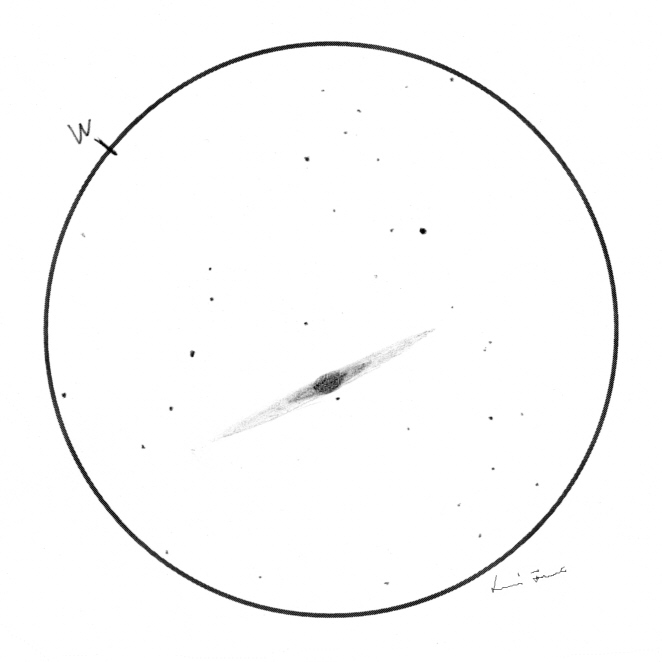
A truly gigantic galaxy even with direct vision, many sources indicate a surface brightness of 9.6 magnitudes, however it looks fainter than suggested because of the large surface area. I estimate a core brightness of about 11.3m and the surrounding areas of nearly 13.5m, therefore this may be an achieveable target for smaller aperture telescopes too. The farthest regions pop in and out with direct vision making it look like two laser beams leaving the core. With averted vision these regions show up clearly, and make the apparent size of the galaxy from large to huge! I estimate a dimension of 16' x 2'. This object reminds me of NGC 5907 (Splinter galaxy), however that has no such a sphere-like core.
|
|
Hi-resolution image: [ reversed sketch | original sketch ]
|
|
|
NGC 4631 + NGC 4656 (Galaxy)
|
|
Also known as: Whale galaxy + Hockeystick galaxy, Arp 281
|
|
Right ascension: 12h 44m
|
Declination: 32° 18'
|
|
Constellation: Canes Venatici
|
|
Date/time: 2009.04.24 21:30 UT
|
|
Equipment: 12" f/5 Newtonian
|
|
FoV: 1° 18'
|
Magnification and filter(s): 45x
|
|
Seeing: 5/10
|
Transparency: 2/5
|
|
Location: Nádasdladány, Hungary
|
|
Observer: Ferenc Lovró
|
Description:
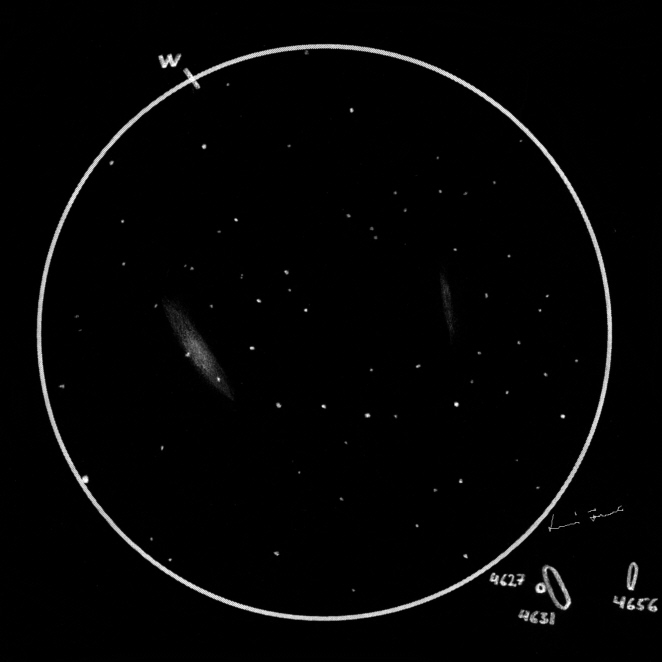
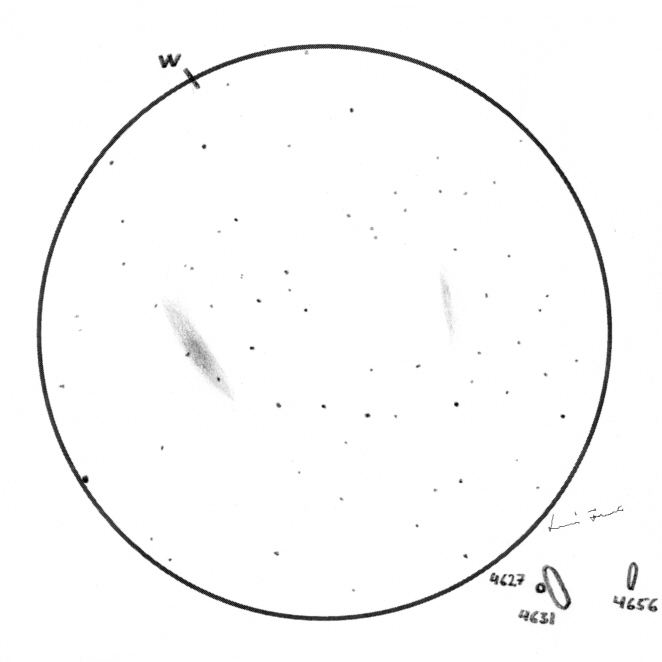
The gigantic, shiny NGC 4631 (also known as the Whale galaxy) and its smaller and much fainter companion, the NGC 4656 (or Hockeystick galaxy) fit perfectly well in an eyepiece with at least 1 degrees of FoV, a very spectacular double. The 4631 is about 10m bright and just about to jump right out of the eyepiece, while the latter is much smaller with a brightness of about 11m only - estimated by me. Both galaxies are heavily distorted because of gravitational tidal forces between the two, not to mention that there's a tiny faint third companion very near NGC 4631 with the identifier NGC 4627 with a brightness of 13m. This galaxy remained hidden to me at this observing session and I could not make out the real hockey stick shape of NGC 4656 out either, possibly the bad transparency and seeing was not really helping me in this. The pair NGC 4631 and 4627 is also listed in Halton Arp's catalogue with number 281.
|
|
Hi-resolution image: [ reversed sketch | original sketch ]
|
|
|
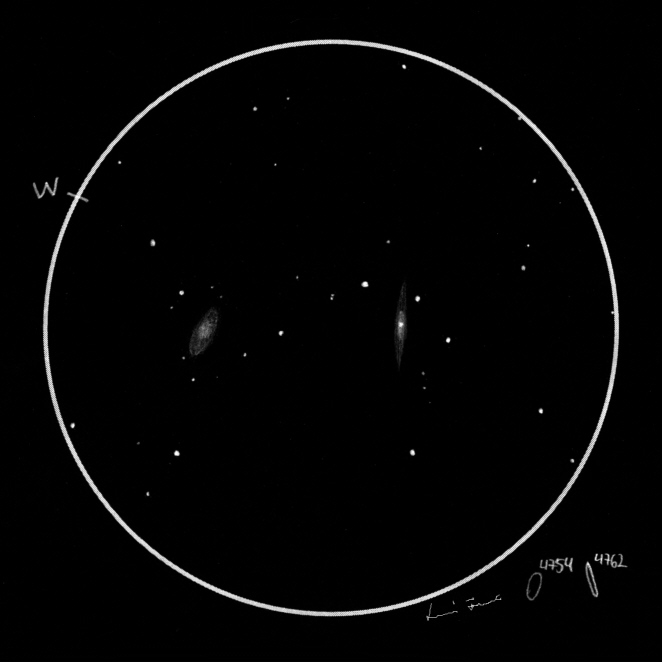
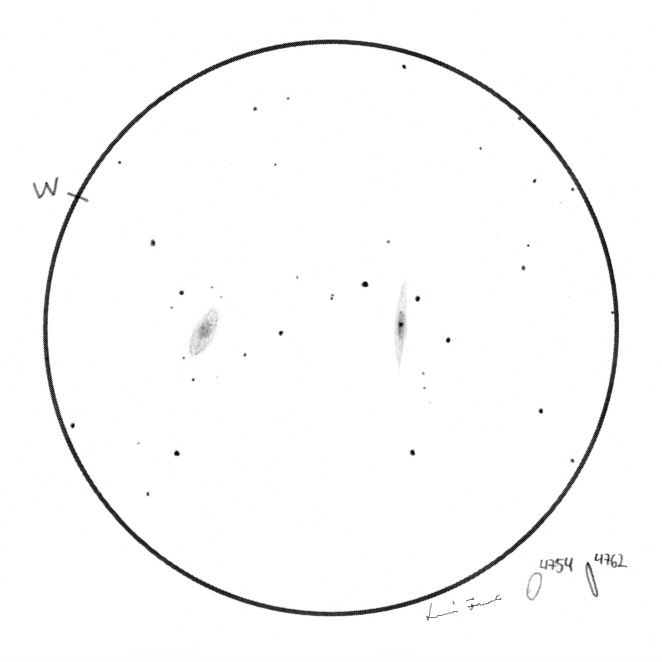
NGC 4754 + NGC 4762 (Galaxy)
|
|
Right ascension: 12h 53m
|
Declination: 11° 12'
|
|
Constellation: Virgo
|
|
Date/time: 2009.05.20 21:00 UT
|
|
Equipment: 12" f/5 Newtonian
|
|
FoV: 31'
|
Magnification and filter(s): 100x
|
|
Seeing: 5/10
|
Transparency: 4/5
|
|
Location: Nádasdladány, Hungary
|
|
Observer: Ferenc Lovró
|
Description:
A spectacular, faint pair of galaxies on the outer edge of the Virgo-cluster. NGC 4762: looks like a needle, a tiny galaxy with definitely brightening core bulb that's fullfilled in a little star-like core. It's a perfectly edge-on galaxy. NGC 4754: looks smaller and much fainter than its companion. It's a nearly face-on galaxy that looks like a diffuse elliptical galaxy with no details at all, except for the almond-shaped, softly brightening core. To the SW of this pair you may notice a third, even fainter companion galaxy, the NGC 4733 only about one full field of vision away.
|
|
Hi-resolution image: [ reversed sketch | original sketch ]
|
|
|
NGC 4866 (Galaxy)
|
|
Right ascension: 13h 00m
|
Declination: 14° 07'
|
|
Constellation: Virgo
|
|
Date/time: 2009.05.20 20:30 UT
|
|
Equipment: 12" f/5 Newtonian
|
|
FoV: 24'
|
Magnification and filter(s): 167x
|
|
Seeing: 5/10
|
Transparency: 4/5
|
|
Location: Nádasdladány, Hungary
|
|
Observer: Ferenc Lovró
|
Description:
A faint, but clearly detectable galaxy of about 12 magnitudes, with a tiny, star-like core. Near this, a faint little star can be noticed that seems to be a supernova, however it is only a bare foreground star. Compared with photographs, it seems that the area seen by me is in fact only the brighter region around the galactic core. The galaxy has even fainter outer territories that cannot be seen visually by me. With these, the area of the galaxy is about twice the size, but for now, I estimate an apparent visual size of about 3.5' x 0.8' only. The foreground star is encircled by the galaxy and it looks as if the latter would be darker around the star. However, this is obviously only an optical illusion. Apart from that, it still shows many details: brighter and darker areas. Because of this, it seems to be an irregular galaxy, yet it is in fact belongs to a rare sub-group of spirals.
|
|
Hi-resolution image: [ reversed sketch | original sketch ]
|
|
|
NGC 5005 (Galaxy)
|
|
Also known as: Caldwell C29
|
|
Right ascension: 13h 11m
|
Declination: 37° 01'
|
|
Constellation: Canes Venatici
|
|
Date/time: 2009.05.17 21:30 UT
|
|
Equipment: 12" f/5 Newtonian
|
|
FoV: 22'
|
Magnification and filter(s): 167x
|
|
Seeing: 6/10
|
Transparency: 3/5
|
|
Location: Nádasdladány, Hungary
|
|
Observer: Ferenc Lovró
|
Description:
Bright but tiny galaxy of 10 magnitudes. Nearby you can find a similar but fainter object, NGC 5033. In a FoV of 1 degree, both galaxies can be seen together, although according to their small apparent size, at such a magnification level they look really insignificant. The NGC 5005 sits at the end of a lane of stars, has a quickly brightening core that does not end up in a star-like nucleus.
|
|
Hi-resolution image: [ reversed sketch | original sketch ]
|
|
|
NGC 5033 (Galaxy)
|
|
Right ascension: 13h 14m
|
Declination: 36° 33'
|
|
Constellation: Canes Venatici
|
|
Date/time: 2009.05.17 21:45 UT
|
|
Equipment: 12" f/5 Newtonian
|
|
FoV: 22'
|
Magnification and filter(s): 167x
|
|
Seeing: 6/10
|
Transparency: 3/5
|
|
Location: Nádasdladány, Hungary
|
|
Observer: Ferenc Lovró
|
Description:
Only about 40' away from NGC 5005, you can find this small, faint galaxy. This one is the fainter of the two, less spectacular with a slightly brightening core. It is in fact a very spectacular spiral, but visually it's more like a simple elliptical galaxy. At its Northern end you can detect a faint star of 13.9m, which appears (especially with averted vision) to twinkle on the surface of the galaxy. It's brightness is measured at 11m.
|
|
Hi-resolution image: [ reversed sketch | original sketch ]
|
|
|
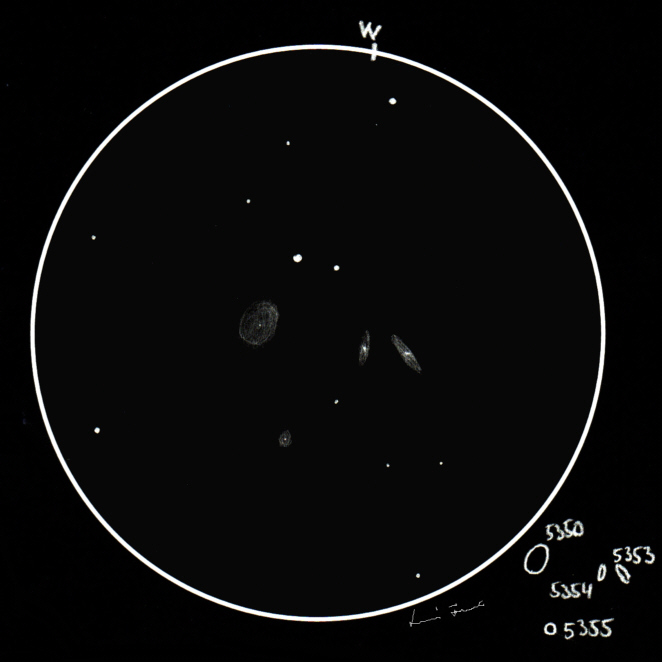
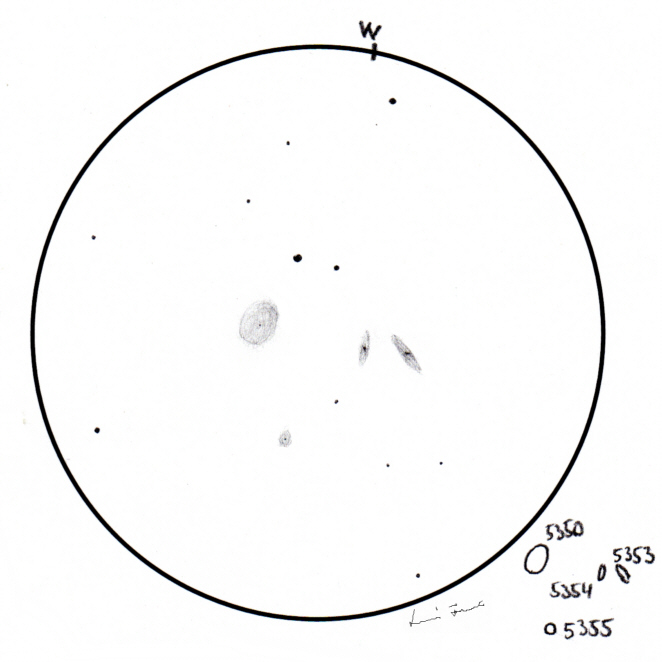
Hickson 68 (Galaxy)
|
|
Also known as: NGC 5350 + NGC 5353 + NGC 5354 + NGC 5355
|
|
Right ascension: 13h 54m
|
Declination: 40° 17'
|
|
Constellation: Canes Venatici
|
|
Date/time: 2010.05.12 22:45 UT
|
|
Equipment: 12" f/5 Newtonian
|
|
FoV: 20'
|
Magnification and filter(s): 167x
|
|
Seeing: 5/10
|
Transparency: 4/5
|
|
Location: Nádasdladány, Hungary
|
|
Observer: Ferenc Lovró
|
Description:
Fantastic spectacular group of galaxies. I can catch 4 of 5 group members. NGC 5353 and 5354 are showing star-like core, NGC 5350 does not show such a feature, although this is clearly the largest of all. NGC 5355 is the faintest, it's so dim that it's hard to detect its exact shape and position angle (PA). Hickson designations are: 68a = NGC 5353 (11m), 68b = NGC 5354 (11.4m), 68c = NGC 5350 (11.3m), 68d = NGC 5355 (13.1m), 68e = NGC 5358 (13.6m). Unfortunately I was unable to detect the last one of the quintet, but it should be visible on a better night.
|
|
Hi-resolution image: [ reversed sketch | original sketch ]
|
|
|
NGC 5529 (Galaxy)
|
|
Right ascension: 14h 16m
|
Declination: 36° 10'
|
|
Constellation: Boötes
|
|
Date/time: 2010.05.12 23:25 UT
|
|
Equipment: 12" f/5 Newtonian
|
|
FoV: 23'
|
Magnification and filter(s): 167x
|
|
Seeing: 5/10
|
Transparency: 3/5
|
|
Location: Nádasdladány, Hungary
|
|
Observer: Ferenc Lovró
|
Description:
Very thin edge-on galaxy. Although it can be detected with direct vision, I can see its real shape and size using averted vision. By looking far beside it and a bit away from the eyepiece it seems as if it doubles its extent. To the East of the galaxy an interesting triplet of stars can be found which is quite noticeable to help to locate this object. I estimate its surface brightness to be around 14.4 magnitudes, with its core a little bit brighter. To the East there's a very faint star of 14.8m that sometimes seem to be inside the galactic body.
|
|
Hi-resolution image: [ reversed sketch | original sketch ]
|
|
|
NGC 5689 (Galaxy)
|
|
Right ascension: 14h 36m
|
Declination: 48° 42'
|
|
Constellation: Boötes
|
|
Date/time: 2010.06.05 20:00 UT
|
|
Equipment: 12" f/5 Newtonian
|
|
FoV: 24'
|
Magnification and filter(s): 167x
|
|
Seeing: 5/10
|
Transparency: 3/5
|
|
Location: Nádasdladány, Hungary
|
|
Observer: Ferenc Lovró
|
Description:
Medium brightness, small galaxy, elongated in the E-W directions, it's shape reminds me of an eye. Its Southern side looks a bit brighter near the fuzzy star-like core. The core is only slightly brighter than the rest of the galaxy and I estimate it to have a brightness of about 13.9m. The air is very humid.
|
|
Hi-resolution image: [ reversed sketch | original sketch ]
|
|
|
NGC 5707 (Galaxy)
|
|
Right ascension: 14h 38m
|
Declination: 51° 31'
|
|
Constellation: Boötes
|
|
Date/time: 2010.06.05 21:00 UT
|
|
Equipment: 12" f/5 Newtonian
|
|
FoV: 15'
|
Magnification and filter(s): 250x
|
|
Seeing: 6/10
|
Transparency: 3/5
|
|
Location: Nádasdladány, Hungary
|
|
Observer: Ferenc Lovró
|
Description:
Very tiny and faint galaxy, I find it a definitely hard object. At 71x all I can notice is that next to a bright star there's some star that looks a bit fuzzy. By increasing the magnification the surface of the galaxy slowly becomes visible. I find it a lovely little galaxy and a real challenge!
|
|
Hi-resolution image: [ reversed sketch | original sketch ]
|
|
|
NGC 5857 + NGC 5859 (Galaxy)
|
|
Right ascension: 15h 08m
|
Declination: 19° 33'
|
|
Constellation: Boötes
|
|
Date/time: 2009.06.13 22:00 UT
|
|
Equipment: 12" f/5 Newtonian
|
|
FoV: 23'
|
Magnification and filter(s): 167x
|
|
Seeing: 6/10
|
Transparency: 3/5
|
|
Location: Nádasdladány, Hungary
|
|
Observer: Ferenc Lovró
|
Description:
An extremely faint pair of galaxies in a sparsely populated starfield, therefore it's recommended to have some experience with starhopping. The brighter one is the NGC 5859, that is a small edge-on galaxy. Its core is brightening slowly. To the NW you may notice a small foggy star which turns out to be the core of another faint galaxy, the NGC 5857. It's much fainter than its companion, and features a star-like core. It nearly touches the outer regions of the NGC 5859. The faintest star of the sketch is catalogued at 15.21m, which is considered to be excellent in such a terrible atmospheric conditions.
|
|
Hi-resolution image: [ reversed sketch | original sketch ]
|
|
|
NGC 5899 (Galaxy)
|
|
Right ascension: 15h 15m
|
Declination: 42° 0'
|
|
Constellation: Boötes
|
|
Date/time: 2010.05.13 0:20 UT
|
|
Equipment: 12" f/5 Newtonian
|
|
FoV: 24'
|
Magnification and filter(s): 167x
|
|
Seeing: 5/10
|
Transparency: 3/5
|
|
Location: Nádasdladány, Hungary
|
|
Observer: Ferenc Lovró
|
Description:
Tiny, extremely faint object. The core is barely brighter, not starlike. I estimate an average visual surface brightness of 14.6m and a dimension of 2' x 0.8'. Unfortunately the bad seeing is not ideal for its observation
|
|
Hi-resolution image: [ reversed sketch | original sketch ]
|
|
|
NGC 5905 + NGC 5908 (Galaxy)
|
|
Right ascension: 15h 16m
|
Declination: 55° 26'
|
|
Constellation: Draco
|
|
Date/time: 2010.06.05 22:30 UT
|
|
Equipment: 12" f/5 Newtonian
|
|
FoV: 28'
|
Magnification and filter(s): 100x
|
|
Seeing: 6/10
|
Transparency: 3/5
|
|
Location: Nádasdladány, Hungary
|
|
Observer: Ferenc Lovró
|
Description:
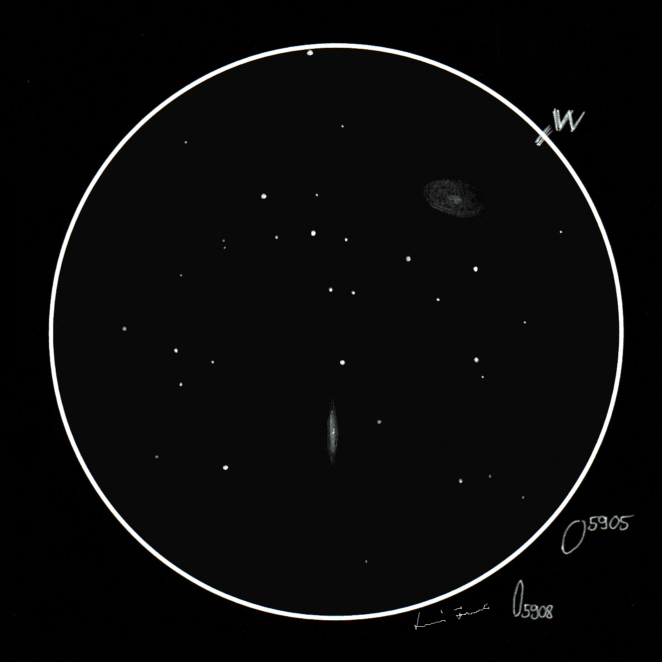
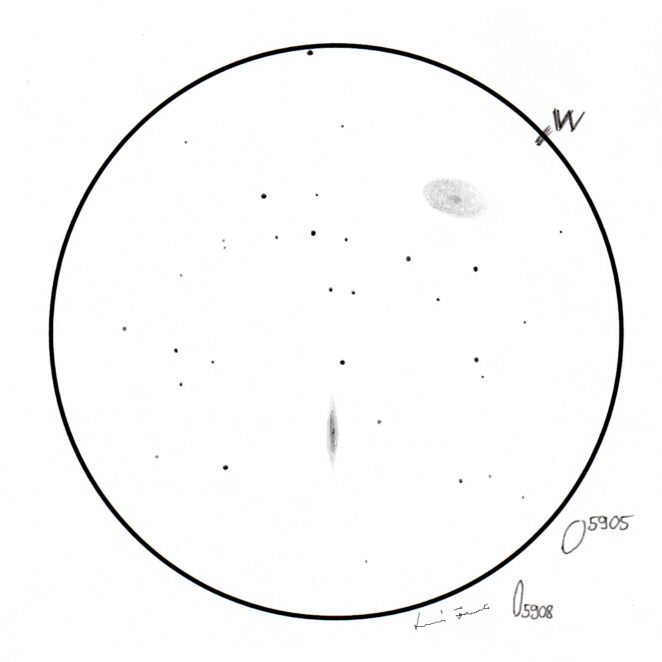
The NGC 5908 is a perfect example of an edge-on galaxy, elongated in a direction of NW-SE, brighter than its companion with a faint, but star-like central core. Another interesting detail I noticed is a bar-like feature in this galaxy. The NGC 5905 is much fainter, a very hard object, shows no sign of a star-like core and it's so faint that I'm sometimes not at all sure in its elongation. This doublet can be found 1° South of the very spectacular Splinter galaxy (NGC 5907).
|
|
Hi-resolution image: [ reversed sketch | original sketch ]
|
|
|
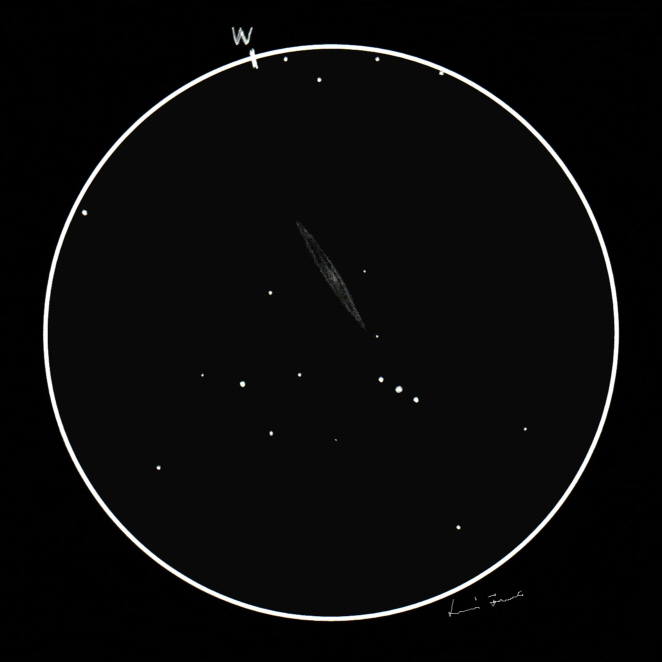
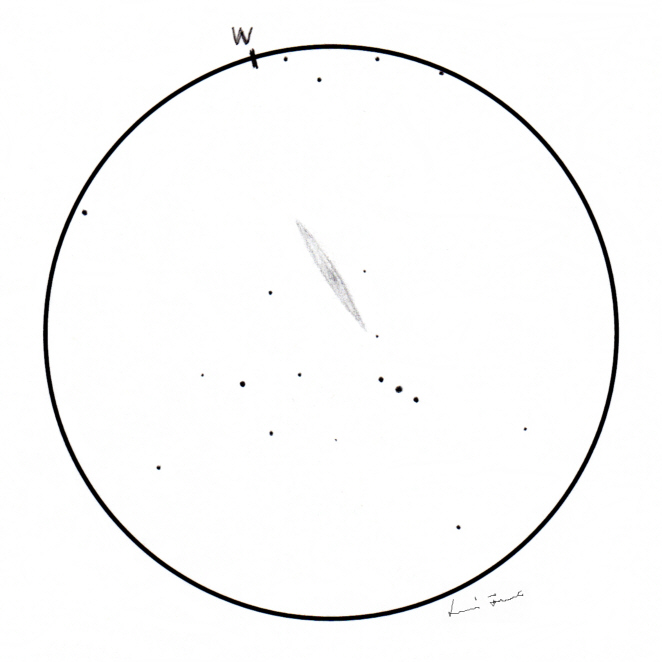
NGC 5907 (Galaxy)
|
|
Also known as: Splinter galaxy
|
|
Right ascension: 15h 16m
|
Declination: 56° 19'
|
|
Constellation: Draco
|
|
Date/time: 2008.06.29 23:00 UT
|
|
Equipment: 12" f/5 Newtonian
|
|
FoV: 40'
|
Magnification and filter(s): 71x
|
|
Seeing: 7/10
|
Transparency: 5/5
|
|
Location: Nádasdladány, Hungary
|
|
Observer: Ferenc Lovró
|
Description:
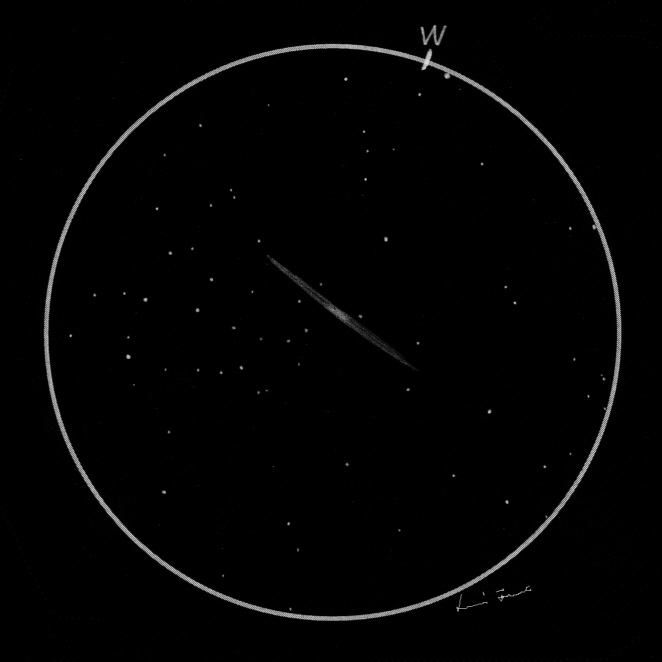
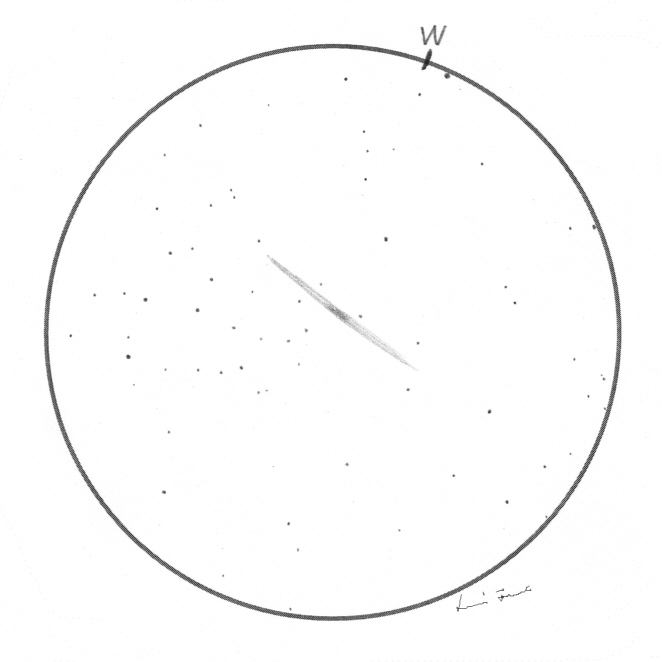
A gigantic, greatly elongated galaxy, visible totally from its edge on. It covers an area of about 13' x 1.4' on the boundary of the constellations Draco and Boötes. It has a homogeneous colour, even its core is just slightly brighter than the rest of its outside territories. When looking at its shape, it's very clear why it is commonly referred to as the Splinter galaxy.
|
|
Hi-resolution image: [ reversed sketch | original sketch ]
|
|
This sketch was featured on Astronomy Sketch of the Day on Oct 23, 2008.
|
|
|
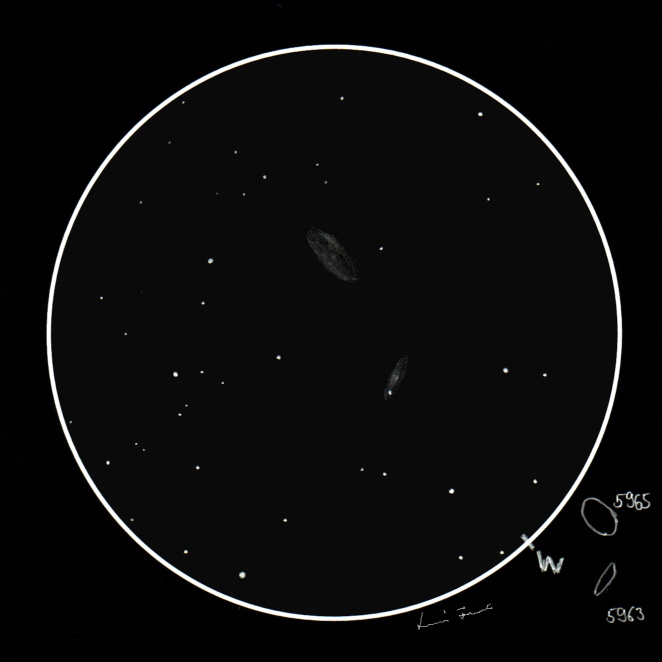
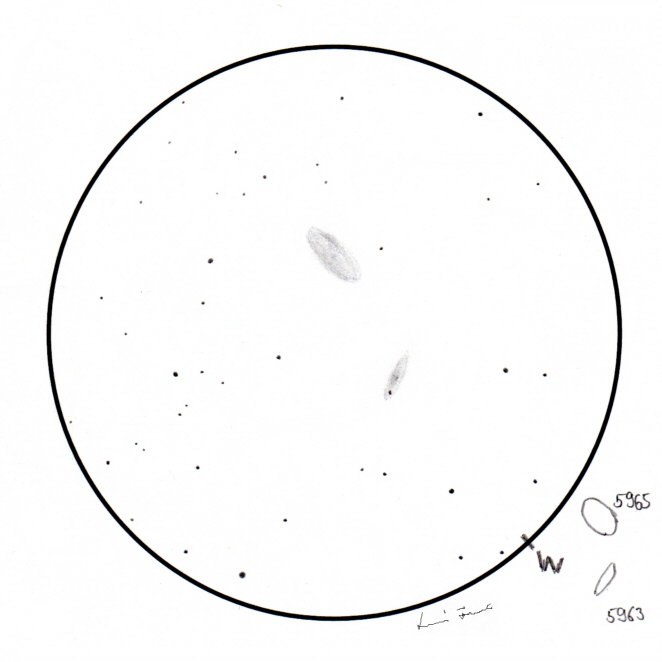
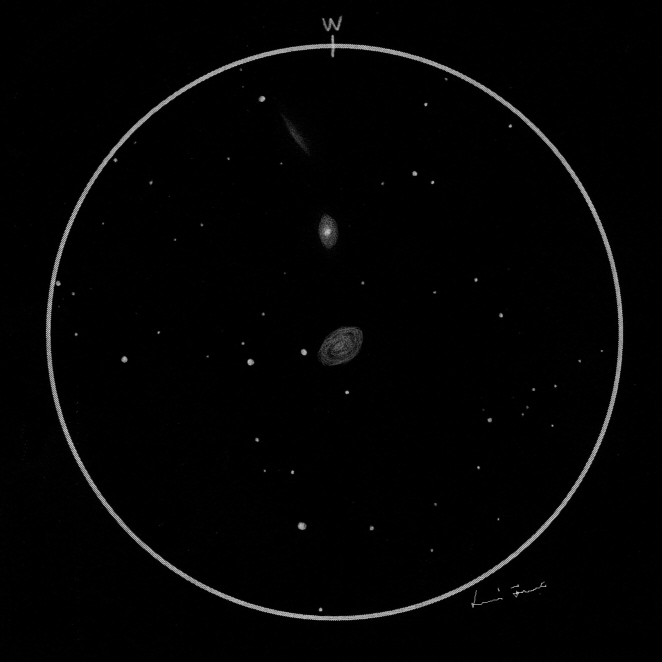
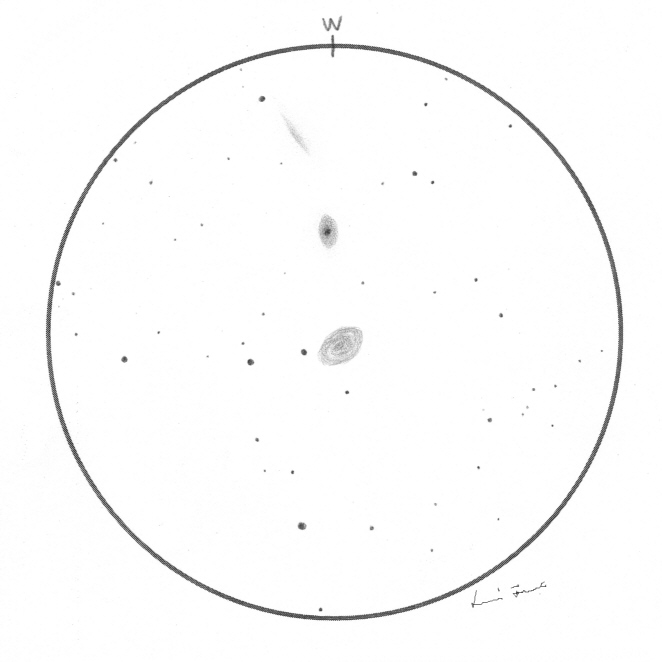
NGC 5963 + NGC 5965 (Galaxy)
|
|
Right ascension: 15h 34m
|
Declination: 56° 35'
|
|
Constellation: Draco
|
|
Date/time: 2010.06.06 22:00 UT
|
|
Equipment: 12" f/5 Newtonian
|
|
FoV: 33'
|
Magnification and filter(s): 100x
|
|
Seeing: 4/10
|
Transparency: 4/5
|
|
Location: Nádasdladány, Hungary
|
|
Observer: Ferenc Lovró
|
Description:
From the two galaxies the NGC 5963 is the brighter and displays a faint star-like core. The NGC 5965 is rather homogeneous with constant surface brightness, yet its Southern side seem to be a little bit brighter than the rest. Later on I've checked some photographs and now it seems that I've seen only the very central features of the NGC 5963.
|
|
Hi-resolution image: [ reversed sketch | original sketch ]
|
|
|
NGC 5981 + NGC 5982 + NGC 5985 (Galaxy)
|
|
Also known as: Draco trio
|
|
Right ascension: 15h 38m
|
Declination: 59° 21'
|
|
Constellation: Draco
|
|
Date/time: 2008.06.30 00:00 UT
|
|
Equipment: 12" f/5 Newtonian
|
|
FoV: 36'
|
Magnification and filter(s): 71x
|
|
Seeing: 7/10
|
Transparency: 5/5
|
|
Location: Nádasdladány, Hungary
|
|
Observer: Ferenc Lovró
|
Description:
The trio, also known as the "Draco group" is just like an illustration for a book to show the variety of galaxies: it consists three totally different galaxies lined up on line from East to West. Some details about these galaxies westward: the huge NGC 5985 (11m) is a nearly face-on spiral galaxy. Plenty of its arms are visible even with direct vision! Its galactic core is not really bright. This is followed by the tiny NGC 5982 (11m) which is an elliptic galaxy with homogeneous surface and a very bright, star-like core. While drawing these, I've noticed that something just appears more to the West: it was the faint NGC 5981 (13.2m), another spiral galaxy, but with edge on. If I were just taking a small glimpse instead of taking the time to sketch this area, I'd have surely miss this gem. This is why sketching is wonderful: it is what makes observation complete!
|
|
Hi-resolution image: [ reversed sketch | original sketch ]
|
|
|
NGC 5987 (Galaxy)
|
|
Right ascension: 15h 40m
|
Declination: 58° 3'
|
|
Constellation: Draco
|
|
Date/time: 2010.06.06 21:30 UT
|
|
Equipment: 12" f/5 Newtonian
|
|
FoV: 24'
|
Magnification and filter(s): 167x
|
|
Seeing: 4/10
|
Transparency: 4/5
|
|
Location: Nádasdladány, Hungary
|
|
Observer: Ferenc Lovró
|
Description:
Small, faint galaxy, highly elongated in the E-W direction. It seems that its Southern side is a bit brighter, the core is slightly star-like, moderately brighter than the surface. Located in a nice environment rich of spectacular star formations that helps to find it.
|
|
Hi-resolution image: [ reversed sketch | original sketch ]
|
|
|
NGC 6015 (Galaxy)
|
|
Right ascension: 15h 52m
|
Declination: 62° 17'
|
|
Constellation: Draco
|
|
Date/time: 2010.06.05 23:00 UT
|
|
Equipment: 12" f/5 Newtonian
|
|
FoV: 31'
|
Magnification and filter(s): 100x
|
|
Seeing: 6/10
|
Transparency: 3/5
|
|
Location: Nádasdladány, Hungary
|
|
Observer: Ferenc Lovró
|
Description:
Large, fairly bright galaxy with barely brighter centre. Looks quite homogeneous. Located in a nice environment, rich in stars.
|
|
Hi-resolution image: [ reversed sketch | original sketch ]
|
|
|
NGC 6503 (Galaxy)
|
|
Right ascension: 17h 49m
|
Declination: 70° 08'
|
|
Constellation: Draco
|
|
Date/time: 2009.07.25 22:00 UT
|
|
Equipment: 12" f/5 Newtonian
|
|
FoV: 26'
|
Magnification and filter(s): 167x
|
|
Seeing: 5/10
|
Transparency: 5/5
|
|
Location: Jászszentlászló, Hungary
|
|
Observer: Ferenc Lovró
|
Description:
Bright, small galaxy near a very yellowish star, which I captured on a surprisingly cold night that offered an excellent transparency in the early evening hours near the village of Jászszentlászló, Hungary during the Kiskun Astro Camp. Its shape is not perfectly cigar shaped, but its northwestern end looks a bit truncated. Its surface is not entirely homogeneous: next to its gradually brightened yet not star-like core it shows many little details, changes in luminosity of its surface. SQM reading: 21.24 m/arcsec^2, 12°C. The faintest field star visible directly is about 15.1 magnitudes bright, the NELM was 6.5 at this time of the evening.
|
|
Hi-resolution image: [ reversed sketch | original sketch ]
|
|
|
NGC 6504 (Galaxy)
|
|
Right ascension: 17h 56m
|
Declination: 33° 12'
|
|
Constellation: Hercules
|
|
Date/time: 2009.05.25 23:45 UT
|
|
Equipment: 12" f/5 Newtonian
|
|
FoV: 21'
|
Magnification and filter(s): 167x
|
|
Seeing: 3/10
|
Transparency: 4/5
|
|
Location: Nádasdladány, Hungary
|
|
Observer: Ferenc Lovró
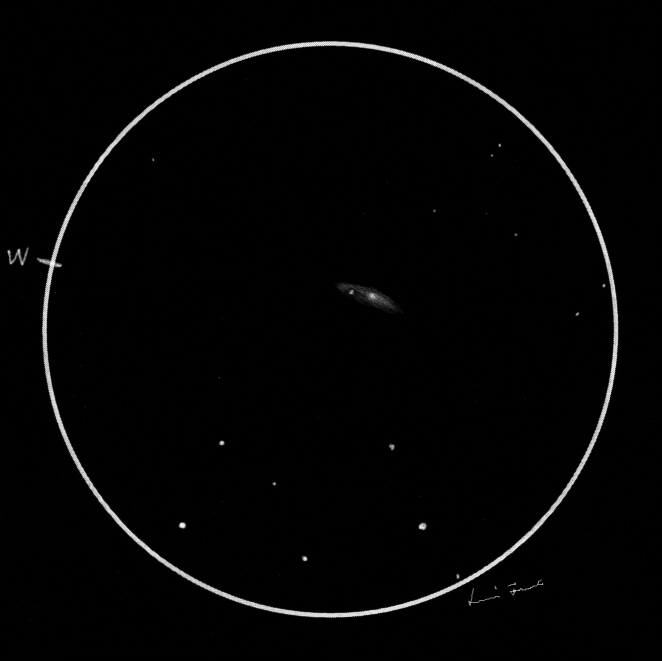
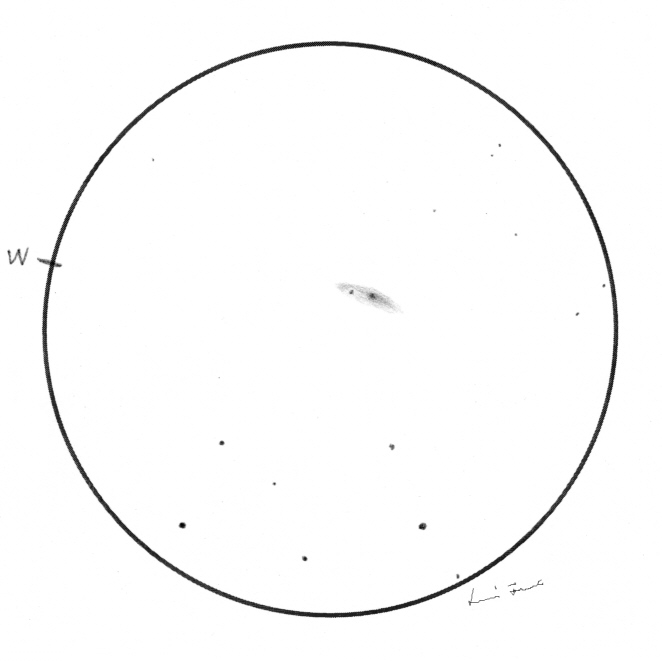
|
Description:
A very faint, tiny little GX with an apparent magnitude of about 13.6-13 magnitudes. Its core is popping out strongly from the galactic plane and resembles an almond, although the Northern side of the core looks brighter, therefore it seems to be asymmetric. It demands high magnification levels. At 250x the shapes were easier to see, unfortunately because of the terrible seeing I had to step back to a lower power. Photographically it looks quite the same as NGC 4762.
|
|
Hi-resolution image: [ reversed sketch | original sketch ]
|
|
|
NGC 7013 (Galaxy)
|
|
Right ascension: 21h 4m
|
Declination: 29° 56'
|
|
Constellation: Cygnus
|
|
Date/time: 2009.08.21 00:30 UT
|
|
Equipment: 12" f/5 Newtonian
|
|
FoV: 17'
|
Magnification and filter(s): 250x
|
|
Seeing: 5/10
|
Transparency: 4/5
|
|
Location: Tarján, Hungary
|
|
Observer: Ferenc Lovró
|
Description:
A really faint galaxy with an almond shaped slightly brighter core. Small, yet easy to find, located just next to a bright, 10 magnitude star. It shows an interesting ring-like feature on photographs, therefore some suspect that this is a spiral galaxy at its early ages. SQM reading: 21.02 m/arcsec^2 8°C.
|
|
Hi-resolution image: [ reversed sketch | original sketch ]
|
|
|
NGC 7217 (Galaxy)
|
|
Right ascension: 22h 7m
|
Declination: 31° 21'
|
|
Constellation: Pegasus
|
|
Date/time: 2008.10.01 23:00 UT
|
|
Equipment: 12" f/5 Newtonian
|
|
FoV: 23'
|
Magnification and filter(s): 167x
|
|
Seeing: 6/10
|
Transparency: 4/5
|
|
Location: Nádasdladány, Hungary
|
|
Observer: Ferenc Lovró
|
Description:
Faint galaxy that looks pretty small, it only gets brighter near its tiny core, but that core is very bright compared to the rest of the body of the galaxy. The 11.1m luminosity that is stated in catalogues I find exaggerated. Its core resembles a blurred star, and according to my estimation, has a brightness of about 13.6m, while the average surface brightness of the galaxy I estimate at 14.1 magnitudes. Its shape is slightly elongated ellipse in the SW-NE directions, with a visible size of 2' x 2'10".
|
|
Hi-resolution image: [ reversed sketch | original sketch ]
|
|
|
NGC 7331 + NGC 7335 (Galaxy)
|
|
Right ascension: 22h 37m
|
Declination: 34° 25'
|
|
Constellation: Pegasus
|
|
Date/time: 2008.10.05 19:30 UT
|
|
Equipment: 12" f/5 Newtonian
|
|
FoV: 22'
|
Magnification and filter(s): 167x
|
|
Seeing: 5/10
|
Transparency: 4/5
|
|
Location: Nádasdladány, Hungary
|
|
Observer: Ferenc Lovró
|
Description:
NGC 7331 is a huge galaxy, elongated in the N-S direction, full of details. Its core is quite bright, raising out towards the West from the galactic plane. The Eastern side of the galaxy looks much larger, the whole surface seems strongly asymmetric. I estimate the brightness of the core to 12.6m, compared to nearby stars using data from the Hubble Guide Star Catalog (GSC), whereas the average brightness of the surface of the galaxy I estimate at 13.5m, which means that it should be visible for most mid-size telescopes under good sky conditions. I measure a size of 1'x6', although according to the large bright galactic core I suspect that it would look much larger under better conditions. To the South of NGC 7331 near the end of the half hour sketching period I've started to see another very subtle little spot which occured to be NGC 7335. To my own estimations, I found it has a surface brightness of about 14.2m, and a size of 0.5'x1.2'. There are more NGC objects visible in the eyepiece, like NGC 7326, 7333 and so on, however most of these were identified later as stars or double stars.
|
|
Hi-resolution image: [ reversed sketch | original sketch ]
|
|
|
NGC 7332 + NGC 7339 (Galaxy)
|
|
Right ascension: 22h 37m
|
Declination: 23° 48'
|
|
Constellation: Pegasus
|
|
Date/time: 2008.10.01 23:45 UT
|
|
Equipment: 12" f/5 Newtonian
|
|
FoV: 18'
|
Magnification and filter(s): 250x
|
|
Seeing: 6/10
|
Transparency: 4/5
|
|
Location: Nádasdladány, Hungary
|
|
Observer: Ferenc Lovró
|
Description:
Two spectacular galaxies of similar size but different look, in a nice pattern, about perpendicular to eachother. NGC 7332 is a bit larger and much brighter, however visually I've seen it slightly smaller than its fainter companion. A reason for this might be its starlike, bright core, that is washing away the dimmer areas, and to which I estimate a brightness of about 12.7m. The galaxy is losing brightness smoothly toward its outer boundaries. NGC 7339 however does not have a starlike core, its surface looks perfectly homogeneous, it's has a shape of a cigar: faint and highly elongated. It has sharp edges. I estimate a surface brightness of 13.2m. Their sizes are: 0.5' x 1.5' for NGC 7332, which is much smaller than what is stated in the catalogue (1.1' x 4.1'!), and 0.5' x 2.3' for NGC 7339. The photos I've seen make me certain that I'm right by the size estimation, because on these the galaxy pair looks quite the same by size.
|
|
Hi-resolution image: [ reversed sketch | original sketch ]
|
|
This sketch was featured on Astronomy Sketch of the Day on Dec 26, 2008.
|
|
|
NGC 7457 (Galaxy)
|
|
Right ascension: 23h 1m
|
Declination: 30° 12'
|
|
Constellation: Pegasus
|
|
Date/time: 2008.11.18 18:00 UT
|
|
Equipment: 12" f/5 Newtonian
|
|
FoV: 15'
|
Magnification and filter(s): 250x
|
|
Seeing: 5/10
|
Transparency: 2/5
|
|
Location: Nádasdladány, Hungary
|
|
Observer: Ferenc Lovró
|
Description:
Large but faint galaxy in the constellation of Pegasus. It is described as a spiral galaxy in the catalogues, however this is not detectable visually: it looks like an elliptic galaxy elongated in the NW-SE direction, with a totally homogeneous surface and a very tiny core that only slightly outshines the galaxy surface. I estimate its brightness to 13 magnitudes, with a size of about 1'x2.5'.
|
|
Hi-resolution image: [ reversed sketch | original sketch ]
|
|
|
NGC 7625 (Galaxy)
|
|
Also known as: Arp 212
|
|
Right ascension: 23h 21m
|
Declination: 17° 17'
|
|
Constellation: Pegasus
|
|
Date/time: 2009.08.20 22:00 UT
|
|
Equipment: 12" f/5 Newtonian
|
|
FoV: 18'
|
Magnification and filter(s): 167x
|
|
Seeing: 5/10
|
Transparency: 4/5
|
|
Location: Tarján, Hungary
|
|
Observer: Ferenc Lovró
|
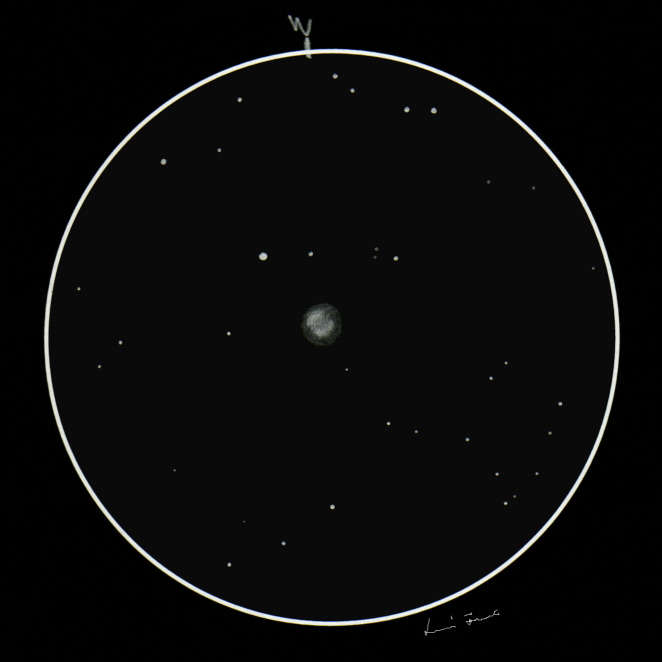
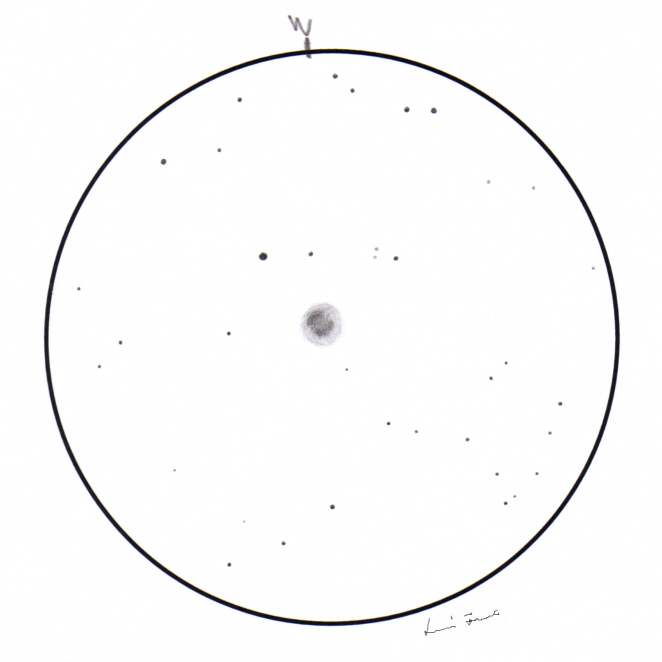
Description:
This 12m faint face-on galaxy of 1' diametre resembles a globular cluster that cannot be resolved at all. Its core brightens slightly, but apart from this it shows no details at all. At about 7-8' to the East, a 9.7 magnitude star is shining in the FoV. This galaxy is also catalogued in Arp's Atlas of Peculiar Galaxies with number 212. SQM reading: 21.03 m/arcsec^2.
|
|
Hi-resolution image: [ reversed sketch | original sketch ]
|
|
|
NGC 7640 (Galaxy)
|
|
Right ascension: 23h 22m
|
Declination: 40° 54'
|
|
Constellation: Andromeda
|
|
Date/time: 2008.11.18 19:30 UT
|
|
Equipment: 12" f/5 Newtonian
|
|
FoV: 23'
|
Magnification and filter(s): 167x
|
|
Seeing: 6/10
|
Transparency: 3/5
|
|
Location: Nádasdladány, Hungary
|
|
Observer: Ferenc Lovró
|
Description:
Faint but still very spectacular spiral galaxy with an estimated brightness of about 12.3m. As I almost never read or view pictures of the objects I want to observe (so the photos in my memory will not change the picture I really see with my own eyes), because of its very asymmetrical shape I first thought that it must be an irregular galaxy, similar to the objects in Halton Arp's compilation of peculiar galaxies. Even its core area seemed to almost fall out of the galaxy itself. However, later on by examining astrophotographs it turned out that what I believed to be its core is in fact a bright foreground star and the real galactic core is in fact located in the brighter little densities near this "fake core". At smaller magnification levels (67x) the shape of the galaxy is easier to see, however by increasing the magnification, the sofar homogeneous arms start to show many details, especially with averted vision near the core. I measured its size as 4.5'x1'.
|
|
Hi-resolution image: [ reversed sketch | original sketch ]
|
|
This sketch was featured on Astronomy Sketch of the Day on Dec 6, 2008.
|
|
|
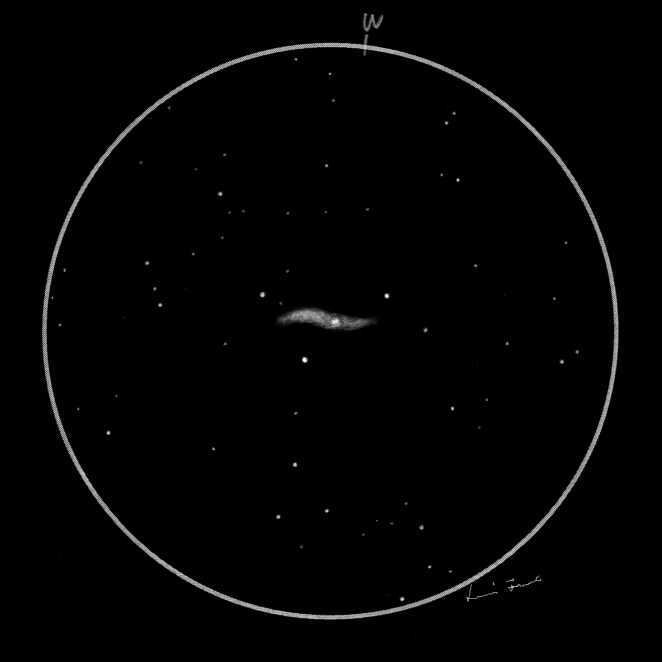
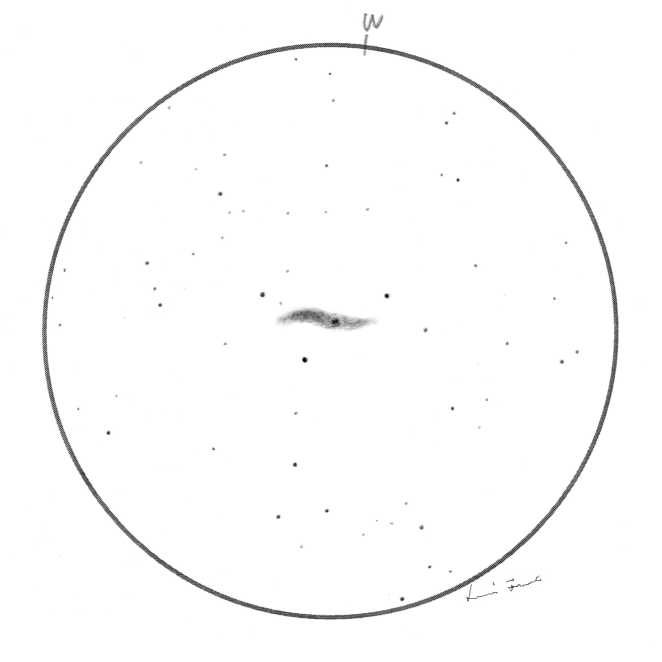
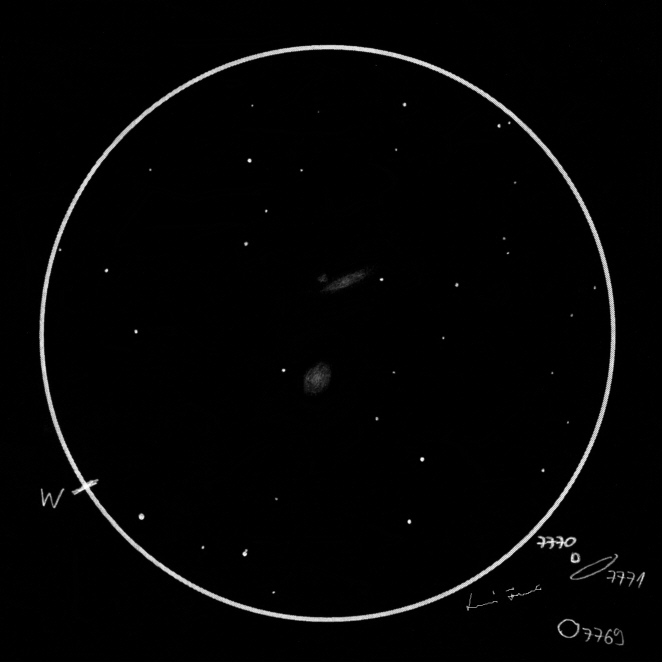
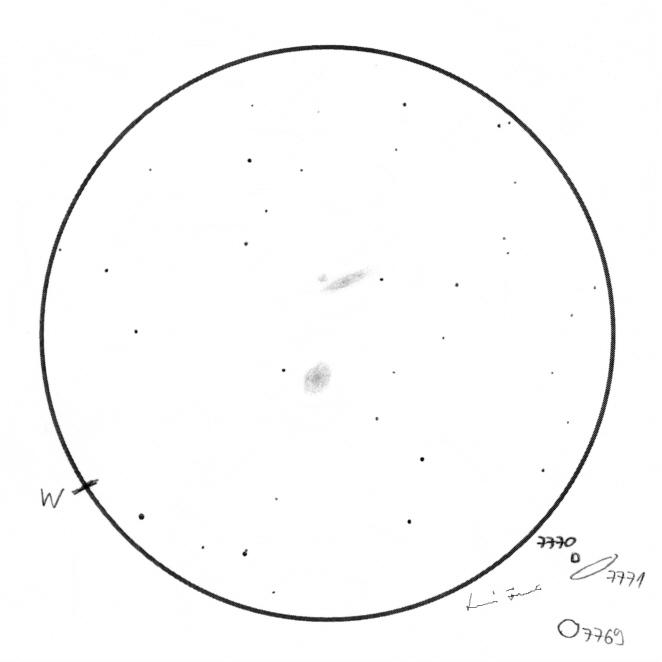
NGC 7769 + NGC 7770 + NGC 7771 (Galaxy)
|
|
Right ascension: 23h 52m
|
Declination: 20° 10'
|
|
Constellation: Pegasus
|
|
Date/time: 2009.08.20 21:30 UT
|
|
Equipment: 12" f/5 Newtonian
|
|
FoV: 32'
|
Magnification and filter(s): 100x
|
|
Seeing: 4/10
|
Transparency: 5/5
|
|
Location: Tarján, Hungary
|
|
Observer: Ferenc Lovró
|
Description:
I've sketched this fantastic trio of galaxies during the Meteor Star Party 2009 in Tarján, Hungary. The two larger ones are the face-on NGC 7769 and the edge-on 7771, both with softly brightening cores. Next to 7771 a small fuzzy object is visible, which surprises me, since my printed star map (TriAtlas B, with a limiting magnitude of about 12) shows no other objects than the two large galaxies at this area of sky. But as I can clearly make out this bright diffuse spot, I place it on the sketch and can't wait to find out what I really saw. It turns out to be the NGC 7770, another faint galaxy of 13.6m. This value I find a bit misleading, because visually its surface is not this much fainter than its two larger companion galaxies. This discovery makes me really happy, just like when I rediscovered NGC 5981 of the Draco Trio. SQM reading: 20.91 m/arcsec^2.
|
|
Hi-resolution image: [ reversed sketch | original sketch ]
|
|
|
NGC 7814 (Galaxy)
|
|
Right ascension: 0h 3m
|
Declination: 16° 9'
|
|
Constellation: Pegasus
|
|
Date/time: 2008.10.31 20:00 UT
|
|
Equipment: 12" f/5 Newtonian
|
|
FoV: 24'
|
Magnification and filter(s): 167x
|
|
Seeing: 6/10
|
Transparency: 3/5
|
|
Location: Nádasdladány, Hungary
|
|
Observer: Ferenc Lovró
|
Description:
This is a special galaxy, being totally edge-on, although this can be seen only on long-exposition photographs. Visually it rather looks like a smaller galaxy laying in a 45 degree angle. What I see however, is only the core of the galaxy and its nearest vicinity. This core is cut into two halves by the dark dust path of the galactic plane, which can only hardly be seen visually, but it is not impossible by using extreme large magnifications. For me it stayed hidden even with 250x, although conditions were not favourable for galaxy hunting. I estimate its average surface brightness to 13m, and its size 1x2.5', but it's obvious that the whole galaxy is much larger than this.
|
|
Hi-resolution image: [ reversed sketch | original sketch ]
|
|
|
M51 + SN 2011dh (Galaxy)
|
|
Also known as: Whirlpool galaxy
|
|
Right ascension: 13h 30m
|
Declination: 47° 8'
|
|
Constellation: Ursa Major
|
|
Date/time: 2011.06.21 21:30 UT
|
|
Equipment: 12" f/5 Newtonian
|
|
FoV: 25'
|
Magnification and filter(s): 167x
|
|
Seeing: 6/10
|
Transparency: 3/5
|
|
Location: Nádasdladány, Hungary
|
|
Observer: Ferenc Lovró
|
Description:
Today was the Summer solstice, so it's not surprising that even at 11pm the Western horizon is still shining in bluish colour, however at East the hazy patch of the Summer Milkyway is already easily noticeable. The spiral structure of the M51 is readily visible at 71x, surprisingly easy and so is the supernova SN2011dh, which I estimate to be at 12.3m and is located in the middle of a large outer spiral arm towards ESE from the galactic core. At such a high brightness this supernova is possibly one of the brightest for this year, at a very easy position for Northern hemisphere observers also with much smaller scopes.
|
|
Hi-resolution image: [ reversed sketch | original sketch ]
|
|
|
NGC 4459 + NGC 4477 + NGC 4479 + NGC 4473 + NGC 4458 + NGC 4461 + NGC 4435 + NGC 4438 (Galaxy)
|
|
Also known as: Markarian's Chain
|
|
Right ascension: 12h 28m
|
Declination: 13° 1'
|
|
Constellation: Virgo
|
|
Date/time: 2012.04.25 22:00 UT
|
|
Equipment: 12" f/5 Newtonian
|
|
FoV: '
|
Magnification and filter(s): 71x
|
|
Seeing: 6/10
|
Transparency: 4/5
|
|
Location: Nádasdladány, Hungary
|
|
Observer: Ferenc Lovró
|
Description:
Almost all members of this spectacular cluster of galaxies is fairly bright, except maybe for NGC 4479 and NGC 4402. The Messier galaxies are especially bright: M84 and M86. The galaxy NGC 4435 has a star-like core and NGC 4438 is remarkably peculiar shaped. The image is a mosaic of multiple FoV's, with a total coverage of about 1x1.5 degrees. The galaxies from left to right are: NGC 4479, NGC 4477, NGC 4473, NGC 4459, NGC 4461, NGC 4458, NGC 4435, NGC 4438, NGC 4425, NGC 4402, M86, NGC 4387, NGC 4388, M84.
SQM reading: 21.32 m/arcsec2, 7°C, light wind.
|
|
Hi-resolution image: [ reversed sketch | original sketch ]
|
|
|
NGC 4567 + NGC 4568 + NGC 4564 (Galaxy)
|
|
Also known as: The Siamese Twins, Butterfly Galaxy
|
|
Right ascension: 12h 37m
|
Declination: 11° 17'
|
|
Constellation: Virgo
|
|
Date/time: 2012.04.26 22:15 UT
|
|
Equipment: 12" f/5 Newtonian
|
|
FoV: 25'
|
Magnification and filter(s): 167x
|
|
Seeing: 5/10
|
Transparency: 3/5
|
|
Location: Nádasdladány, Hungary
|
|
Observer: Ferenc Lovró
|
Description:
I belive this duo of galaxies is probably the most remarkable member of the enormous Coma/Virgo supercluster of galaxies. The FoV is dominated by the two interacting galaxies also known as The Siamese Twins or Butterfly Galaxy. They are not really bright, and with no sign of an outstanding central bulge. The third galaxy of the FoV, NGC 4564 has a similar brightness, but is much smaller than the twins.
SQM reading: 21.38 m/arcsec2, 7°C. The upper atmosphere is very humid with Venus having a clearly visible halo.
|
|
Hi-resolution image: [ reversed sketch | original sketch ]
|
|
|
M64 (Galaxy)
|
|
Also known as: Black Eye Galaxy
|
|
Right ascension: 12h 57m
|
Declination: 21° 37'
|
|
Constellation: Coma Berenices
|
|
Date/time: 2012.04.26 23:00 UT
|
|
Equipment: 12" f/5 Newtonian
|
|
FoV: 36'
|
Magnification and filter(s): 100x
|
|
Seeing: 4/10
|
Transparency: 3/5
|
|
Location: Nádasdladány, Hungary
|
|
Observer: Ferenc Lovró
|
Description:
The well known M64 or Black Eye Galaxy (sometimes mentioned as Black Eye Nebula) is a fine specimen of large and bright Messier galaxies (although Charles Messier didn't know what galaxies were). It has a tiny star-like central core with a noticeable bulge around it, and a thin dark patch of dust lane to the NE of the core. This feature is not easily visible. On the major axis of the ellipse I can detect signs of spiral arms on both sides of the core.
SQM reading: 21.44 m/arcsec2, 6°C, light wind.
|
|
Hi-resolution image: [ reversed sketch | original sketch ]
|
|
|
NGC 4414 (Galaxy)
|
|
Right ascension: 12h 27m
|
Declination: 31° 9'
|
|
Constellation: Coma Berenices
|
|
Date/time: 2012.04.27 22:15 UT
|
|
Equipment: 12" f/5 Newtonian
|
|
FoV: 24'
|
Magnification and filter(s): 167x
|
|
Seeing: 4/10
|
Transparency: 2/5
|
|
Location: Nádasdladány, Hungary
|
|
Observer: Ferenc Lovró
|
Description:
The conditions are not ideal for observing galaxies this night as theres a strong humidity in the upper atmosphere, the Moon is just disappearing over the horizon, making some of the clouds and contrails shine. This small, bright galaxy however appears to be a very easy target. Has an almond shaped central area nearly developed into a star-like core. The Southern part of the galaxy seems to be noticeably larger than the Northern side, almost round compared to that.
SQM reading: 21.02 m/arcsec2, 7°C.
|
|
Hi-resolution image: [ reversed sketch | original sketch ]
|
|
|
NGC 5875 (Galaxy)
|
|
Right ascension: 15h 10m
|
Declination: 52° 29'
|
|
Constellation: Boötes
|
|
Date/time: 2012.06.16 22:45 UT
|
|
Equipment: 12" f/5 Newtonian
|
|
FoV: 15'
|
Magnification and filter(s): 250x
|
|
Seeing: 7/10
|
Transparency: 3/5
|
|
Location: Nádasdladány, Hungary
|
|
Observer: Ferenc Lovró
|
Description:
Small and very faint galaxy, elliptical by direct vision, but seems lentil-shaped by averted vision, bit more shiny to the SW side. With averted vision its core looks star-like, but it's only a little bit brighter than its surface.
|
|
Hi-resolution image: [ reversed sketch | original sketch ]
|
|
|
NGC 5876 (Galaxy)
|
|
Right ascension: 15h 10m
|
Declination: 54° 28'
|
|
Constellation: Boötes
|
|
Date/time: 2012.06.16 23:20 UT
|
|
Equipment: 12" f/5 Newtonian
|
|
FoV: 10'
|
Magnification and filter(s): 300x
|
|
Seeing: 5/10
|
Transparency: 3/5
|
|
Location: Nádasdladány, Hungary
|
|
Observer: Ferenc Lovró
|
Description:
Very tiny elliptical galaxy near the galactic companion NGC 5874. According to my map the latter should be brighter, however that is almost invisible while this one's definitely visible already with 71x power. It has a tiny star-like core. Lies in a trapesium asterism. It has a perfectly even surface except for its core.
SQM reading: 21.3 MPSAS, 13°C.
|
|
Hi-resolution image: [ reversed sketch | original sketch ]
|
|
|
NGC 6181 (Galaxy)
|
|
Right ascension: 16h 33m
|
Declination: 19° 48'
|
|
Constellation: Hercules
|
|
Date/time: 2012.06.18 23:20 UT
|
|
Equipment: 12" f/5 Newtonian
|
|
FoV: 19'
|
Magnification and filter(s): 250x
|
|
Seeing: 6/10
|
Transparency: 3/5
|
|
Location: Nádasdladány, Hungary
|
|
Observer: Ferenc Lovró
|
Description:
Tiny, very faint galaxy with no surface details and no visible core. Its shape resembles an almond. About 4:1 elongated on its N-S axis.
SQM reading: 21.23 MPSAS, 14°C.
|
|
Hi-resolution image: [ reversed sketch | original sketch ]
|
|
|
NGC 2903 (Galaxy)
|
|
Right ascension: 9h 33m
|
Declination: 21° 26'
|
|
Constellation: Leo
|
|
Date/time: 2013.02.08 20:40 UT
|
|
Equipment: 4.5" f/8 Newtonian
|
|
FoV: 55'
|
Magnification and filter(s): 60x
|
|
Seeing: 6/10
|
Transparency: 4/5
|
|
SQM: 21.4 m/as2
|
Temperature: -3°C
|
|
Humidity: dry
|
Wind: none
|
|
Sight: 2 - minor details, somewhat interesting
|
|
Difficulty: 3 - moderately visible, dark adaptation needed, averted vision might add to details
|
|
Position: 1 - very easy, many bright stars nearby
|
|
Location: Lipótfa, Zselic, Hungary
|
|
Observer: Ferenc Lovró
|
Description:
Slightly fainter galaxy with an elongation of 1:4 in the SSE-NNW direction. Its core is like a faint, out of focus star. Surprisingly easy to see this galaxy with my little 114/900 Newtonian, with direct vision, although I believe a strong reason behind this is my superb sky in the Zselic Starry-Sky Park.
|
|
Hi-resolution image: [ reversed sketch | original sketch ]
|
|
|
NGC 3198 (Galaxy)
|
|
Right ascension: 10h 21m
|
Declination: 45° 29'
|
|
Constellation: Ursa Major
|
|
Date/time: 2013.02.08 21:30 UT
|
|
Equipment: 4.5" f/8 Newtonian
|
|
FoV: 45'
|
Magnification and filter(s): 60x
|
|
Seeing: 6/10
|
Transparency: 4/5
|
|
SQM: 21.36 m/as2
|
Temperature: -7°C
|
|
Humidity: low
|
Wind: none
|
|
Sight: 1 - nothing spectacular
|
|
Difficulty: 4 - hardly visible, dark adaptation and very dark skies needed, averted vision is required to see details
|
|
Position: 3 - moderate, some starhopping needed
|
|
Location: Lipótfa, Zselic, Hungary
|
|
Observer: Ferenc Lovró
|
Description:
Extremely faint - at least to my little Newtonian. Elongated by 1:4 in the E-W directions. It has a somewhat heavy position, and to tell the truth, I've found the galaxy after a longer search. I can detect the GX only with averted vision most of the time. Its core is only a little bit brighter than its surface, and has a shape of an almond. Sometimes its Southern half appears brighter than the Northern.
|
|
Hi-resolution image: [ reversed sketch | original sketch ]
|
|
|
NGC 3184 + NGC 3179 (Galaxy)
|
|
Right ascension: 10h 18m
|
Declination: 41° 25'
|
|
Constellation: Ursa Major
|
|
Date/time: 2013.03.07 22:40 UT
|
|
Equipment: 12" f/5 Newtonian
|
|
FoV: 40'
|
Magnification and filter(s): 71x
|
|
Seeing: 4/10
|
Transparency: 4/5
|
|
SQM: 21.28 m/as2
|
Temperature: 6°C
|
|
Humidity: dry
|
Wind: breeze
|
|
Sight: 3 - definite details, interesting look
|
|
Difficulty: 4 - hardly visible, dark adaptation and very dark skies needed, averted vision is required to see details
|
|
Position: 1 - very easy, many bright stars nearby
|
|
Location: Nádasdladány, Hungary
|
|
Observer: Ferenc Lovró
|
Description:
NGC 3184 is much brighter, a perfectly round, face-on galaxy, while its companion is a much fainter nearly edge-on galaxy dancing on the border of direct visibility. The 3184 has a brighter core that isn't round but rather amorphous, and features a brighter arc on the SW side of the galaxy. Later by checking photos I've found that these are all spiral features, it's a really exciting object. NGC 3179 has an almost star-like core, with a real star nearby.
|
|
Hi-resolution image: [ reversed sketch | original sketch ]
|
|
|
NGC 7250 + SN 2013dy (Galaxis)
|
|
Rektaszcenzió: 22h 19m
|
Deklináció: 40° 38'
|
|
Csillagkép: Lacerta
|
|
Dátum/idő: 2013.07.21 01:00 UT
|
|
Műszer: 300/1500 Newton
|
|
Látómező: '
|
Nagyítás és szűrő(k): 300x
|
|
Nyugodtság: 7/10
|
Átlátszóság: 2/5
|
|
SQM: 20.01 m/as2
|
Hőmérséklet: 11°C
|
|
Páratartalom: száraz
|
Szél: nincs
|
|
Látvány: 1 - egyáltalán nem látványos
|
|
Nehézség: 5 - szinte láthatatlan, teljes sötétadaptáció, nagyon sötét ég és elfordított látás szükséges a megpillantásához
|
|
Pozíció: 4 - nehéz, összetett csillagról-csillagra ugrálás szükséges
|
|
Helyszín: Nádasdladány, Magyarország
|
|
Észlelő: Ferenc Lovró
|
Leírás:
Az SN 2013dy szupernóva szülőgalaxisa, az NGC 7250 halvány ködfoltként tűnik fel a látómezőben. A fényes égi háttér ellen (melyet a telihold és a kombájnok felverte légköri por okoz) a nagyítás növelésével próbálok tenni. Tegnap nem sikerült leészlelnem a szupernóvát, de ma sikerrel jártam, bár most is nagyon nehéz feladat volt. Vizuálisan 12.3 magnitúdóra becsülöm a fényességét.
|
|
Nagyfelbontású képek: [ inverz rajz | eredeti rajz ]
|
|
NGC 7250 + SN 2013dy (Galaxy)
|
|
Right ascension: 22h 19m
|
Declination: 40° 38'
|
|
Constellation: Lacerta
|
|
Date/time: 2013.07.21 01:00 UT
|
|
Equipment: 12" f/5 Newtonian
|
|
FoV: '
|
Magnification and filter(s): 300x
|
|
Seeing: 7/10
|
Transparency: 2/5
|
|
SQM: 20.01 m/as2
|
Temperature: 11°C
|
|
Humidity: dry
|
Wind: none
|
|
Sight: 1 - nothing spectacular
|
|
Difficulty: 5 - almost invisible, total dark adaptation, very dark skies and averted vision is a must to see the object
|
|
Position: 4 - hard, complex starhopping needed
|
|
Location: Nádasdladány, Hungary
|
|
Observer: Ferenc Lovró
|
Description:
The host galaxy of the supernova SN 2013dy, NGC 7250 appears as a very faint patch of light in the FoV. I try to compensate for the bright sky background by increasing the magnification, caused by the rising full Moon and the dust in the air caused by harvesters. Yesterday my observation was negative, but today I succeeded, although it was still a very difficult task. I estimate the brightness of the supernova to nearly 12.3m visually.
|
|
Hi-resolution image: [ reversed sketch | original sketch ]
|
|
|
M82 + SN 2014J (Galaxy)
|
|
Also known as: Cigar galaxy
|
|
Right ascension: h m
|
Declination: ° '
|
|
Constellation: Ursa Major
|
|
Date/time: 2014.01.23 17:30 UT
|
|
Equipment: 12" f/5 Newtonian
|
|
FoV: '
|
Magnification and filter(s): 167xx
|
|
Seeing: 3/10
|
Transparency: 2/5
|
|
SQM: 19.94 m/as2
|
|
Humidity: moderate
|
Wind: breeze
|
|
Sight: 4 - lots of details, very interesting, unique look
|
|
Difficulty: 2 - easily visible, some dark adaptation needed, averted vision might add to details
|
|
Position: 2 - easy, bright star nearby
|
|
Location: Nádasdladány, Hungary
|
|
Observer: Ferenc Lovró
|
Description:
On 2014.01.22 Fossey et al. discovered this possible supernova in the famous M82 irregular galaxy. Surprisingly the discovery were made at a visual magnitude of about 11.7m, which is quite bright, and especially weird that in such a well-known galaxy a supernova can remain undiscovered for so long (days actually, within the range of a 12" telescope visually). I believe that the reason might be that on long exposure photographs the SN is not so different than the little bright knots in the GX, and probably many algorithms missed identifying the exploded star.
So, despite the fact that the satellite images shown 100% cloud coverage, I decided to believe to my own eyes and not satellites, and went out to check the sky condition. To my surprise, the sky was clear! There was a nice little hole in the clouds above me, hooray!
Although the GX was in a bad position for me - just half a degree above our roof, and right in the middle of the light pollution of a nearby lamp and the smoke out of our chimney - I could catch both the GX and its SN very easily. I've estimated the SN at a visual magniture of 11.4m, which is about 0.1-0.2m lower than actual measured brightness around that time.
The conclusion behind this supernova is that there is still a good chance to beat robots and algorithms and discover a supernova visually! Just imagine how many observers around the globe have seen this supernova without realizing that they have discovered something new.
|
|
Hi-resolution image: [ reversed sketch | original sketch ]
|
|
|
NGC 2775 (Galaxy)
|
|
Also known as: Caldwell C48, Herschel H2-1
|
|
Right ascension: 9h 11m
|
Declination: 6° 58'
|
|
Constellation: Cancer
|
|
Date/time: 2014.03.01 21:45 UT
|
|
Equipment: 12" f/5 Newtonian
|
|
FoV: 22'
|
Magnification and filter(s): 167x
|
|
Seeing: 4/10
|
Transparency: 3/5
|
|
SQM: 21.27 m/as2
|
Temperature: 5°C
|
|
Humidity: low
|
Wind: gusts
|
|
Sight: 2 - minor details, somewhat interesting
|
|
Difficulty: 2 - easily visible, some dark adaptation needed, averted vision might add to details
|
|
Position: 2 - easy, bright star nearby
|
|
Location: Nádasdladány, Hungary
|
|
Observer: Ferenc Lovró
|
Description:
Small, round spiral galaxy that is slightly elongated to the N-S. Its central region is moderately brighter than its disk. I estimate its dimensions to 1.5x2' with the center shining at about 13.5m and the surface at about 14m. I find the official 11m brightness catalogue data very misleading.
|
|
Hi-resolution image: [ reversed sketch | original sketch ]
|
|
|
NGC 2985 (Galaxy)
|
|
Right ascension: 9h 52m
|
Declination: 72° 13'
|
|
Constellation: Ursa Major
|
|
Date/time: 2014.03.08 21:30 UT
|
|
Equipment: 12" f/5 Newtonian
|
|
FoV: 9'
|
Magnification and filter(s): 300x
|
|
Seeing: 7/10
|
Transparency: 2/5
|
|
SQM: 19.64 m/as2
|
Temperature: 5°C
|
|
Humidity: moderate
|
Wind: gusts
|
|
Sight: 3 - definite details, interesting look
|
|
Difficulty: 4 - hardly visible, dark adaptation and very dark skies needed, averted vision is required to see details
|
|
Position: 3 - moderate, some starhopping needed
|
|
Location: Nádasdladány, Hungary
|
|
Observer: Ferenc Lovró
|
Description:
Tiny galaxy with a slight elongation on its NS axis. Sometimes I suspect seeing its spiral pattern, but it's a very difficult sight with the current sky conditions and the Half Moon lurking nearby. I can see a star to the SE of its center that might be a possible supernova, but unfortunately by checking images later, I find that it's simply a foreground star.
|
|
Hi-resolution image: [ reversed sketch | original sketch ]
|
|
|
NGC 2403 (Galaxy)
|
|
Right ascension: 7h 37m
|
Declination: 65° 36'
|
|
Constellation: Camelopardalis
|
|
Date/time: 2014.03.22 21:45 UT
|
|
Equipment: 12" f/5 Newtonian
|
|
FoV: 38'
|
Magnification and filter(s): 167x
|
|
Seeing: 7/10
|
Transparency: 3/5
|
|
SQM: 21.12 m/as2
|
Temperature: 9°C
|
|
Humidity: dry
|
Wind: breeze
|
|
Sight: 4 - lots of details, very interesting, unique look
|
|
Difficulty: 2 - easily visible, some dark adaptation needed, averted vision might add to details
|
|
Position: 3 - moderate, some starhopping needed
|
|
Location: Nádasdladány, Hungary
|
|
Observer: Ferenc Lovró
|
Description:
Quite large and bright galaxy that already appears as a tiny fuzzy object in my 8x50 finderscope. Many foreground stars appear over its surface. A feature that resembles a dust lane shows up immediately on the Southern side of the galaxy and after a deeper observation the Northern side starts to display a similar dust lane although it's less defined. As progressing with the sketching a real spiral galaxy starts to appear in front of me, which fact is confirmed after checking astro images after my sketching session - I never look up an object before observation, so my memories about them will not change my vision.
This is a real showpiece spiral galaxy, I wonder why it's so rarely mentioned.
|
|
Hi-resolution image: [ reversed sketch | original sketch ]
|
|
|
NGC 2964 + NGC 2968 (Galaxis)
|
|
Rektaszcenzió: 9h 44m
|
Deklináció: 31° 54'
|
|
Csillagkép: Leo
|
|
Dátum/idő: 2014.03.28 21:30 UT
|
|
Műszer: 300/1500 Newton
|
|
Látómező: 24'
|
Nagyítás és szűrő(k): 167x
|
|
Nyugodtság: 3/10
|
Átlátszóság: 3/5
|
|
SQM: 21.13 m/as2
|
Hőmérséklet: 6°C
|
|
Páratartalom: alacsony
|
Szél: szellő
|
|
Látvány: 3 - határozott részletek, érdekes látvány
|
|
Nehézség: 4 - alig látható, sötétadaptáció és nagyon sötét ég szükséges, elfordított látás kell bizonyos részletekhez
|
|
Pozíció: 2 - könnyű, fényes csillag a közelben
|
|
Helyszín: Nádasdladány, Magyarország
|
|
Észlelő: Ferenc Lovró
|
Leírás:
Érdekes, de nagyon halvány galaxispáros az Oroszlán csillagképben. Mindkettő ovális, a délnyugati NGC 2964-nek nagoyn enyhe csillagszerű magja van, valamint egy főképp elfordított látással megpillantható részletet is tartogat: az északkeleti oldala enyhén fényesebb, mint a másik, és háromszög-szerű alakot vesz fel. Méghalványabb társa, az NGC 2968 semmilyen részletet sem mutat.
|
|
Nagyfelbontású képek: [ inverz rajz | eredeti rajz ]
|
|
NGC 2964 + NGC 2968 (Galaxy)
|
|
Right ascension: 9h 44m
|
Declination: 31° 54'
|
|
Constellation: Leo
|
|
Date/time: 2014.03.28 21:30 UT
|
|
Equipment: 12" f/5 Newtonian
|
|
FoV: 24'
|
Magnification and filter(s): 167x
|
|
Seeing: 3/10
|
Transparency: 3/5
|
|
SQM: 21.13 m/as2
|
Temperature: 6°C
|
|
Humidity: low
|
Wind: breeze
|
|
Sight: 3 - definite details, interesting look
|
|
Difficulty: 4 - hardly visible, dark adaptation and very dark skies needed, averted vision is required to see details
|
|
Position: 2 - easy, bright star nearby
|
|
Location: Nádasdladány, Hungary
|
|
Observer: Ferenc Lovró
|
Description:
Interesting but very faint pair of galaxies in the constellation Leo the lion. Both of them is oval, the galaxy NGC 2964 to the SW has a very delicate star-like core. This galaxy also displays an interesting detail mostly with the averted vision: its NE side is a bit brighter than the other, forming a triangular shape. Its even fainter companion, the NGC 2968 does not show any detail.
|
|
Hi-resolution image: [ reversed sketch | original sketch ]
|
|
|
NGC 3301 (Galaxis)
|
|
Rektaszcenzió: 10h 38m
|
Deklináció: 21° 48'
|
|
Csillagkép: Leo
|
|
Dátum/idő: 2014.03.28 22:15 UT
|
|
Műszer: 300/1500 Newton
|
|
Látómező: 11'
|
Nagyítás és szűrő(k): 300x
|
|
Nyugodtság: 4/10
|
Átlátszóság: 3/5
|
|
SQM: 21.24 m/as2
|
Hőmérséklet: 3°C
|
|
Páratartalom: száraz
|
Szél: nincs
|
|
Látvány: 2 - gyenge részletek, aránylag érdekes
|
|
Nehézség: 4 - alig látható, sötétadaptáció és nagyon sötét ég szükséges, elfordított látás kell bizonyos részletekhez
|
|
Pozíció: 3 - közepes, némi csillagról-csillagra ugrálás szükséges
|
|
Helyszín: Nádasdladány, Magyarország
|
|
Észlelő: Ferenc Lovró
|
Leírás:
Apró, halvány galaxis, DNy-ÉK irányban erőteljesen elnyújtva. A magja határozottan fényesedik, de nincs csillagszerű magja, ellenben egy jól definiált központi kerekséget mutat. Északra és délre ettő két körívet látok, melyek a galaxis felületénél némileg fényesebbek bár nem vagyok benne biztos, hogy nem csak egy optikai illúzió áldozata lettem. A későbbi ellenőrzés alapján vizuálisan csak a galaxis központját láthattam.
|
|
Nagyfelbontású képek: [ inverz rajz | eredeti rajz ]
|
|
NGC 3301 (Galaxy)
|
|
Right ascension: 10h 38m
|
Declination: 21° 48'
|
|
Constellation: Leo
|
|
Date/time: 2014.03.28 22:15 UT
|
|
Equipment: 12" f/5 Newtonian
|
|
FoV: 11'
|
Magnification and filter(s): 300x
|
|
Seeing: 4/10
|
Transparency: 3/5
|
|
SQM: 21.24 m/as2
|
Temperature: 3°C
|
|
Humidity: dry
|
Wind: none
|
|
Sight: 2 - minor details, somewhat interesting
|
|
Difficulty: 4 - hardly visible, dark adaptation and very dark skies needed, averted vision is required to see details
|
|
Position: 3 - moderate, some starhopping needed
|
|
Location: Nádasdladány, Hungary
|
|
Observer: Ferenc Lovró
|
Description:
Tiny, faint galaxy with a strong elongation to the SW-NE direction. Its core is definitely brighter but instead of featuring a star-like core, it displays a little central disk. To the North and South of this I can see two arcs that are somewhat brighter than the surface of the galaxy, although I'm not sure if what I see is only an illusion. According to a check I've done later, I've only witnessed the central part of this object.
|
|
Hi-resolution image: [ reversed sketch | original sketch ]
|
|
|
NGC 3254 (Galaxis)
|
|
Rektaszcenzió: 10h 30m
|
Deklináció: 29° 26'
|
|
Csillagkép: Leo Minor
|
|
Dátum/idő: 2014.03.29 20:30 UT
|
|
Műszer: 300/1500 Newton
|
|
Látómező: 24'
|
Nagyítás és szűrő(k): 167x
|
|
Nyugodtság: 2/10
|
Átlátszóság: 3/5
|
|
SQM: 21.26 m/as2
|
Hőmérséklet: 6°C
|
|
Páratartalom: alacsony
|
Szél: nincs
|
|
Látvány: 2 - gyenge részletek, aránylag érdekes
|
|
Nehézség: 4 - alig látható, sötétadaptáció és nagyon sötét ég szükséges, elfordított látás kell bizonyos részletekhez
|
|
Pozíció: 3 - közepes, némi csillagról-csillagra ugrálás szükséges
|
|
Helyszín: Nádasdladány, Magyarország
|
|
Észlelő: Ferenc Lovró
|
Leírás:
Nagyon halvány, erősen elnyújtott, közel tökéletesen éléről látszó galaxis. Nagyon kis méretű, sajnos a rossz seeing lehetetlenné teszi nagyobb nagyítások használatát. Nagyon halvány csillagszerű mag sejthető.
|
|
Nagyfelbontású képek: [ inverz rajz | eredeti rajz ]
|
|
NGC 3254 (Galaxy)
|
|
Right ascension: 10h 30m
|
Declination: 29° 26'
|
|
Constellation: Leo Minor
|
|
Date/time: 2014.03.29 20:30 UT
|
|
Equipment: 12" f/5 Newtonian
|
|
FoV: 24'
|
Magnification and filter(s): 167x
|
|
Seeing: 2/10
|
Transparency: 3/5
|
|
SQM: 21.26 m/as2
|
Temperature: 6°C
|
|
Humidity: low
|
Wind: none
|
|
Sight: 2 - minor details, somewhat interesting
|
|
Difficulty: 4 - hardly visible, dark adaptation and very dark skies needed, averted vision is required to see details
|
|
Position: 3 - moderate, some starhopping needed
|
|
Location: Nádasdladány, Hungary
|
|
Observer: Ferenc Lovró
|
Description:
Very faint, strongly elongated, nearly perfectly edge-on galaxy. A really tiny one, but the bad seeing does not allow me to use a higher magnification. I suspect a very faint star-like core.
|
|
Hi-resolution image: [ reversed sketch | original sketch ]
|
|
|
NGC 3003 (Galaxis)
|
|
Rektaszcenzió: 9h 49m
|
Deklináció: 33° 19'
|
|
Csillagkép: Leo Minor
|
|
Dátum/idő: 2014.03.29 21:00 UT
|
|
Műszer: 300/1500 Newton
|
|
Látómező: 23'
|
Nagyítás és szűrő(k): 167x
|
|
Nyugodtság: 3/10
|
Átlátszóság: 3/5
|
|
SQM: 21.27 m/as2
|
Hőmérséklet: 3°C
|
|
Páratartalom: alacsony
|
Szél: nincs
|
|
Látvány: 2 - gyenge részletek, aránylag érdekes
|
|
Nehézség: 4 - alig látható, sötétadaptáció és nagyon sötét ég szükséges, elfordított látás kell bizonyos részletekhez
|
|
Pozíció: 4 - nehéz, összetett csillagról-csillagra ugrálás szükséges
|
|
Helyszín: Nádasdladány, Magyarország
|
|
Észlelő: Ferenc Lovró
|
Leírás:
Nagyon halvány, éléről látszó galaxis, K-Ny elnyúltsággal. Felülete sima, semmilyen központi fényesedés nem látszik, de a mag mandula formájú, és ennek déli oldala némileg laposabbnak tűnik, mint az északi. Alacsony nagyítással vizsgálva egy látómezőben szerepel a közeli NGC 3021 galaxissal.
|
|
Nagyfelbontású képek: [ inverz rajz | eredeti rajz ]
|
|
NGC 3003 (Galaxy)
|
|
Right ascension: 9h 49m
|
Declination: 33° 19'
|
|
Constellation: Leo Minor
|
|
Date/time: 2014.03.29 21:00 UT
|
|
Equipment: 12" f/5 Newtonian
|
|
FoV: 23'
|
Magnification and filter(s): 167x
|
|
Seeing: 3/10
|
Transparency: 3/5
|
|
SQM: 21.27 m/as2
|
Temperature: 3°C
|
|
Humidity: low
|
Wind: none
|
|
Sight: 2 - minor details, somewhat interesting
|
|
Difficulty: 4 - hardly visible, dark adaptation and very dark skies needed, averted vision is required to see details
|
|
Position: 4 - hard, complex starhopping needed
|
|
Location: Nádasdladány, Hungary
|
|
Observer: Ferenc Lovró
|
Description:
A very faint edge-on galaxy with an E-W elongation. Its surface is very smooth without any sign of a brighter central region, but its central bulge is almond shaped with its Southern side somewhat flatter than its Northern. When viewing with low magnification, it appears in one FoV with the nearby galaxy NGC 3021.
|
|
Hi-resolution image: [ reversed sketch | original sketch ]
|
|
|
NGC 3021 (Galaxis)
|
|
Rektaszcenzió: 9h 52m
|
Deklináció: 33° 29'
|
|
Csillagkép: Leo Minor
|
|
Dátum/idő: 2014.03.29 21:30 UT
|
|
Műszer: 300/1500 Newton
|
|
Látómező: 26'
|
Nagyítás és szűrő(k): 167x
|
|
Nyugodtság: 3/10
|
Átlátszóság: 3/5
|
|
SQM: 21.32 m/as2
|
Hőmérséklet: 3°C
|
|
Páratartalom: alacsony
|
Szél: nincs
|
|
Látvány: 2 - gyenge részletek, aránylag érdekes
|
|
Nehézség: 3 - közepesen látható, de sötétadaptáció szükséges, elfordított látás javíthat a részleteken
|
|
Pozíció: 3 - közepes, némi csillagról-csillagra ugrálás szükséges
|
|
Helyszín: Nádasdladány, Magyarország
|
|
Észlelő: Ferenc Lovró
|
Leírás:
Közeli társánál, az NGC 3003 galaxisnál fényesebb, de nagyon kis méretű galaxis. Majdnem tökéletesen kerek alakja van, kivéve, hogy - főképp elfordított látással vizsgálva - a nyugati oldala nagyobbnak tűnik, ettől a galaxis alakja esőcsepp-formát vesz fel. Ezen részletet leszámítva nem mutat más érdekességet, habár magát a látómezőt elég látványossá teszi egy előtércsillag, nagyon közel a galaxishoz, attól DK-re.
|
|
Nagyfelbontású képek: [ inverz rajz | eredeti rajz ]
|
|
NGC 3021 (Galaxy)
|
|
Right ascension: 9h 52m
|
Declination: 33° 29'
|
|
Constellation: Leo Minor
|
|
Date/time: 2014.03.29 21:30 UT
|
|
Equipment: 12" f/5 Newtonian
|
|
FoV: 26'
|
Magnification and filter(s): 167x
|
|
Seeing: 3/10
|
Transparency: 3/5
|
|
SQM: 21.32 m/as2
|
Temperature: 3°C
|
|
Humidity: low
|
Wind: none
|
|
Sight: 2 - minor details, somewhat interesting
|
|
Difficulty: 3 - moderately visible, dark adaptation needed, averted vision might add to details
|
|
Position: 3 - moderate, some starhopping needed
|
|
Location: Nádasdladány, Hungary
|
|
Observer: Ferenc Lovró
|
Description:
Brighter than its nearby companion, the NGC 3003 galaxy, but it is very tiny. It has an almost perfectly circular shape, except that especially with averted vision its Western side seem to grow, making the galaxy look like a raindrop. Beside this feature it shows no details, although the FoV itself is interesting with the foreground star to the SE very close to the galaxy.
|
|
Hi-resolution image: [ reversed sketch | original sketch ]
|
|
|
NGC 3294 (Galaxis)
|
|
Rektaszcenzió: 10h 37m
|
Deklináció: 37° 15'
|
|
Csillagkép: Leo Minor
|
|
Dátum/idő: 2014.03.29 22:00 UT
|
|
Műszer: 300/1500 Newton
|
|
Látómező: 23'
|
Nagyítás és szűrő(k): 167x
|
|
Nyugodtság: 3/10
|
Átlátszóság: 2/5
|
|
SQM: 21.23 m/as2
|
Hőmérséklet: 1°C
|
|
Páratartalom: alacsony
|
Szél: szellő
|
|
Látvány: 2 - gyenge részletek, aránylag érdekes
|
|
Nehézség: 3 - közepesen látható, de sötétadaptáció szükséges, elfordított látás javíthat a részleteken
|
|
Pozíció: 3 - közepes, némi csillagról-csillagra ugrálás szükséges
|
|
Helyszín: Nádasdladány, Magyarország
|
|
Észlelő: Ferenc Lovró
|
Leírás:
Közepes méretű, viszonylag halvány galaxis, ÉNy-DK elnyúltsággal. Széles, homogén felülete van. Elfordított látásra elég jól reagál.
|
|
Nagyfelbontású képek: [ inverz rajz | eredeti rajz ]
|
|
NGC 3294 (Galaxy)
|
|
Right ascension: 10h 37m
|
Declination: 37° 15'
|
|
Constellation: Leo Minor
|
|
Date/time: 2014.03.29 22:00 UT
|
|
Equipment: 12" f/5 Newtonian
|
|
FoV: 23'
|
Magnification and filter(s): 167x
|
|
Seeing: 3/10
|
Transparency: 2/5
|
|
SQM: 21.23 m/as2
|
Temperature: 1°C
|
|
Humidity: low
|
Wind: breeze
|
|
Sight: 2 - minor details, somewhat interesting
|
|
Difficulty: 3 - moderately visible, dark adaptation needed, averted vision might add to details
|
|
Position: 3 - moderate, some starhopping needed
|
|
Location: Nádasdladány, Hungary
|
|
Observer: Ferenc Lovró
|
Description:
Moderate sized, relatively faint galaxy elongated in the NW-SE direction. It has a wide body with a very smooth brightness throughout the entire surface. It responds really well to averted vision.
|
|
Hi-resolution image: [ reversed sketch | original sketch ]
|
|
|
NGC 3941 (Galaxis)
|
|
Rektaszcenzió: 11h 54m
|
Deklináció: 36° 54'
|
|
Csillagkép: Ursa Major
|
|
Dátum/idő: 2014.03.29 22:25 UT
|
|
Műszer: 300/1500 Newton
|
|
Látómező: 25'
|
Nagyítás és szűrő(k): 167x
|
|
Nyugodtság: 2/10
|
Átlátszóság: 3/5
|
|
SQM: 21.22 m/as2
|
|
Páratartalom: alacsony
|
Szél: nincs
|
|
Látvány: 3 - határozott részletek, érdekes látvány
|
|
Nehézség: 3 - közepesen látható, de sötétadaptáció szükséges, elfordított látás javíthat a részleteken
|
|
Pozíció: 4 - nehéz, összetett csillagról-csillagra ugrálás szükséges
|
|
Helyszín: Nádasdladány, Magyarország
|
|
Észlelő: Ferenc Lovró
|
Leírás:
Apró, halvány, ovális galaxis, É-D nyújtottsággal, bár valódi alakja leginkább csak elfordított látással mutatkozik meg. Magja igazán látványos apró, fényes kerek alakjával. Az objektumtól északra és délre rengeteg fényes csillag láthtó, de érdekes módon a használt nagyítás mellett a látómező viszont teljesen kihalt.
|
|
Nagyfelbontású képek: [ inverz rajz | eredeti rajz ]
|
|
NGC 3941 (Galaxy)
|
|
Right ascension: 11h 54m
|
Declination: 36° 54'
|
|
Constellation: Ursa Major
|
|
Date/time: 2014.03.29 22:25 UT
|
|
Equipment: 12" f/5 Newtonian
|
|
FoV: 25'
|
Magnification and filter(s): 167x
|
|
Seeing: 2/10
|
Transparency: 3/5
|
|
SQM: 21.22 m/as2
|
|
Humidity: low
|
Wind: none
|
|
Sight: 3 - definite details, interesting look
|
|
Difficulty: 3 - moderately visible, dark adaptation needed, averted vision might add to details
|
|
Position: 4 - hard, complex starhopping needed
|
|
Location: Nádasdladány, Hungary
|
|
Observer: Ferenc Lovró
|
Description:
Small, faint oval with a N-S elongation, although its real shape mostly appears with averted vision only. Its core is really spectacular with its tiny, bright, disk shape. To the North and South of this object lots of bright stars appear, but interestingly the FoV is still almost empty at this magnification.
|
|
Hi-resolution image: [ reversed sketch | original sketch ]
|
|
|
NGC 4485 + NGC 4490 (Galaxis)
|
|
Egyéb elnevezés: Arp 269, Cocoon Galaxy, Selyemgubó Galaxis
|
|
Rektaszcenzió: 12h 31m
|
Deklináció: 41° 37'
|
|
Csillagkép: Canes Venatici
|
|
Dátum/idő: 2014.05.23 21:40 UT
|
|
Műszer: 300/1500 Newton
|
|
Látómező: 32'
|
Nagyítás és szűrő(k): 100x
|
|
Nyugodtság: 7/10
|
Átlátszóság: 3/5
|
|
SQM: 21.18 m/as2
|
Hőmérséklet: 15°C
|
|
Páratartalom: alacsony
|
Szél: nincs
|
|
Látvány: 4 - sok részlet, nagyon érdekes, egyedi kinézet
|
|
Nehézség: 3 - közepesen látható, de sötétadaptáció szükséges, elfordított látás javíthat a részleteken
|
|
Pozíció: 2 - könnyű, fényes csillag a közelben
|
|
Helyszín: Nádasdladány, Magyarország
|
|
Észlelő: Ferenc Lovró
|
Leírás:
Nagyon látványos galaxispáros, ami Halton Arp katalógusában is szerepel, 269-es számmal. A nagyobb NGC 4490 azonnal részleteket is mutat, és a nagyítást növelve két spirálkar kezd látszani, kelet és nyugat felé hagyva el a kerek magot. A galaxis déli oldala enyhén kerekdedebb, míg az északi laposabbnak hat. Kisebb társa, az NGC 4485 kerek, de északi felén enyhén fényesebb a felülete.
Ezúttal sem tanulmányoztam az objektumot az észlelés előtt, így nagyon boldoggá tett, mikor utólag asztofotók bizonyították az általam látott részletek valódiságát.
|
|
Nagyfelbontású képek: [ inverz rajz | eredeti rajz ]
|
|
NGC 4485 + NGC 4490 (Galaxy)
|
|
Also known as: Arp 269, Cocoon Galaxy
|
|
Right ascension: 12h 31m
|
Declination: 41° 37'
|
|
Constellation: Canes Venatici
|
|
Date/time: 2014.05.23 21:40 UT
|
|
Equipment: 12" f/5 Newtonian
|
|
FoV: 32'
|
Magnification and filter(s): 100x
|
|
Seeing: 7/10
|
Transparency: 3/5
|
|
SQM: 21.18 m/as2
|
Temperature: 15°C
|
|
Humidity: low
|
Wind: none
|
|
Sight: 4 - lots of details, very interesting, unique look
|
|
Difficulty: 3 - moderately visible, dark adaptation needed, averted vision might add to details
|
|
Position: 2 - easy, bright star nearby
|
|
Location: Nádasdladány, Hungary
|
|
Observer: Ferenc Lovró
|
Description:
A very spectacular pair of galaxies, also listed in Halton Arp's Atlas of Peculiar Galaxies with number 269. NGC 4490 (the larger galaxy) displays details instantly, and by increasing the power two spiral arms become apparent, departing the round central area to the East and West. The Southern side of the galaxy looks more round while the Northern looks more flat. It's minor companion, the NGC 4485 is round, however it shows a slightly brighter Northern side.
Like always, I did not study this object before my observation, so I was very happy to see how much resemblance my sketch has with the astrophotos I've seen later.
|
|
Hi-resolution image: [ reversed sketch | original sketch ]
|
|
|
NGC 4157 (Galaxis)
|
|
Rektaszcenzió: 12h 12m
|
Deklináció: 50° 24'
|
|
Csillagkép: Ursa Major
|
|
Dátum/idő: 2014.05.23 22:00 UT
|
|
Műszer: 300/1500 Newton
|
|
Látómező: 28'
|
Nagyítás és szűrő(k): 167x
|
|
Nyugodtság: 7/10
|
Átlátszóság: 3/5
|
|
SQM: 21.18 m/as2
|
Hőmérséklet: 13°C
|
|
Páratartalom: száraz
|
Szél: nincs
|
|
Látvány: 3 - határozott részletek, érdekes látvány
|
|
Nehézség: 3 - közepesen látható, de sötétadaptáció szükséges, elfordított látás javíthat a részleteken
|
|
Pozíció: 4 - nehéz, összetett csillagról-csillagra ugrálás szükséges
|
|
Helyszín: Nádasdladány, Magyarország
|
|
Észlelő: Ferenc Lovró
|
Leírás:
Az éléről látszó galaxisok egy nagyon szép példája ez az objektum, ráadásul igazán tetszetős csillagmezőben helyezkedik el. Magvidéke csak enyhén fényesebb a galaxis testénél, és talán némileg csillagszerű. Nem könnyű objektum, elfordított látással a kiterjedése határozottan megnő.
|
|
Nagyfelbontású képek: [ inverz rajz | eredeti rajz ]
|
|
NGC 4157 (Galaxy)
|
|
Right ascension: 12h 12m
|
Declination: 50° 24'
|
|
Constellation: Ursa Major
|
|
Date/time: 2014.05.23 22:00 UT
|
|
Equipment: 12" f/5 Newtonian
|
|
FoV: 28'
|
Magnification and filter(s): 167x
|
|
Seeing: 7/10
|
Transparency: 3/5
|
|
SQM: 21.18 m/as2
|
Temperature: 13°C
|
|
Humidity: dry
|
Wind: none
|
|
Sight: 3 - definite details, interesting look
|
|
Difficulty: 3 - moderately visible, dark adaptation needed, averted vision might add to details
|
|
Position: 4 - hard, complex starhopping needed
|
|
Location: Nádasdladány, Hungary
|
|
Observer: Ferenc Lovró
|
Description:
A very nice example of edge-on galaxies in a very nice field of stars. It's nucleus is only slightly brighter, a bit stellar looking. Not an easy object, using averted vision its size grows apparently.
|
|
Hi-resolution image: [ reversed sketch | original sketch ]
|
|
|
NGC 4100 (Galaxis)
|
|
Rektaszcenzió: 12h 07m
|
Deklináció: 49° 30'
|
|
Csillagkép: Ursa Major
|
|
Dátum/idő: 2014.05.23 22:30 UT
|
|
Műszer: 300/1500 Newton
|
|
Látómező: 25'
|
Nagyítás és szűrő(k): 167x
|
|
Nyugodtság: 6/10
|
Átlátszóság: 3/5
|
|
SQM: 21.11 m/as2
|
Hőmérséklet: 13°C
|
|
Páratartalom: száraz
|
Szél: nincs
|
|
Látvány: 2 - gyenge részletek, aránylag érdekes
|
|
Nehézség: 4 - alig látható, sötétadaptáció és nagyon sötét ég szükséges, elfordított látás kell bizonyos részletekhez
|
|
Pozíció: 3 - közepes, némi csillagról-csillagra ugrálás szükséges
|
|
Helyszín: Nádasdladány, Magyarország
|
|
Észlelő: Ferenc Lovró
|
Leírás:
É-D elnyúltságú, nagyon szép ovális alakú, halvány galaxis. Érdekes módon a hossztengelyének végein nem annyira laposodó, mint inkább szivar alakú objektum. Északi oldala enyhén fényesebbnek tűnik. Szép csillagkörnyezetben található.
|
|
Nagyfelbontású képek: [ inverz rajz | eredeti rajz ]
|
|
NGC 4100 (Galaxy)
|
|
Right ascension: 12h 07m
|
Declination: 49° 30'
|
|
Constellation: Ursa Major
|
|
Date/time: 2014.05.23 22:30 UT
|
|
Equipment: 12" f/5 Newtonian
|
|
FoV: 25'
|
Magnification and filter(s): 167x
|
|
Seeing: 6/10
|
Transparency: 3/5
|
|
SQM: 21.11 m/as2
|
Temperature: 13°C
|
|
Humidity: dry
|
Wind: none
|
|
Sight: 2 - minor details, somewhat interesting
|
|
Difficulty: 4 - hardly visible, dark adaptation and very dark skies needed, averted vision is required to see details
|
|
Position: 3 - moderate, some starhopping needed
|
|
Location: Nádasdladány, Hungary
|
|
Observer: Ferenc Lovró
|
Description:
Faint galaxy with a N-S elongation and a very nice oval shape that's no too flat, but looks a bit like a cigar. Its Northern side appears a bit brighter. Situated in a nice stellar neighborhood.
|
|
Hi-resolution image: [ reversed sketch | original sketch ]
|
|
|
NGC 4449 (Galaxis)
|
|
Egyéb elnevezés: Caldwell 21
|
|
Rektaszcenzió: 12h 29m
|
Deklináció: 44° 01'
|
|
Csillagkép: Canes Venatici
|
|
Dátum/idő: 2014.05.23 23:00 UT
|
|
Műszer: 300/1500 Newton
|
|
Látómező: 27'
|
Nagyítás és szűrő(k): 167x
|
|
Nyugodtság: 6/10
|
Átlátszóság: 3/5
|
|
SQM: 21.14 m/as2
|
Hőmérséklet: 14°C
|
|
Páratartalom: száraz
|
Szél: szellő
|
|
Látvány: 4 - sok részlet, nagyon érdekes, egyedi kinézet
|
|
Nehézség: 3 - közepesen látható, de sötétadaptáció szükséges, elfordított látás javíthat a részleteken
|
|
Pozíció: 3 - közepes, némi csillagról-csillagra ugrálás szükséges
|
|
Helyszín: Nádasdladány, Magyarország
|
|
Észlelő: Ferenc Lovró
|
Leírás:
Első ránézésre egyszerű ovális galaxisnak tűnik, de alaposabban megvizsgálva nagyon érdekes részleteket kezdek sejteni: magjától keletre mintha egy apró farkinca törne ki a magból. A központjától a hossztengely mentén mindkét irányban sűrűbb csomók látszanak. Végül a galaxis testén kívül, attól északra egy nagyon halvány csomósodást vélek felfedezni.
Később asztrofotókon vizsgálva meg a galaxist látszik, hogy ez az irreguláris objektum igazán kaotikus belső struktúrájú, nem csoda, hogy ennyi érdekes apró részlet tárult a szemem elé!
|
|
Nagyfelbontású képek: [ inverz rajz | eredeti rajz ]
|
|
NGC 4449 (Galaxy)
|
|
Also known as: Caldwell 21
|
|
Right ascension: 12h 29m
|
Declination: 44° 01'
|
|
Constellation: Canes Venatici
|
|
Date/time: 2014.05.23 23:00 UT
|
|
Equipment: 12" f/5 Newtonian
|
|
FoV: 27'
|
Magnification and filter(s): 167x
|
|
Seeing: 6/10
|
Transparency: 3/5
|
|
SQM: 21.14 m/as2
|
Temperature: 14°C
|
|
Humidity: dry
|
Wind: breeze
|
|
Sight: 4 - lots of details, very interesting, unique look
|
|
Difficulty: 3 - moderately visible, dark adaptation needed, averted vision might add to details
|
|
Position: 3 - moderate, some starhopping needed
|
|
Location: Nádasdladány, Hungary
|
|
Observer: Ferenc Lovró
|
Description:
For the first view it looks like a simple oval galaxy, however with an in-depth observation I start to see very confusing details: to the East of its nucleus a little tail seems to break out, both side of the core displays dense fuzzy knots, and last but not least, I suspect a very faint spot to the North, just outside the body of the galaxy.
Checking the astrophotos of this galaxy later leaves me shocked: the irregular object has a really chaotic inside, no wonder I've seen so many details!
|
|
Hi-resolution image: [ reversed sketch | original sketch ]
|
|
|
NGC 4085 + NGC 4088 (Galaxis)
|
|
Egyéb elnevezés: Arp 18
|
|
Rektaszcenzió: 12h 06m
|
Deklináció: 50° 28'
|
|
Csillagkép: Ursa Major
|
|
Dátum/idő: 2014.05.23 23:30 UT
|
|
Műszer: 300/1500 Newton
|
|
Látómező: 35'
|
Nagyítás és szűrő(k): 100x
|
|
Nyugodtság: 6/10
|
Átlátszóság: 4/5
|
|
SQM: 21.08 m/as2
|
Hőmérséklet: 13°C
|
|
Páratartalom: alacsony
|
Szél: nincs
|
|
Látvány: 3 - határozott részletek, érdekes látvány
|
|
Nehézség: 5 - szinte láthatatlan, teljes sötétadaptáció, nagyon sötét ég és elfordított látás szükséges a megpillantásához
|
|
Pozíció: 3 - közepes, némi csillagról-csillagra ugrálás szükséges
|
|
Helyszín: Nádasdladány, Magyarország
|
|
Észlelő: Ferenc Lovró
|
Leírás:
Egy nagyon érdekes kölcsönható páros, Halton Arp híres katalógusában a 18-as számmal szerepel. Térképem alapján közel azonos méretű és fényességű tagokra számítok, de egyáltalán nem ez a helyzet: első próbálkozásaimnál az NGC 4085-öt észre sem vettem, miközben a nagyobb és fényesebb NGC 4088 uralja a látómezőt. Ezen az estén számos alkalommal visszatértem ehhez a kettőshöz, mert nem hagyott nyugodni, hogy nem látom sehol az NGC 4085-öt. Végül siker koronázta a próbálkozásaim, végre feltűnik ez a galaxis is, ám rettentően halvány és aprócska csillagváros. A nagyobb társa (NGC 4088) nem mutat részleteket, kifejezetten homogén, elliptikus.
Az objektumok nehézségére 5-öst adtam, ám ez csak az NGC 4085 trükkös láthatóságának köszönhető, nagyobb társa viszonylag könnyű préda.
|
|
Nagyfelbontású képek: [ inverz rajz | eredeti rajz ]
|
|
NGC 4085 + NGC 4088 (Galaxy)
|
|
Also known as: Arp 18
|
|
Right ascension: 12h 06m
|
Declination: 50° 28'
|
|
Constellation: Ursa Major
|
|
Date/time: 2014.05.23 23:30 UT
|
|
Equipment: 12" f/5 Newtonian
|
|
FoV: 35'
|
Magnification and filter(s): 100x
|
|
Seeing: 6/10
|
Transparency: 4/5
|
|
SQM: 21.08 m/as2
|
Temperature: 13°C
|
|
Humidity: low
|
Wind: none
|
|
Sight: 3 - definite details, interesting look
|
|
Difficulty: 5 - almost invisible, total dark adaptation, very dark skies and averted vision is a must to see the object
|
|
Position: 3 - moderate, some starhopping needed
|
|
Location: Nádasdladány, Hungary
|
|
Observer: Ferenc Lovró
|
Description:
A very interesting interacting pair, also listed as nr. 18 in Halton Arp's famous catalogue of peculiar galaxies. Based on my map I expect a couple nearly equal in size and brightness, however this is not the case at all. I've even missed NGC 4085 for my first tries, while the larger NGC 4088 is brightly rules the FoV. I return to this object many times during the evening, because I'm so upset by not seeing NGC 4085, however when I first glimpse this object, it's etremely faint and tiny. The larger NGC 4088 does not display details, looks quite homogeneous, elliptical. I gave a score of 5 on the difficulty only because of the tricky appearance of NGC 4085.
|
|
Hi-resolution image: [ reversed sketch | original sketch ]
|
|
|
NGC 7817 (Galaxy)
|
|
Right ascension: 23h 21m
|
Declination: 8° 15'
|
|
Constellation: Pegasus
|
|
Date/time: 2014.09.29 23:10 UT
|
|
Equipment: 12" f/5 Newtonian
|
|
FoV: 24'
|
Magnification and filter(s): 167x
|
|
Seeing: 4/10
|
Transparency: 3/5
|
|
SQM: 21.43 m/as2
|
Temperature: 5°C
|
|
Humidity: low
|
Wind: none
|
|
Sight: 2 - minor details, somewhat interesting
|
|
Difficulty: 3 - moderately visible, dark adaptation needed, averted vision might add to details
|
|
Position: 3 - moderate, some starhopping needed
|
|
Location: Nádasdladány, Hungary
|
|
Observer: Ferenc Lovró
|
Description:
Faint but instantly visible, almond-shaped galaxy. Doesn't reveal details, has a perfectly regular shape. Its core is not brighter than the rest of the surface. It doesn't grow with averted vision, however it displays a contour with much higher contrast when using this observing technique. Located in an interesting stellar environment. The star located to its West is a faint 14.8m one.
|
|
Hi-resolution image: [ reversed sketch | original sketch ]
|
|
|
NGC 2344 (Galaxy)
|
|
Right ascension: 7h 14m
|
Declination: 47° 8'
|
|
Constellation: Lynx
|
|
Date/time: 2015.01.13 22:30 UT
|
|
Equipment: 12" f/5 Newtonian
|
|
FoV: 17'
|
Magnification and filter(s): 214x
|
|
Seeing: 6/10
|
Transparency: 3/5
|
|
SQM: 20.99 m/as2
|
Temperature: -4°C
|
|
Humidity: low
|
Wind: none
|
|
Sight: 2 - minor details, somewhat interesting
|
|
Difficulty: 4 - hardly visible, dark adaptation and very dark skies needed, averted vision is required to see details
|
|
Position: 5 - extremely hard, difficult to starhop due to lack of stars nearby
|
|
Location: Nádasdladány, Hungary
|
|
Observer: Ferenc Lovró
|
Description:
A very hard catch in the faint constellation of Lynx. I expected something larger based on my map. It's perfectly round, with a definitely denser nucleus. Very faint - catalogues list it between 12 and 13.1 magnitudes, I believe it is closer to the latter. The air is full of dust particles because of fireplace heating in the neighborhood, which makes diffuse details hard to see.
|
|
Hi-resolution image: [ reversed sketch | original sketch ]
|
|
|
NGC 3900 (Galaxy)
|
|
Right ascension: 11h 50m
|
Declination: 26° 56'
|
|
Constellation: Leo
|
|
Date/time: 2015.04.09 20:45 UT
|
|
Equipment: 12" f/5 Newtonian
|
|
FoV: 13'
|
Magnification and filter(s): 250x
|
|
Seeing: 7/10
|
Transparency: 2/5
|
|
SQM: 21.02 m/as2
|
Temperature: 6°C
|
|
Humidity: moderate
|
|
Sight: 2 - minor details, somewhat interesting
|
|
Difficulty: 4 - hardly visible, dark adaptation and very dark skies needed, averted vision is required to see details
|
|
Position: 4 - hard, complex starhopping needed
|
|
Location: Talpa Minor Observatory
|
|
Observer: Ferenc Lovró
|
Description:
A very faint galaxy, I see no star-like nucleus, however the central regions are somewhat brighter, and show many barely discernible brighter knots on the long axis of the galaxy. High humidity kills details.
This is my first real observation in self-made observatory (besides a quick check of Jupiter without proper collimation after I've transferred my light-bucket to the dome). Climate is excellent, plenty of space, the radio is on, very cozy place. What I've quickly discovered is that I must pay attention not to reach the side of the slit with the OTA's light path plus I've found that the SQM sees quite a lot in infrared despite the block filter in front of its detector. I have a strong infrared floodlight to support my security cameras that are watching the dome, and if I leave the infrared lights on, the SQM measures about 16 MPSAS instead of 21. Sorry for this interruption, now back to the observations. ;)
|
|
Hi-resolution image: [ reversed sketch | original sketch ]
|
|
|
NGC 3486 (Galaxy)
|
|
Right ascension: 11h 01m
|
Declination: 28° 54'
|
|
Constellation: Leo Minor
|
|
Date/time: 2015.04.09 21:15 UT
|
|
Equipment: 12" f/5 Newtonian
|
|
FoV: 15'
|
Magnification and filter(s): 250x
|
|
Seeing: 7/10
|
Transparency: 2/5
|
|
SQM: 20.91 m/as2
|
Temperature: 4°C
|
|
Humidity: moderate
|
|
Sight: 3 - definite details, interesting look
|
|
Difficulty: 4 - hardly visible, dark adaptation and very dark skies needed, averted vision is required to see details
|
|
Position: 4 - hard, complex starhopping needed
|
|
Location: Talpa Minor Observatory
|
|
Observer: Ferenc Lovró
|
Description:
Small galaxy with a fuzzy star-like core. Elongated to the SW-NE directions, I suspect a spiral arm on the Southwestern edge of the galaxy, however the sight is very uncertain.
|
|
Hi-resolution image: [ reversed sketch | original sketch ]
|
|
|
NGC 3504 + NGC 3512 (Galaxy)
|
|
Right ascension: 11h 05m
|
Declination: 27° 54'
|
|
Constellation: Leo Minor
|
|
Date/time: 2015.04.10 21:20 UT
|
|
Equipment: 12" f/5 Newtonian
|
|
FoV: 24'
|
Magnification and filter(s): 167x
|
|
Seeing: 6/10
|
Transparency: 3/5
|
|
SQM: 21.01 m/as2
|
Temperature: 7°C
|
|
Humidity: moderate
|
|
Sight: 3 - definite details, interesting look
|
|
Difficulty: 3 - moderately visible, dark adaptation needed, averted vision might add to details
|
|
Position: 4 - hard, complex starhopping needed
|
|
Location: Talpa Minor Observatory
|
|
Observer: Ferenc Lovró
|
Description:
The Eastern member of the couple, NGC 3512 is somewhat brighter, face-on galaxy that looks perfectly homogeneous without any particular detail. The Western NGC 3504 has a gradually brightening core, and a stellar object can be seen to the East of the core that looks as if its situated in a spiral arm of the face-on host galaxy.
|
|
Hi-resolution image: [ reversed sketch | original sketch ]
|
|
|
NGC 3813 (Galaxy)
|
|
Right ascension: 11h 42m
|
Declination: 36° 28'
|
|
Constellation: Ursa Major
|
|
Date/time: 2015.04.10 21:45 UT
|
|
Equipment: 12" f/5 Newtonian
|
|
FoV: 13'
|
Magnification and filter(s): 250x
|
|
Seeing: 7/10
|
Transparency: 3/5
|
|
SQM: 21.10 m/as2
|
Temperature: 6°C
|
|
Humidity: moderate
|
|
Sight: 3 - definite details, interesting look
|
|
Difficulty: 3 - moderately visible, dark adaptation needed, averted vision might add to details
|
|
Position: 4 - hard, complex starhopping needed
|
|
Location: Talpa Minor Observatory
|
|
Observer: Ferenc Lovró
|
Description:
E-W elongated elliptic galaxy appears in a nearly edge-on angle. Not particularly faint, with a homogeneous surface. Many faint stars appear around the body of the galaxy especially around its long axis, adding much to the looks of the FoV.
|
|
Hi-resolution image: [ reversed sketch | original sketch ]
|
|
|
NGC 3414 + NGC 3418 (Galaxy)
|
|
Right ascension: 10h 52m
|
Declination: 27° 57'
|
|
Constellation: Leo Minor
|
|
Date/time: 2015.04.18 21:30 UT
|
|
Equipment: 12" f/5 Newtonian
|
|
FoV: 23'
|
Magnification and filter(s): 167x
|
|
Seeing: 6/10
|
Transparency: 3/5
|
|
SQM: 21.16 m/as2
|
Temperature: 2°C
|
|
Humidity: moderate
|
|
Sight: 3 - definite details, interesting look
|
|
Difficulty: 4 - hardly visible, dark adaptation and very dark skies needed, averted vision is required to see details
|
|
Position: 4 - hard, complex starhopping needed
|
|
Location: Talpa Minor Observatory
|
|
Observer: Ferenc Lovró
|
Description:
The tiny, faint spot of NGC 3414 appears instantly in the FoV, it has a stellar core with strong knots around its longer axis. I also suspect some brighter triangular areas around this axis. To my surprise, NGC 3418 is also visible in the eyepiece with direct vision, its NS-elongated body is very tiny and faint. The faintest star I see in this field is 15m.
|
|
Hi-resolution image: [ reversed sketch | original sketch ]
|
|
|
NGC 3294 (Galaxy)
|
|
Right ascension: 10h 37m
|
Declination: 37° 15'
|
|
Constellation: Leo Minor
|
|
Date/time: 2015.04.18 22:00 UT
|
|
Equipment: 12" f/5 Newtonian
|
|
FoV: 23'
|
Magnification and filter(s): 167x
|
|
Seeing: 6/10
|
Transparency: 2/5
|
|
SQM: 20.87 m/as2
|
Temperature: 3°C
|
|
Humidity: moderate
|
Wind: breeze
|
|
Sight: 2 - minor details, somewhat interesting
|
|
Difficulty: 3 - moderately visible, dark adaptation needed, averted vision might add to details
|
|
Position: 4 - hard, complex starhopping needed
|
|
Location: Talpa Minor Observatory
|
|
Observer: Ferenc Lovró
|
Description:
WNW-ESE elongated, almond shaped galaxy. Visible directly at an instant. Small, no stellar core visible. Its Northern half appears slightly brighter. I've observed this galaxy as a mistake, because I've already bagged it almost exactly one year ago: here. Seems that my logs are not really accurate and some of my observations may be missing from the "already observed" list of mine. :)
|
|
Hi-resolution image: [ reversed sketch | original sketch ]
|
|
|
NGC 5962 (Galaxy)
|
|
Right ascension: 15h 37m
|
Declination: 16° 36'
|
|
Constellation: Serpens
|
|
Date/time: 2015.07.07 22:15 UT
|
|
Equipment: 12" f/5 Newtonian
|
|
FoV: 22'
|
Magnification and filter(s): 167x
|
|
Seeing: 5/10
|
Transparency: 3/5
|
|
SQM: 20.41 m/as2
|
Temperature: 24°C
|
|
Humidity: moderate
|
Wind: breeze
|
|
Sight: 2 - minor details, somewhat interesting
|
|
Difficulty: 4 - hardly visible, dark adaptation and very dark skies needed, averted vision is required to see details
|
|
Position: 2 - easy, bright star nearby
|
|
Location: Talpa Minor Observatory
|
|
Observer: Ferenc Lovró
|
Description:
Small, faint galaxy, looks 2 to 1 elongated to the EW. Very uncertainly at times I suspect a thin spiral arm to the West, could be just an illusion? Its core is brighter but not stellar looking. High humidity after a heat record day, doesn't really help with seeing faint details of galaxies. I've checked some astrophotographies after the observation and it's still unclear whether there was a spiral arm, or not.
|
|
Hi-resolution image: [ reversed sketch | original sketch ]
|
|
|
NGC 6223 (Galaxy)
|
|
Right ascension: 16h 43m
|
Declination: 61° 35'
|
|
Constellation: Draco
|
|
Date/time: 2015.07.07 23:00 UT
|
|
Equipment: 12" f/5 Newtonian
|
|
FoV: 10'
|
Magnification and filter(s): 250x
|
|
Seeing: 4/10
|
Transparency: 2/5
|
|
SQM: 19.72 m/as2
|
Temperature: 24°C
|
|
Humidity: high
|
Wind: breeze
|
|
Sight: 1 - nothing spectacular
|
|
Difficulty: 4 - hardly visible, dark adaptation and very dark skies needed, averted vision is required to see details
|
|
Position: 3 - moderate, some starhopping needed
|
|
Location: Talpa Minor Observatory
|
|
Observer: Ferenc Lovró
|
Description:
Extremely faint, tiny galaxy, although I'm sure that with better sky conditions (the rising Moon lits the highly humid sky) it would be easier and more spectacular. It's slightly elongated to the WNW-ESE direction, but almost round by shape with a core only slightly brighter than the rest. At 71x power it only appears occasionally at 250x it clearly appears by direct vision at all times, but it's a definitely hard sight.
|
|
Hi-resolution image: [ reversed sketch | original sketch ]
|
|
|
NGC 6140 (Galaxy)
|
|
Right ascension: 16h 21m
|
Declination: 65° 22'
|
|
Constellation: Draco
|
|
Date/time: 2015.07.10 22:00 UT
|
|
Equipment: 12" f/5 Newtonian
|
|
FoV: 16'
|
Magnification and filter(s): 214x
|
|
Seeing: 7/10
|
Transparency: 4/5
|
|
SQM: 21.11 m/as2
|
Temperature: 19°C
|
|
Humidity: low
|
Wind: none
|
|
Sight: 1 - nothing spectacular
|
|
Difficulty: 5 - almost invisible, total dark adaptation, very dark skies and averted vision is a must to see the object
|
|
Position: 3 - moderate, some starhopping needed
|
|
Location: Talpa Minor Observatory
|
|
Observer: Ferenc Lovró
|
Description:
Very faint, small galaxy, with a nearly undeterminable shape: most of the time it appears spherical, but sometimes it turns into a triangle pointing to the East. Reacts fine to averted vision, rewarding me with a much larger size, but even with this method it is just barely visible. The 15.7m star on its North appears to be surrounded by faint fuzziness. New limiting magnitude record! Two of the stars on this sketch are no less than 15.8m faint! :D
|
|
Hi-resolution image: [ reversed sketch | original sketch ]
|
|
|
NGC 5949 (Galaxy)
|
|
Right ascension: 15h 28m
|
Declination: 64° 43'
|
|
Constellation: Draco
|
|
Date/time: 2015.07.10 22:30 UT
|
|
Equipment: 12" f/5 Newtonian
|
|
FoV: 12'
|
Magnification and filter(s): 250x
|
|
Seeing: 6/10
|
Transparency: 4/5
|
|
SQM: 21.09 m/as2
|
Temperature: 18°C
|
|
Humidity: low
|
Wind: none
|
|
Sight: 3 - definite details, interesting look
|
|
Difficulty: 3 - moderately visible, dark adaptation needed, averted vision might add to details
|
|
Position: 3 - moderate, some starhopping needed
|
|
Location: Talpa Minor Observatory
|
|
Observer: Ferenc Lovró
|
Description:
Oval galaxy elongated to the NW-SE. Based on my map (Triatlas-B) it should be a tiny, faint object, yet to my surprise it is relatively large, and definitely easy to see. Reacts very well to increasing magnification. It appears a bit asymmetrical: its SE side is brighter and its NW side is more elongated.
|
|
Hi-resolution image: [ reversed sketch | original sketch ]
|
|
|
NGC 278 (Galaxy)
|
|
Also known as: Herschel H159-1
|
|
Right ascension: 53h 00m
|
Declination: 47° 38'
|
|
Constellation: Cassiopeia
|
|
Date/time: 2015.12.30 19:15 UT
|
|
Equipment: 12" f/5 Newtonian
|
|
FoV: 12'
|
Magnification and filter(s): 250x
|
|
Seeing: 3/10
|
Transparency: 3/5
|
|
SQM: 21.06 m/as2
|
Temperature: -7°C
|
|
Humidity: low
|
Wind: breeze
|
|
Sight: 2 - minor details, somewhat interesting
|
|
Difficulty: 3 - moderately visible, dark adaptation needed, averted vision might add to details
|
|
Position: 3 - moderate, some starhopping needed
|
|
Location: Talpa Minor Observatory
|
|
Observer: Ferenc Lovró
|
Description:
Surprisingly small galaxy, but appears easily even at 71x. Not really faint, with a brighter core that isn't stellar, but looks rather like a small disk.
|
|
Hi-resolution image: [ reversed sketch | original sketch ]
|
|
|
NGC 5984 (Galaxy)
|
|
Right ascension: 15h 44m
|
Declination: 14° 11'
|
|
Constellation: Serpens
|
|
Date/time: 2016.06.06 22:10 UT
|
|
Equipment: 12" f/5 Newtonian
|
|
FoV: 16'
|
Magnification and filter(s): 250x
|
|
Seeing: 7/10
|
Transparency: 3/5
|
|
SQM: 21.38 m/as2
|
Temperature: 15°C
|
|
Humidity: moderate
|
Wind: breeze
|
|
Sight: 2 - minor details, somewhat interesting
|
|
Difficulty: 4 - hardly visible, dark adaptation and very dark skies needed, averted vision is required to see details
|
|
Position: 2 - easy, bright star nearby
|
|
Location: Talpa Minor Observatory
|
|
Observer: Ferenc Lovró
|
Description:
Small edge-on galaxy. Not homogeneous. No apparent star-like core. Difficult view on the current humid sky.
|
|
Hi-resolution image: [ reversed sketch | original sketch ]
|
|
|
NGC 7052 (Galaxy)
|
|
Right ascension: 21h 19m
|
Declination: 26° 31'
|
|
Constellation: Vulpecula
|
|
Date/time: 2016.08.03 22:30 UT
|
|
Equipment: 12" f/5 Newtonian
|
|
FoV: '
|
Magnification and filter(s): 250x + 15 filter(s)
|
|
Seeing: 8/10
|
Transparency: 5/5
|
|
SQM: 21.48 m/as2
|
Temperature: 17°C
|
|
Wind: none
|
|
Sight: 2 - minor details, somewhat interesting
|
|
Difficulty: 3 - moderately visible, dark adaptation needed, averted vision might add to details
|
|
Position: 3 - moderate, some starhopping needed
|
|
Location: Talpa Minor Observatory
|
|
Observer: Ferenc Lovró
|
Description:
Elongated to the WSW-ENE direction, this is a surprisingly small galaxy - at least I've expected a much larger object based on my map. Its surface brightness is however way higher than expected. It's core is not visibly brighter than the rest, but its WSW side is a bit brighter and this side of the galaxy is also better defined, the ENE side disappears in the sky background gradually. Is this phenomena perhaps a result of a spiral structure?To the East of the core, outside of its body, a tiny (foreground) star is very apparent.
|
|
Hi-resolution image: [ reversed sketch | original sketch ]
|
|
|
NGC 7080 (Galaxy)
|
|
Right ascension: 21h 31m
|
Declination: 26° 48'
|
|
Constellation: Vulpecula
|
|
Date/time: 2016.08.03 22:50 UT
|
|
Equipment: 12" f/5 Newtonian
|
|
FoV: 25'
|
Magnification and filter(s): 250x
|
|
Seeing: 8/10
|
Transparency: 5/5
|
|
SQM: 21.43 m/as2
|
Temperature: 15°C
|
|
Wind: none
|
|
Sight: 4 - lots of details, very interesting, unique look
|
|
Difficulty: 5 - almost invisible, total dark adaptation, very dark skies and averted vision is a must to see the object
|
|
Position: 3 - moderate, some starhopping needed
|
|
Location: Talpa Minor Observatory
|
|
Observer: Ferenc Lovró
|
Description:
Very faint and small galaxy. Some details are revealed by averted vision. With direct vision its simply a diffuse, tiny spot. In the W-E direction I observe a flat body, perhaps this is the central region of the galaxy. On this sits on the NW-SE direction a hat-shaped feature, similar to that of a mushroom. To the S of the fuzzy object a very faint, small, fuzzy spot appears time-by-time, is this perhaps the star-forming region of a spiral arm?
|
|
Hi-resolution image: [ reversed sketch | original sketch ]
|
|
|
NGC 7137 (Galaxy)
|
|
Right ascension: 21h 49m
|
Declination: 22° 14'
|
|
Constellation: Pegasus
|
|
Date/time: 2016.08.03 23:15 UT
|
|
Equipment: 12" f/5 Newtonian
|
|
FoV: 16'
|
Magnification and filter(s): 250x
|
|
Seeing: 7/10
|
Transparency: 5/5
|
|
SQM: 21.55 m/as2
|
Temperature: 16°C
|
|
Humidity: low
|
Wind: none
|
|
Sight: 2 - minor details, somewhat interesting
|
|
Difficulty: 3 - moderately visible, dark adaptation needed, averted vision might add to details
|
|
Position: 3 - moderate, some starhopping needed
|
|
Location: Talpa Minor Observatory
|
|
Observer: Ferenc Lovró
|
Description:
Surprisingly easy to see, as a tiny, fuzzy little spot. Slightly elongated to the W-E direction, but it's almost disk-shaped. It displays a very sharp edge which makes the looks spectacular. This edge is best visible with averted vision. Completely homogeneous.
|
|
Hi-resolution image: [ reversed sketch | original sketch ]
|
|
|
NGC 7177 (Galaxy)
|
|
Right ascension: 22h 02m
|
Declination: 17° 49'
|
|
Constellation: Pegasus
|
|
Date/time: 2016.08.03 23:40 UT
|
|
Equipment: 12" f/5 Newtonian
|
|
FoV: 16'
|
Magnification and filter(s): 250x
|
|
Seeing: 6/10
|
Transparency: 5/5
|
|
SQM: 21.60 m/as2
|
Temperature: 16°C
|
|
Humidity: moderate
|
Wind: none
|
|
Sight: 4 - lots of details, very interesting, unique look
|
|
Difficulty: 3 - moderately visible, dark adaptation needed, averted vision might add to details
|
|
Position: 5 - extremely hard, difficult to starhop due to lack of stars nearby
|
|
Location: Talpa Minor Observatory
|
|
Observer: Ferenc Lovró
|
Description:
Very tiny galaxy, yet instantly visible at 71x as defocused star. By increasing the magnification a very spectacular structure appears: looks like it grows some tentacles, of which the Southern one is the most apparent.
|
|
Hi-resolution image: [ reversed sketch | original sketch ]
|
|
|
NGC 6792 (Galaxy)
|
|
Right ascension: 19h 22m
|
Declination: 43° 10'
|
|
Constellation: Lyra
|
|
Date/time: 2016.08.08 20:40 UT
|
|
Equipment: 12" f/5 Newtonian
|
|
FoV: 12'
|
Magnification and filter(s): 300x
|
|
Seeing: 4/10
|
Transparency: 5/5
|
|
SQM: 21.34 m/as2
|
Temperature: 15°C
|
|
Humidity: low
|
Wind: none
|
|
Sight: 3 - definite details, interesting look
|
|
Difficulty: 4 - hardly visible, dark adaptation and very dark skies needed, averted vision is required to see details
|
|
Position: 3 - moderate, some starhopping needed
|
|
Location: Talpa Minor Observatory
|
|
Observer: Ferenc Lovró
|
Description:
Faint galaxy, much smaller than expected. NE-SW elongation, at high magnification it shows a cucumber or banana shape, at its Western side I see a well defined edge, as if a significant dust lane would border the bright surface on this side. This feature is especially remarkable by using averted vision. The galaxy also reacts well to this observational trick.
|
|
Hi-resolution image: [ reversed sketch | original sketch ]
|
|
|
NGC 6745 (Galaxy)
|
|
Right ascension: 19h 02m
|
Declination: 40° 47'
|
|
Constellation: Lyra
|
|
Date/time: 2016.08.08 21:15 UT
|
|
Equipment: 12" f/5 Newtonian
|
|
FoV: 13'
|
Magnification and filter(s): 300x
|
|
Seeing: 4/10
|
Transparency: 5/5
|
|
SQM: 21.36 m/as2
|
Temperature: 14°C
|
|
Humidity: low
|
Wind: none
|
|
Sight: 2 - minor details, somewhat interesting
|
|
Difficulty: 4 - hardly visible, dark adaptation and very dark skies needed, averted vision is required to see details
|
|
Position: 3 - moderate, some starhopping needed
|
|
Location: Talpa Minor Observatory
|
|
Observer: Ferenc Lovró
|
Description:
Nearly N-S elongation, faint, tiny galaxy, with a rhombus shape. I don't see the peculiar bird shape this galaxy is famous for. The core is somewhat brighter, otherwise it looks smooth.
|
|
Hi-resolution image: [ reversed sketch | original sketch ]
|
|
|
NGC 6675 (Galaxy)
|
|
Right ascension: 18h 38m
|
Declination: 40° 05'
|
|
Constellation: Lyra
|
|
Date/time: 2016.08.08 21:40 UT
|
|
Equipment: 12" f/5 Newtonian
|
|
FoV: 12'
|
Magnification and filter(s): 375x
|
|
Seeing: 4/10
|
Transparency: 5/5
|
|
SQM: 21.48 m/as2
|
Temperature: 14°C
|
|
Humidity: low
|
Wind: none
|
|
Sight: 2 - minor details, somewhat interesting
|
|
Difficulty: 4 - hardly visible, dark adaptation and very dark skies needed, averted vision is required to see details
|
|
Position: 1 - very easy, many bright stars nearby
|
|
Location: Talpa Minor Observatory
|
|
Observer: Ferenc Lovró
|
Description:
E-W elongated to a very small extent, but it's more or less spherical. Faint, very-very small galaxy. I see a tiny, faint little stellar-looking core.
|
|
Hi-resolution image: [ reversed sketch | original sketch ]
|
|
|
NGC 6703 (Galaxy)
|
|
Right ascension: 18h 48m
|
Declination: 45° 35'
|
|
Constellation: Lyra
|
|
Date/time: 2016.08.08 22:10 UT
|
|
Equipment: 12" f/5 Newtonian
|
|
FoV: 13'
|
Magnification and filter(s): 375x
|
|
Seeing: 4/10
|
Transparency: 5/5
|
|
SQM: 21.33 m/as2
|
Temperature: 14°C
|
|
Humidity: low
|
Wind: none
|
|
Sight: 3 - definite details, interesting look
|
|
Difficulty: 3 - moderately visible, dark adaptation needed, averted vision might add to details
|
|
Position: 1 - very easy, many bright stars nearby
|
|
Location: Talpa Minor Observatory
|
|
Observer: Ferenc Lovró
|
Description:
Compact, but surprisingly bright galaxy, with an fuzzy stellar core. Thanks to this and its tiny diameter, at small magnification it looks like the member of a stellar path flowing in the N-S direction. With larger FoV it fits together with NGC 6702, but in that case its shape becomes too compact. This shape is like a rhombus with W-E elongation. For a mosaic featuring both galaxies, please click here.
|
|
Hi-resolution image: [ reversed sketch | original sketch ]
|
|
|
NGC 6702 (Galaxy)
|
|
Right ascension: 18h 47m
|
Declination: 45° 44'
|
|
Constellation: Lyra
|
|
Date/time: 2016.08.08 22:25 UT
|
|
Equipment: 12" f/5 Newtonian
|
|
FoV: 13'
|
Magnification and filter(s): 375x
|
|
Seeing: 4/10
|
Transparency: 4/5
|
|
SQM: 21.30 m/as2
|
Temperature: 14°C
|
|
Humidity: low
|
Wind: none
|
|
Sight: 2 - minor details, somewhat interesting
|
|
Difficulty: 4 - hardly visible, dark adaptation and very dark skies needed, averted vision is required to see details
|
|
Position: 1 - very easy, many bright stars nearby
|
|
Location: Talpa Minor Observatory
|
|
Observer: Ferenc Lovró
|
Description:
Situated close to the galaxy NGC 6703, but this one is significantly fainter, although they have the same apparent size. It looks like an ellipse, a tiny little bit elongated in the N-S direction, however the view is very uncertain. For a mosaic featuring both galaxies, please click here.
|
|
Hi-resolution image: [ reversed sketch | original sketch ]
|
|
|
NGC 6674 (Galaxy)
|
|
Right ascension: 18h 39m
|
Declination: 25° 24'
|
|
Constellation: Hercules
|
|
Date/time: 2016.08.28 21:30 UT
|
|
Equipment: 12" f/5 Newtonian
|
|
FoV: 12'
|
Magnification and filter(s): 214x
|
|
Seeing: 7/10
|
Transparency: 4/5
|
|
SQM: 21.32 m/as2
|
Temperature: 16°C
|
|
Humidity: low
|
Wind: none
|
|
Sight: 2 - minor details, somewhat interesting
|
|
Difficulty: 4 - hardly visible, dark adaptation and very dark skies needed, averted vision is required to see details
|
|
Position: 3 - moderate, some starhopping needed
|
|
Location: Talpa Minor Observatory
|
|
Observer: Ferenc Lovró
|
Description:
Quite insignificant, small, very faint galaxy. It has the shape of an eye, elongated in the N-E direction. It has a minor stellar core. Much more interesting is the ring of stars to the SE, which is one eye of a much larger smiley face asterism. When I looked at photographs after the observation, it turned out that what I've seen is only the central part of the galaxy, probably a wide bar, and the galactic body itself is elongated in a different direction than this bar.
|
|
Hi-resolution image: [ reversed sketch | original sketch ]
|
|
|
NGC 6632 (Galaxis)
|
|
Rektaszcenzió: 18h 26m
|
Deklináció: 27° 33'
|
|
Csillagkép: Hercules
|
|
Dátum/idő: 2016.08.28 22:00 UT
|
|
Műszer: 300/1500 Newton
|
|
Látómező: 12'
|
Nagyítás és szűrő(k): 250x
|
|
Nyugodtság: 6/10
|
Átlátszóság: 4/5
|
|
SQM: 21.15 m/as2
|
Hőmérséklet: 15°C
|
|
Páratartalom: alacsony
|
Szél: nincs
|
|
Látvány: 1 - egyáltalán nem látványos
|
|
Nehézség: 3 - közepesen látható, de sötétadaptáció szükséges, elfordított látás javíthat a részleteken
|
|
Pozíció: 4 - nehéz, összetett csillagról-csillagra ugrálás szükséges
|
|
Helyszín: Talpa Minor Csillagvizsgáló
|
|
Észlelő: Ferenc Lovró
|
Leírás:
Apró, É-D irányban elnyúlt ovális galaxis. Nem mutat részleteket, magja jelentéktelen. Nagyon halvány! A szúnyogok elsőszámú ellenségeim lettek ezen az éjszakán...
|
|
Nagyfelbontású képek: [ inverz rajz | eredeti rajz ]
|
|
NGC 6632 (Galaxy)
|
|
Right ascension: 18h 26m
|
Declination: 27° 33'
|
|
Constellation: Hercules
|
|
Date/time: 2016.08.28 22:00 UT
|
|
Equipment: 12" f/5 Newtonian
|
|
FoV: 12'
|
Magnification and filter(s): 250x
|
|
Seeing: 6/10
|
Transparency: 4/5
|
|
SQM: 21.15 m/as2
|
Temperature: 15°C
|
|
Humidity: low
|
Wind: none
|
|
Sight: 1 - nothing spectacular
|
|
Difficulty: 3 - moderately visible, dark adaptation needed, averted vision might add to details
|
|
Position: 4 - hard, complex starhopping needed
|
|
Location: Talpa Minor Observatory
|
|
Observer: Ferenc Lovró
|
Description:
Tiny oval galaxy with N-S direction. Does not show details, the core is insignificant. Very faint! Mosquitoes became my main enemies this evening.
|
|
Hi-resolution image: [ reversed sketch | original sketch ]
|
|
|
NGC 660 (Galaxy)
|
|
Right ascension: 1h 44m
|
Declination: 13° 44'
|
|
Constellation: Pisces
|
|
Date/time: 2016.11.22 21:15 UT
|
|
Equipment: 12" f/5 Newtonian
|
|
FoV: 13'
|
Magnification and filter(s): 250x
|
|
Seeing: 7/10
|
Transparency: 3/5
|
|
SQM: 21.21 m/as2
|
Temperature: 2°C
|
|
Humidity: moderate
|
Wind: none
|
|
Sight: 2 - minor details, somewhat interesting
|
|
Difficulty: 4 - hardly visible, dark adaptation and very dark skies needed, averted vision is required to see details
|
|
Position: 3 - moderate, some starhopping needed
|
|
Location: Talpa Minor Observatory
|
|
Observer: Ferenc Lovró
|
Description:
This galaxy has an elongation of SW-NE direction, it's quite faint yet immediately visible in the FoV. Looks somewhat asymmetrical with its mass more pronounced towards its NE side. Its core isn't stellar but it looks like a large loaf of bread and it is moderately brighter than the surface of the galaxy.
|
|
Hi-resolution image: [ reversed sketch | original sketch ]
|
|
|
NGC 185 (Galaxy)
|
|
Right ascension: 0h 40m
|
Declination: 48° 26'
|
|
Constellation: Cassiopeia
|
|
Date/time: 2016.11.22 22:00 UT
|
|
Equipment: 12" f/5 Newtonian
|
|
FoV: 25'
|
Magnification and filter(s): 167x
|
|
Seeing: 7/10
|
Transparency: 3/5
|
|
SQM: 21.05 m/as2
|
Temperature: 2°C
|
|
Humidity: high
|
Wind: none
|
|
Sight: 3 - definite details, interesting look
|
|
Difficulty: 1 - instantly visible, no dark adaptation or averted vision needed
|
|
Position: 3 - moderate, some starhopping needed
|
|
Location: Talpa Minor Observatory
|
|
Observer: Ferenc Lovró
|
Description:
Large, a little bit oval shaped bright galaxy. It's very gently elongated SW-NE. The core is visibly brighter than the rest, and looks as if there's a mustache-shaped feature on its major axis. This detail is not readily visible, takes a bit of patience and time to appear. The humidity of the air is getting extremely high, making the circumstances far from ideal.
|
|
Hi-resolution image: [ reversed sketch | original sketch ]
|
|
|
NGC 972 (Galaxy)
|
|
Right ascension: 02h 35m
|
Declination: 29° 23'
|
|
Constellation: Aries
|
|
Date/time: 2017.01.19 22:00 UT
|
|
Equipment: 12" f/5 Newtonian
|
|
FoV: 13'
|
Magnification and filter(s): 250x
|
|
Seeing: 7/10
|
Transparency: 3/5
|
|
SQM: 21.09 m/as2
|
Temperature: -7°C
|
|
Humidity: moderate
|
Wind: none
|
|
Sight: 2 - minor details, somewhat interesting
|
|
Difficulty: 4 - hardly visible, dark adaptation and very dark skies needed, averted vision is required to see details
|
|
Position: 3 - moderate, some starhopping needed
|
|
Location: Talpa Minor Observatory
|
|
Observer: Ferenc Lovró
|
Description:
Faint galaxy, however it is instantly visible in the FoV. Elongated highly to the N-S. Looks smooth at first, but after a lengthy observation it starts to display two brighter little knots to the East of the galactic core.
|
|
Hi-resolution image: [ reversed sketch | original sketch ]
|
|
|
NGC 7053 (Galaxy)
|
|
Right ascension: 21h 22m
|
Declination: 23° 10'
|
|
Constellation: Pegasus
|
|
Date/time: 2017.10.16 19:45 UT
|
|
Equipment: 12" f/5 Newtonian
|
|
FoV: 11'
|
Magnification and filter(s): 250x
|
|
Seeing: 9/10
|
Transparency: 4/5
|
|
SQM: 21.19 m/as2
|
Temperature: 10°C
|
|
Humidity: dry
|
Wind: none
|
|
Sight: 1 - nothing spectacular
|
|
Difficulty: 5 - almost invisible, total dark adaptation, very dark skies and averted vision is a must to see the object
|
|
Position: 4 - hard, complex starhopping needed
|
|
Location: Talpa Minor Observatory
|
|
Observer: Ferenc Lovró
|
Description:
Very faint galaxy, I've been searching for a long time until finally I was able to clearly identify it. Once found, it's no longer hard to track, despite it's really really faint. A bit elliptic with an elongation of NE-SW. Sometimes, especially with averted vision it looks rather like an irregular galaxy. Difficult object!
|
|
Hi-resolution image: [ reversed sketch | original sketch ]
|
|
|
NGC 7286 (Galaxy)
|
|
Right ascension: 22h 29m
|
Declination: 29° 11'
|
|
Constellation: Pegasus
|
|
Date/time: 2017.10.16 20:45 UT
|
|
Equipment: 12" f/5 Newtonian
|
|
FoV: 13'
|
Magnification and filter(s): 250x
|
|
Seeing: 9/10
|
Transparency: 4/5
|
|
SQM: 21.33 m/as2
|
Temperature: 10°C
|
|
Humidity: low
|
Wind: none
|
|
Sight: 3 - definite details, interesting look
|
|
Difficulty: 4 - hardly visible, dark adaptation and very dark skies needed, averted vision is required to see details
|
|
Position: 3 - moderate, some starhopping needed
|
|
Location: Talpa Minor Observatory
|
|
Observer: Ferenc Lovró
|
Description:
Quite faint and tiny galaxy, difficult to observe. With an elongation of W-E, it's almost perfectly edge on, very thin object. I suspect two details time to time: a very thin band of dust on the long axis and it seems like there's a faint central bulge on the Southern side.
|
|
Hi-resolution image: [ reversed sketch | original sketch ]
|
|
|
NGC 7479 (Galaxy)
|
|
Right ascension: 23h 06m
|
Declination: 12° 25'
|
|
Constellation: Pegasus
|
|
Date/time: 2017.10.16 20:30 UT
|
|
Equipment: 12" f/5 Newtonian
|
|
FoV: 25'
|
Magnification and filter(s): 167x
|
|
Seeing: 8/10
|
Transparency: 4/5
|
|
SQM: 21.25 m/as2
|
Temperature: 9°C
|
|
Humidity: low
|
Wind: none
|
|
Sight: 3 - definite details, interesting look
|
|
Difficulty: 4 - hardly visible, dark adaptation and very dark skies needed, averted vision is required to see details
|
|
Position: 3 - moderate, some starhopping needed
|
|
Location: Talpa Minor Observatory
|
|
Observer: Ferenc Lovró
|
Description:
Elongated to the N-S, with a shape of an eye. Faint, but it is obviously visible even at small magnifications like 71x. Smooth surface, no stellar core or any detail worth mentioning, except the faint star to the SW of the galaxy that sometimes seem to be on the surface of the object.
|
|
Hi-resolution image: [ reversed sketch | original sketch ]
|
|
|
NGC 7497 (Galaxy)
|
|
Right ascension: 23h 10m
|
Declination: 18° 17'
|
|
Constellation: Pegasus
|
|
Date/time: 2017.10.19 20:45 UT
|
|
Equipment: 12" f/5 Newtonian
|
|
FoV: 23'
|
Magnification and filter(s): 167x
|
|
Seeing: 6/10
|
Transparency: 3/5
|
|
SQM: 21.42 m/as2
|
Temperature: 8°C
|
|
Humidity: high
|
Wind: none
|
|
Sight: 3 - definite details, interesting look
|
|
Difficulty: 4 - hardly visible, dark adaptation and very dark skies needed, averted vision is required to see details
|
|
Position: 2 - easy, bright star nearby
|
|
Location: Talpa Minor Observatory
|
|
Observer: Ferenc Lovró
|
Description:
At 71x it appears with direct vision in the FoV as an extremely faint galaxy. I tried to make the view better by increasing the magnification to 250x to make the bright sky background fainter, but it just made the object disappear completely. I went back to 167x, that gives me the best views. It is so faint that I need to use averted vision all the time. Highly elongated to the NE-SW. It must be a really interesting object on a darker, less foggy sky.
|
|
Hi-resolution image: [ reversed sketch | original sketch ]
|
|
|
NGC 7664 (Galaxy)
|
|
Right ascension: 23h 28m
|
Declination: 25° 11'
|
|
Constellation: Pegasus
|
|
Date/time: 2017.10.19 21:30 UT
|
|
Equipment: 12" f/5 Newtonian
|
|
FoV: 15'
|
Magnification and filter(s): 250x
|
|
Seeing: 6/10
|
Transparency: 3/5
|
|
SQM: 21.43 m/as2
|
Temperature: 7°C
|
|
Humidity: high
|
Wind: none
|
|
Sight: 3 - definite details, interesting look
|
|
Difficulty: 4 - hardly visible, dark adaptation and very dark skies needed, averted vision is required to see details
|
|
Position: 3 - moderate, some starhopping needed
|
|
Location: Talpa Minor Observatory
|
|
Observer: Ferenc Lovró
|
Description:
Very tiny and very faint elliptic galaxy. At 71x it is already visible as a fuzzy little spot, but it is necessary to increase the magnification for better looks. Interesting, but with my 6mm TMB Planetary II eyepiece it disappears whereas with my 6mm Synta GoldLine eyepiece it appears nicely, which is weird as usually the Planetary EP gives a much better view, but now the GoldLine wins easily. This is a fine example why one needs more eyepieces of the same focal length.
|
|
Hi-resolution image: [ reversed sketch | original sketch ]
|
|
|
NGC 16 (Galaxy)
|
|
Right ascension: 23h 28m
|
Declination: 25° 11'
|
|
Constellation: Pegasus
|
|
Date/time: 2017.10.19 21:50 UT
|
|
Equipment: 12" f/5 Newtonian
|
|
FoV: 17'
|
Magnification and filter(s): 250x
|
|
Seeing: 6/10
|
Transparency: 3/5
|
|
SQM: 21.41 m/as2
|
Temperature: 6°C
|
|
Humidity: high
|
Wind: none
|
|
Sight: 2 - minor details, somewhat interesting
|
|
Difficulty: 4 - hardly visible, dark adaptation and very dark skies needed, averted vision is required to see details
|
|
Position: 2 - easy, bright star nearby
|
|
Location: Talpa Minor Observatory
|
|
Observer: Ferenc Lovró
|
Description:
Faint, very small oval galaxy with an elongation to the NNE-SSW. The core is disk shaped and is obviously brighter than the galactic surface. Visible already with low magnification, but the shape can only be seen clearly at higher powers.
|
|
Hi-resolution image: [ reversed sketch | original sketch ]
|
|
|
NGC 1169 (Galaxy)
|
|
Right ascension: 03h 05m
|
Declination: 46° 27'
|
|
Constellation: Perseus
|
|
Date/time: 2017.10.20 21:15 UT
|
|
Equipment: 12" f/5 Newtonian
|
|
FoV: 15'
|
Magnification and filter(s): 250x
|
|
Seeing: 7/10
|
Transparency: 3/5
|
|
SQM: 21.25 m/as2
|
Temperature: 6°C
|
|
Humidity: high
|
Wind: none
|
|
Sight: 3 - definite details, interesting look
|
|
Difficulty: 5 - almost invisible, total dark adaptation, very dark skies and averted vision is a must to see the object
|
|
Position: 3 - moderate, some starhopping needed
|
|
Location: Talpa Minor Observatory
|
|
Observer: Ferenc Lovró
|
Description:
At the edge of direct visibility, very tiny galaxy. The shape is very difficult to see because of the low surface brightness. It isn't smooth, and it looks like it has TWO stellar cores. I suspect a little tentacle on the Northern side. At 71x it looks like a defocused star. At 250x it looks better but it's still best to view with averted vision. This is a fine example that one must always believe his eyes: I never check objects beforehand but decide on what to observe on the spot, based on my list of previously unobserved objects. I've checked later on astrophotographs and it really has a dual stellar core - probably one of them is a foreground star.
|
|
Hi-resolution image: [ reversed sketch | original sketch ]
|
|
|
NGC 1184 (Galaxy)
|
|
Right ascension: 03h 20m
|
Declination: 80° 51'
|
|
Constellation: Cepheus
|
|
Date/time: 2017.10.20 22:15 UT
|
|
Equipment: 12" f/5 Newtonian
|
|
FoV: 15'
|
Magnification and filter(s): 250x
|
|
Seeing: 5/10
|
Transparency: 3/5
|
|
SQM: 21.40 m/as2
|
Temperature: 6°C
|
|
Humidity: high
|
Wind: none
|
|
Sight: 3 - definite details, interesting look
|
|
Difficulty: 3 - moderately visible, dark adaptation needed, averted vision might add to details
|
|
Position: 4 - hard, complex starhopping needed
|
|
Location: Talpa Minor Observatory
|
|
Observer: Ferenc Lovró
|
Description:
Moderately bright, highly elongated to the SSE-NNW. Surprisingly large and spectacular. Especially on its Western side I suspect a well defined central bulge. The two ends are very sharp and react well on averted vision: the galaxy clearly grows. Nice galaxy, perhaps I should try again on a night with less humidity in the atmosphere.
|
|
Hi-resolution image: [ reversed sketch | original sketch ]
|
| |
|
|
 gmail*com.
 [25]
[25]