|
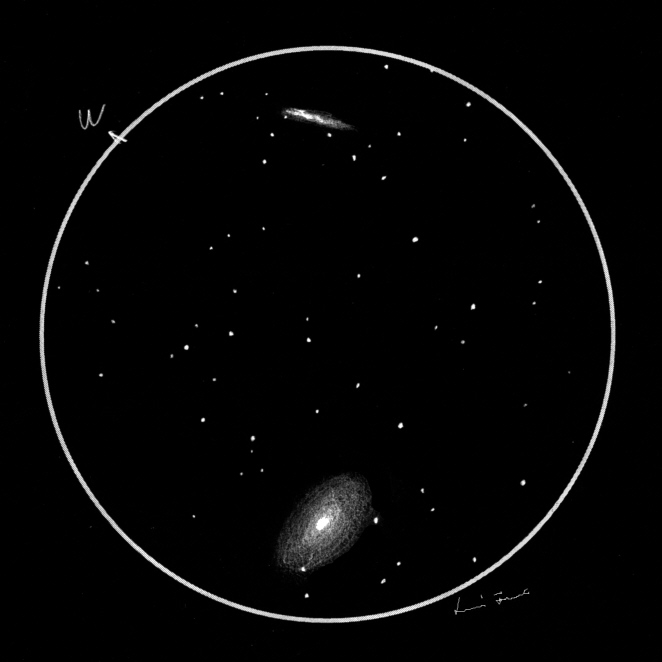
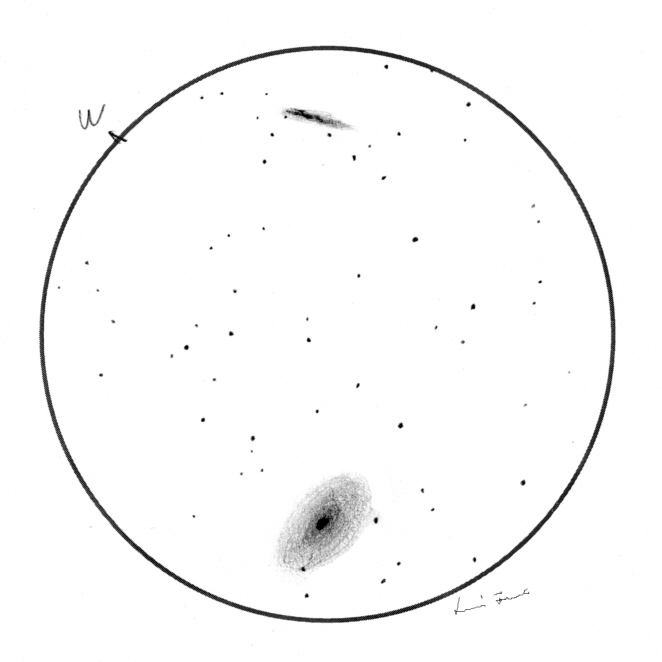
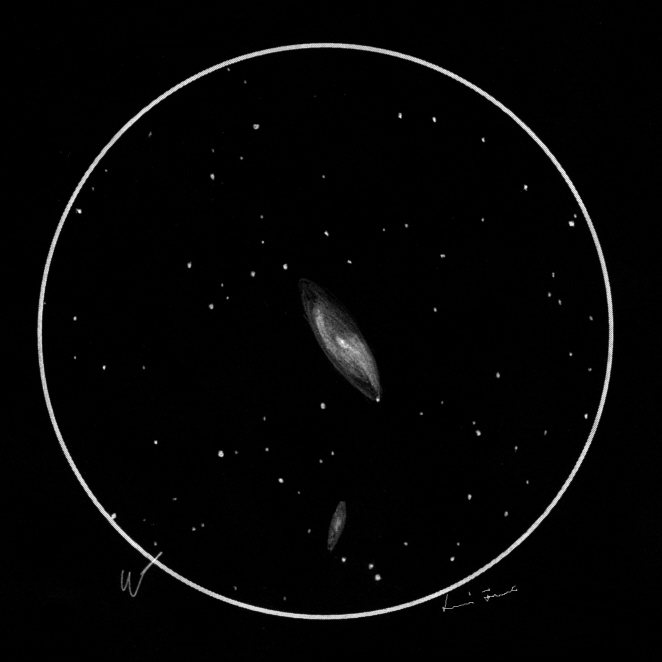
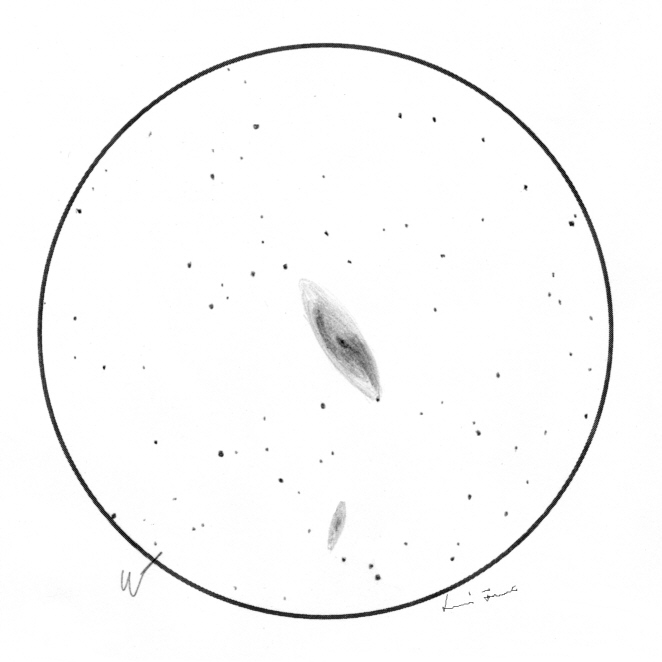
M51 + NGC 5195 (Galaxy)
|
|
Also known as: NGC 5194 + NGC 5195
|
|
Right ascension: 13h 30m
|
Declination: 47° 14'
|
|
Constellation: Canes Venatici
|
|
Date/time: 2008.04.27 21:00 UT
|
|
Equipment: 12" f/5 Newtonian
|
|
FoV: 50'
|
Magnification and filter(s): 71x
|
|
Seeing: 6/10
|
Transparency: 4/5
|
|
Location: Nádasdladány, Hungary
|
|
Observer: Ferenc Lovró
|
Description:
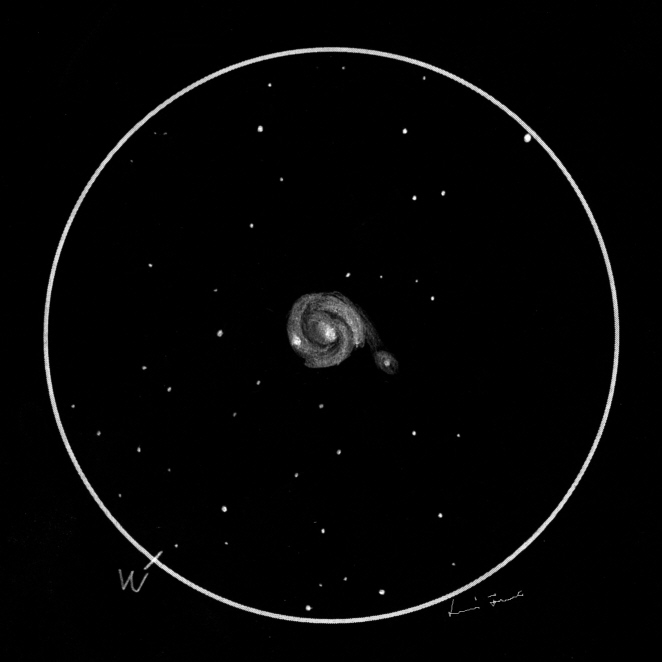
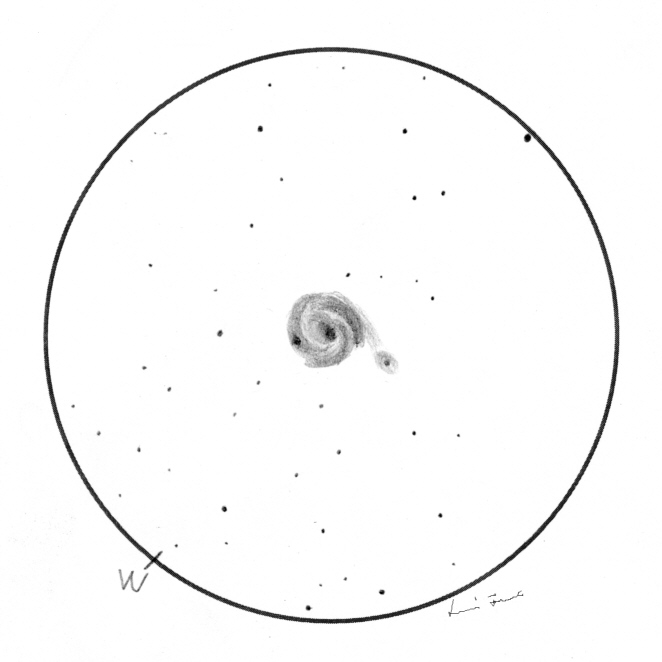
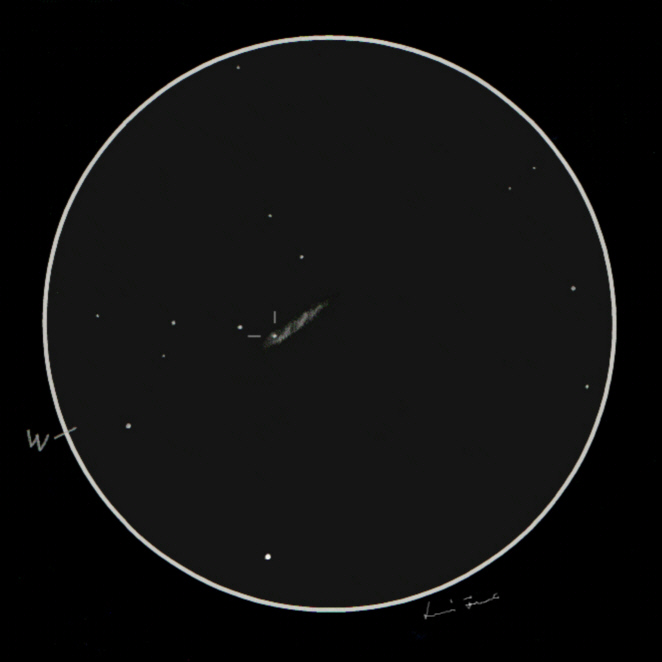
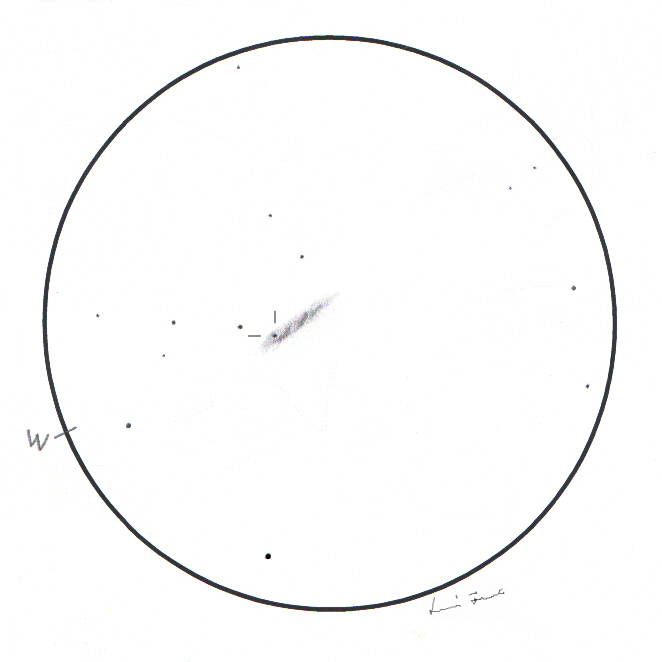
The spiral galaxy of M51, better known as the Whirlpool-galaxy is one of the most famous Messier objects. Thanks to its position and high luminosity, it's a very easy and impressive target. The spiral arms of M51 look beautiful and sharp, and with a little patience you can see even the bridge of matter between it and its interacting companion (NGC 5195), also with direct vision.
|
|
Hi-resolution image: [ reversed sketch | original sketch ]
|
|
|
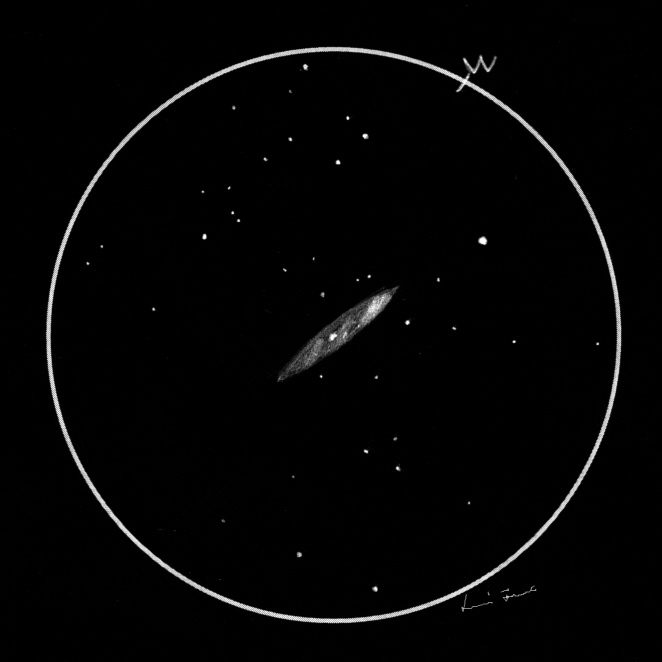
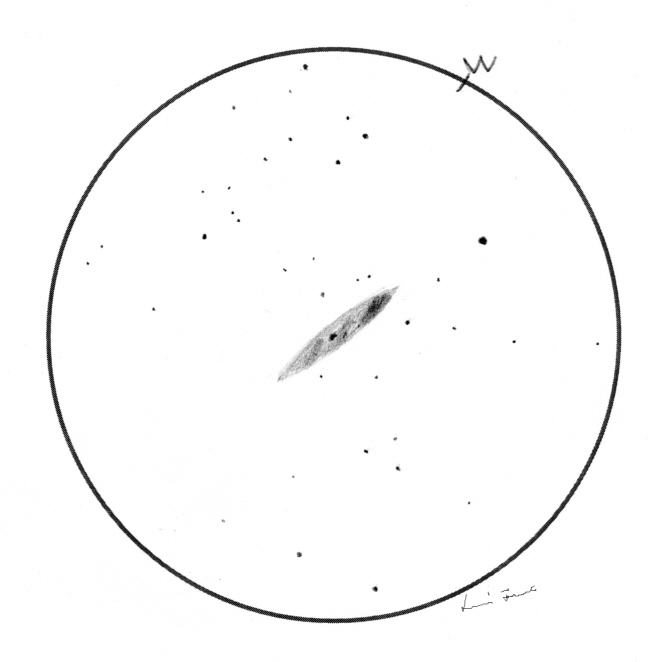
M51 + SN 2011dh (Galaxy)
|
|
Also known as: Whirlpool galaxy
|
|
Right ascension: 13h 30m
|
Declination: 47° 8'
|
|
Constellation: Ursa Major
|
|
Date/time: 2011.06.21 21:30 UT
|
|
Equipment: 12" f/5 Newtonian
|
|
FoV: 25'
|
Magnification and filter(s): 167x
|
|
Seeing: 6/10
|
Transparency: 3/5
|
|
Location: Nádasdladány, Hungary
|
|
Observer: Ferenc Lovró
|
Description:
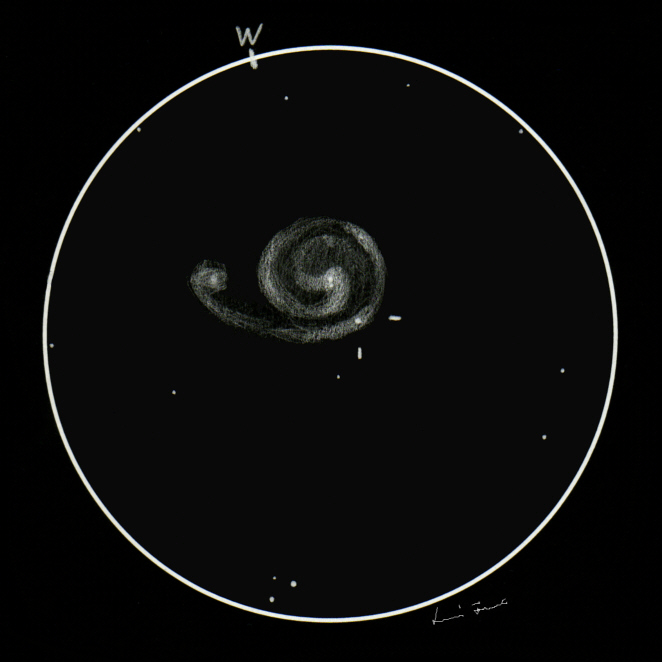
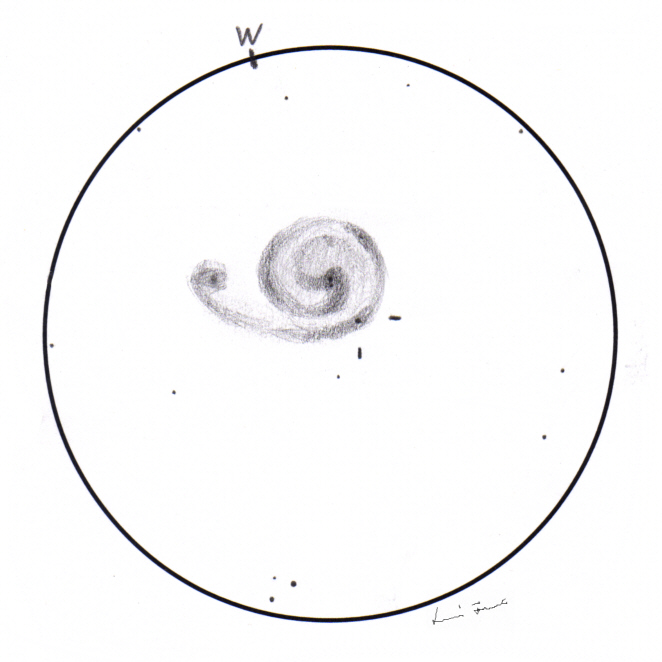
Today was the Summer solstice, so it's not surprising that even at 11pm the Western horizon is still shining in bluish colour, however at East the hazy patch of the Summer Milkyway is already easily noticeable. The spiral structure of the M51 is readily visible at 71x, surprisingly easy and so is the supernova SN2011dh, which I estimate to be at 12.3m and is located in the middle of a large outer spiral arm towards ESE from the galactic core. At such a high brightness this supernova is possibly one of the brightest for this year, at a very easy position for Northern hemisphere observers also with much smaller scopes.
|
|
Hi-resolution image: [ reversed sketch | original sketch ]
|
|
M52 + OCL261 (Nyílthalmaz) 
|
|
Egyéb elnevezés: NGC 7654 + Czernik 43 (Cz 43)
|
|
Rektaszcenzió: 23h 24m
|
Deklináció: 61° 35'
|
|
Csillagkép: Cassiopeia
|
|
Dátum/idő: 2008.01.24 18:00 UT
|
|
Műszer: 300/1500 Newton
|
|
Látómező: 40'
|
Nagyítás és szűrő(k): 71x
|
|
Nyugodtság: 5/10
|
Átlátszóság: 3/5
|
|
Helyszín: Nádasdladány, Magyarország
|
|
Észlelő: Ferenc Lovró
|
Leírás:
Könnyű megtalálni ezt a két csillaghalmazt a Kassziopeia csillagkép közelében. A Messier 52 nagyon nagy nyílthalmaz, határai jól definiáltak, átmérője legalább 20'. Egy nagyon fényes csillag meghatározó eleme a halmaznak, egyébként csillagokban gazdag objektum, de ezek jelentősen halványabbak fényes társuknál. Az M52-től keletre látható az OCL261 nyílthalmaz (más néven Czernik 43), tucatnyi halvány csillag alkotja.
|
|
Nagyfelbontású képek: [ inverz rajz | eredeti rajz ]
|
M52 + OCL261 (Open cluster) 
|
|
Also known as: NGC 7654 + Czernik 43 (Cz 43)
|
|
Right ascension: 23h 24m
|
Declination: 61° 35'
|
|
Constellation: Cassiopeia
|
|
Date/time: 2008.01.24 18:00 UT
|
|
Equipment: 12" f/5 Newtonian
|
|
FoV: 40'
|
Magnification and filter(s): 71x
|
|
Seeing: 5/10
|
Transparency: 3/5
|
|
Location: Nádasdladány, Hungary
|
|
Observer: Ferenc Lovró
|
Description:
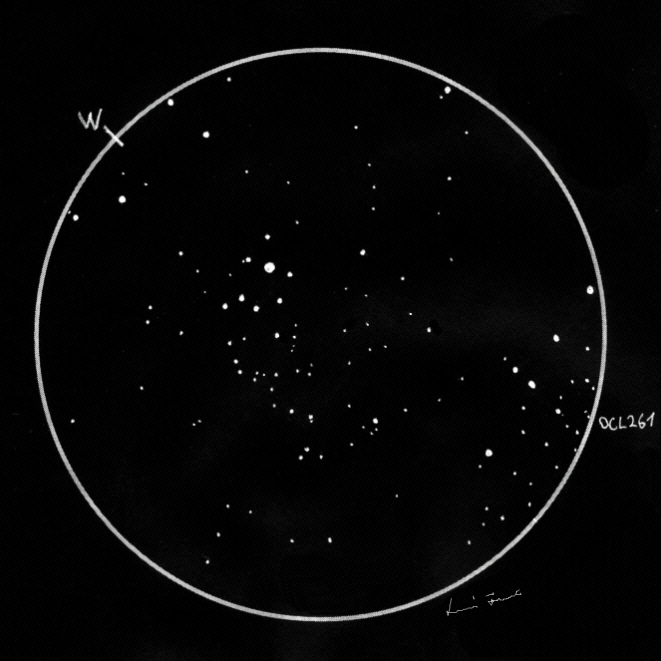
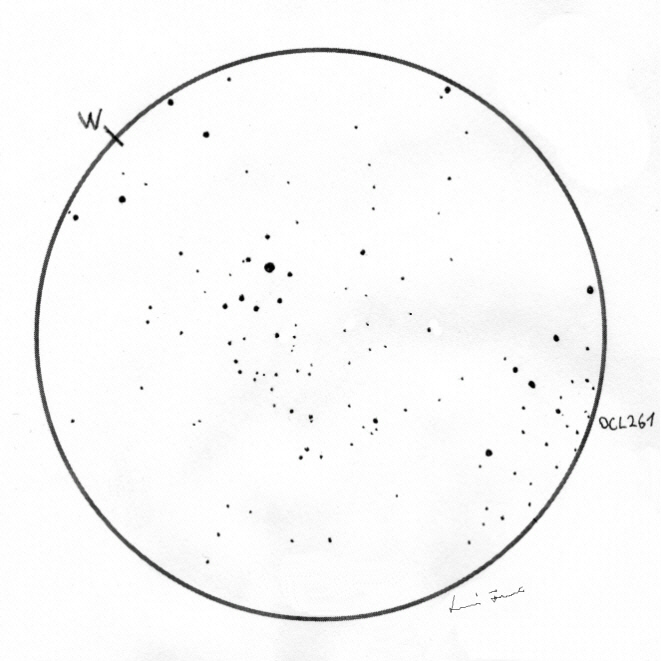
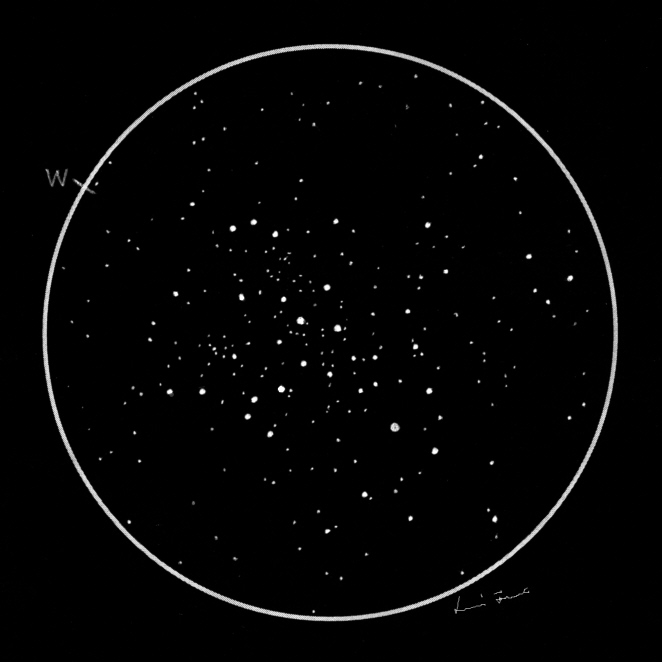
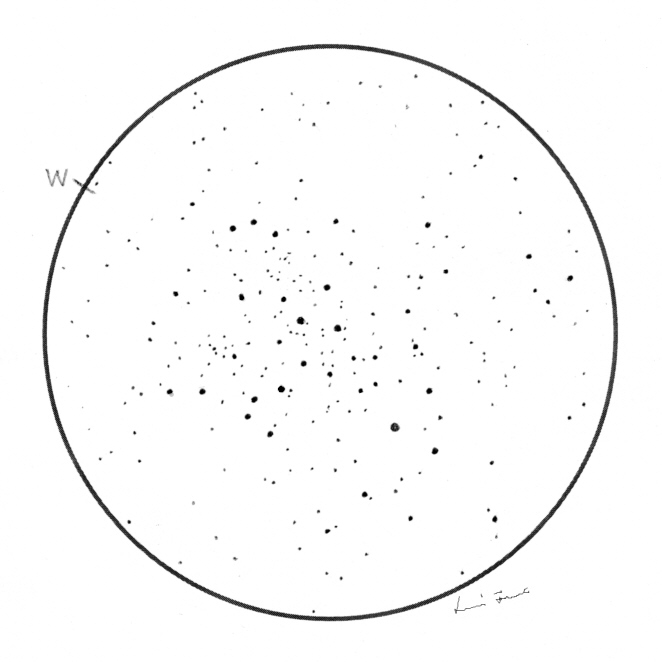
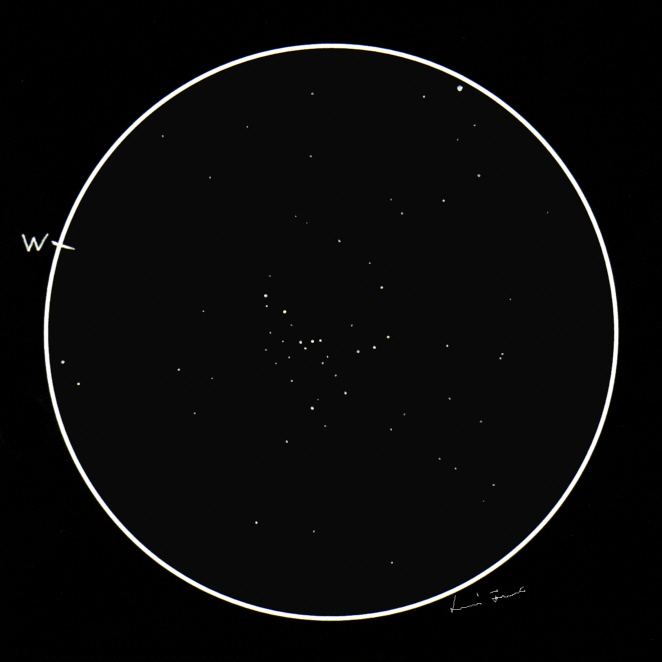
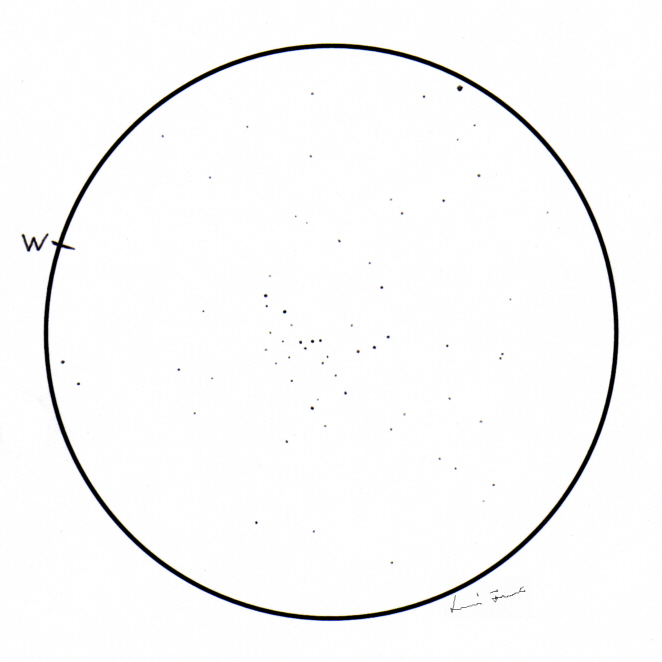
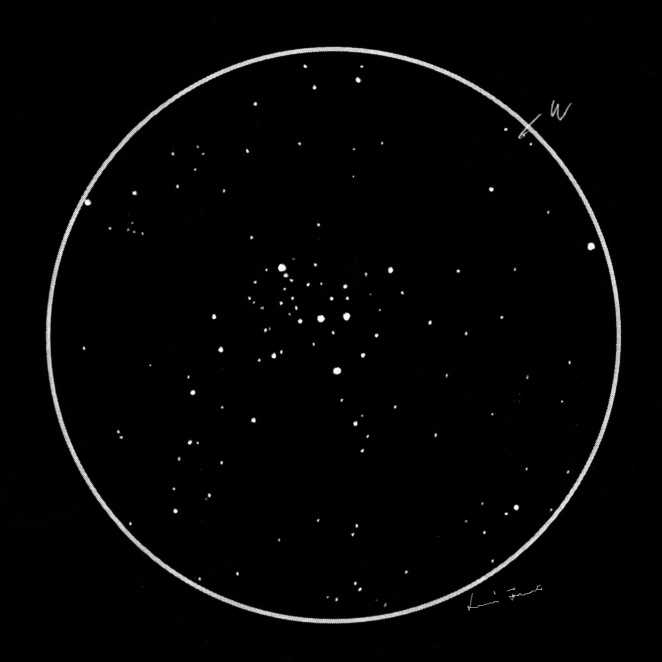
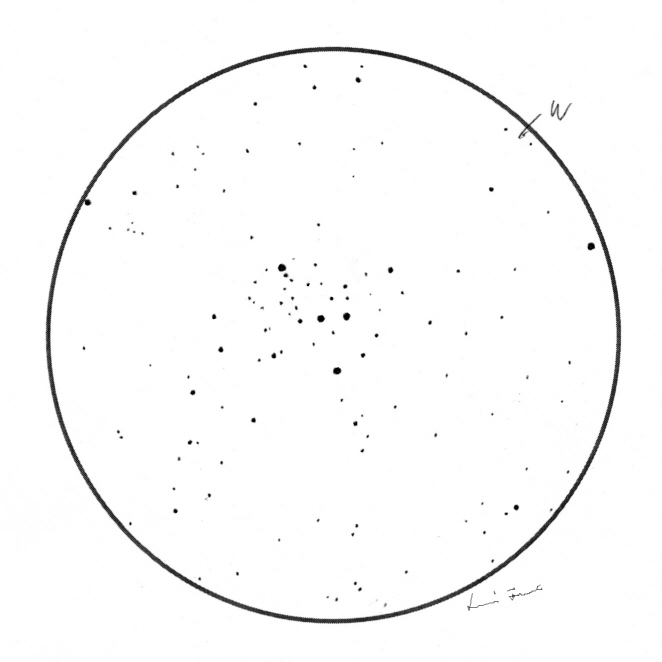
These two star clusters can be found easily nearby the constellation Cassiopeia. The Messier object M52 is a quite large open cluster with clearly identifiable boundaries and has a diameter of at least 20'. Its image is determined by a very bright star, however the cluster itself looks quite rich, even though the brightness of other stars is not even close to their brightest companion. To the east from M52, behind a wall of shiny stars lies the open cluster OCL261 (also known as Czernik 43), populated with a dozen dim stars.
|
|
Hi-resolution image: [ reversed sketch | original sketch ]
|
|
|
M53 (Globular cluster)
|
|
Also known as: NGC 5024
|
|
Right ascension: 13h 13m
|
Declination: 18° 10'
|
|
Constellation: Coma Berenices
|
|
Date/time: 2008.03.31 21:00 UT
|
|
Equipment: 12" f/5 Newtonian
|
|
FoV: 20'
|
Magnification and filter(s): 167x
|
|
Seeing: 6/10
|
Transparency: 4/5
|
|
Location: Nádasdladány, Hungary
|
|
Observer: Ferenc Lovró
|
Description:
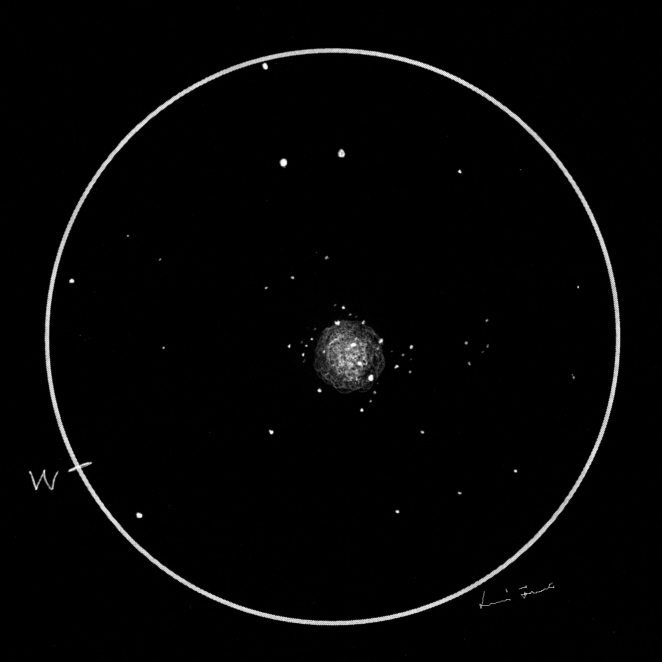
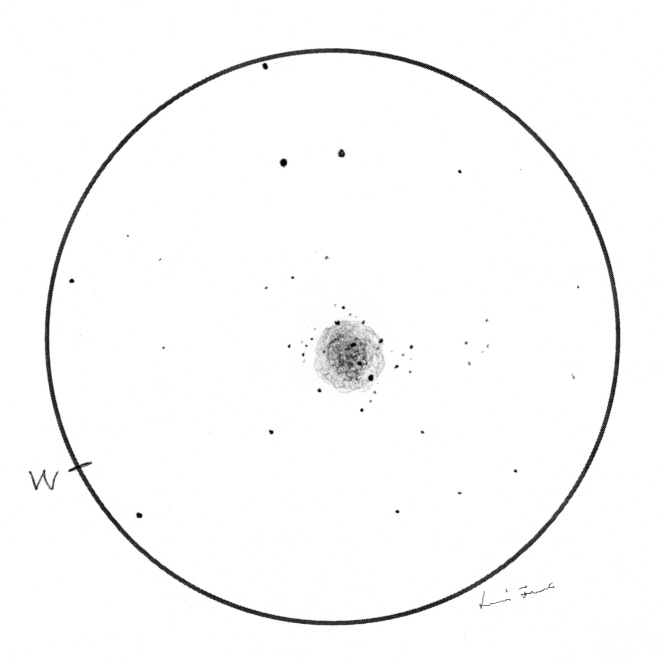
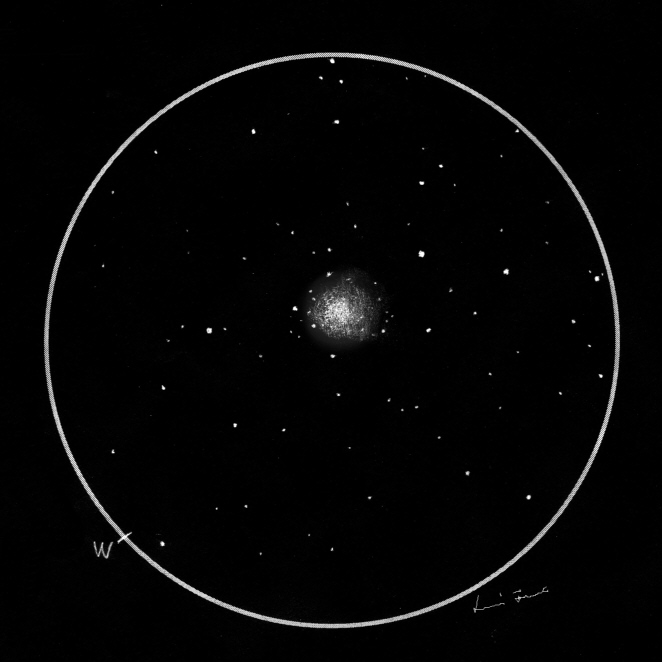
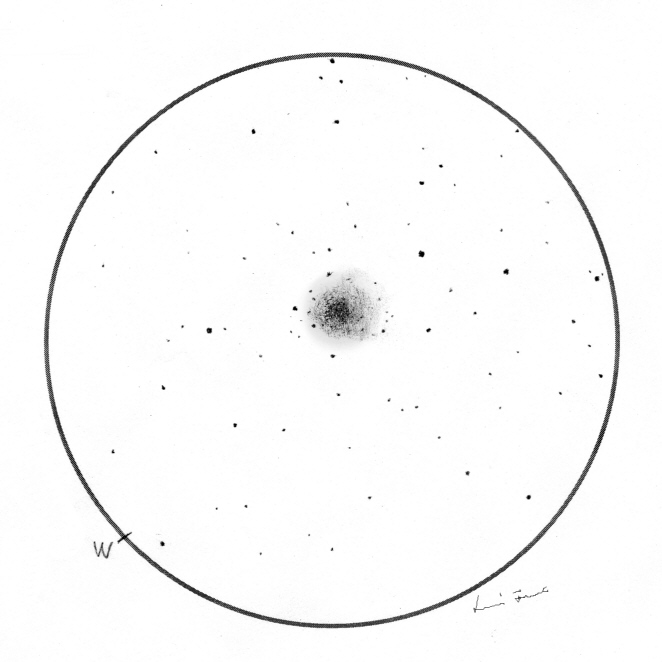
This globular cluster is really breathtaking. More than a dozen of stars can be separated also with direct vision. By using averted vision, this number jumps to several dozens. It is not really getting denser towards the centre, although what we see is actually the core already: the real diametre of the cluster is actually 21', yet the half of its gross weight stays inside a circle of 1.1'.
|
|
Hi-resolution image: [ reversed sketch | original sketch ]
|
|
|
M57 (Planetáris köd)
|
|
Egyéb elnevezés: Gyűrűsköd, NGC 6720
|
|
Rektaszcenzió: 18h 54m
|
Deklináció: 33° 2'
|
|
Csillagkép: Lyra
|
|
Dátum/idő: 2008.06.10 21:30 UT
|
|
Műszer: 300/1500 Newton
|
|
Látómező: 14'
|
Nagyítás és szűrő(k): 250x
|
|
Nyugodtság: 7/10
|
Átlátszóság: 4/5
|
|
Helyszín: Nádasdladány, Magyarország
|
|
Észlelő: Ferenc Lovró
|
Leírás:
A Lant csillagkép híres Gyűrűsköde még azok számára is jól ismert objektum, akik kevésbé megszállottjai a csillagászatnak. Érdekessége, hogy a vizuális felületi fényessége nagyjából fél magnitúdóval magasabb, mint a fotografikus a spektrumát felépítő elemeknek köszönhetően, így bármekkora méretű távcsővel érdemes vetni rá egy pillantást. Pozíciója nagyon könnyű: nem lehet eltéveszteni, nagyjából félúton található a béta és gamma Lyrae között. Központi csillaga (14.7m) számomra alig érzékelhető, még elfordított látással sem mondanám biztosra, hogy láttam. Valószínűleg mégsötétebb égre lett volna szükségem. UHC szűrő nem sokat javít a látványon, ellenben a nagy nagyítás szükséges, ha részleteket is szeretnénk látni.
|
|
Nagyfelbontású képek: [ inverz rajz | eredeti rajz ]
|
|
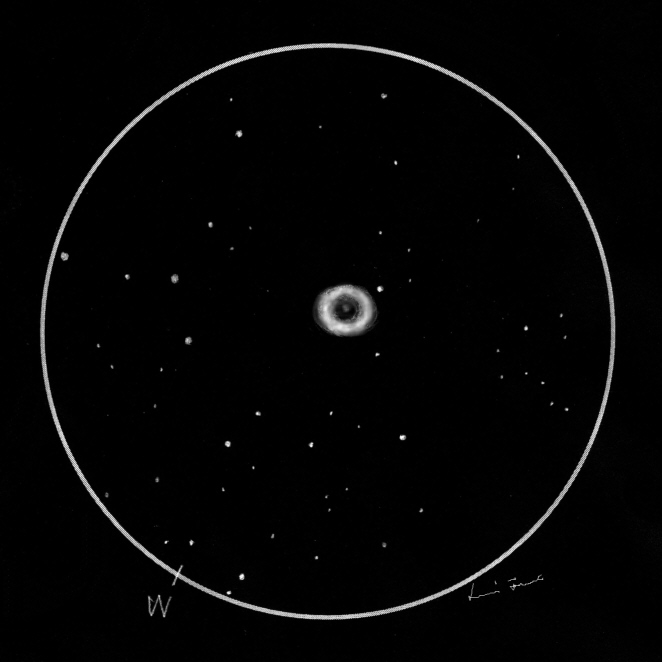
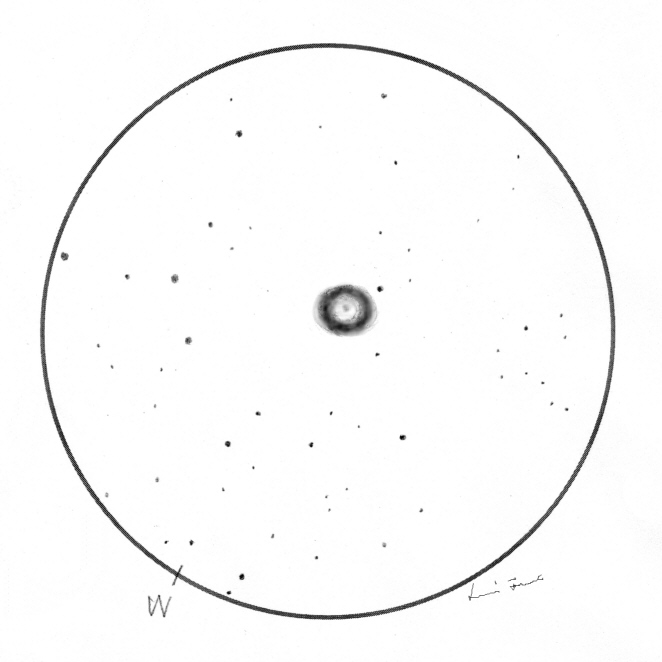
M57 (Planetary nebula)
|
|
Also known as: Ring nebula, NGC 6720
|
|
Right ascension: 18h 54m
|
Declination: 33° 2'
|
|
Constellation: Lyra
|
|
Date/time: 2008.06.10 21:30 UT
|
|
Equipment: 12" f/5 Newtonian
|
|
FoV: 14'
|
Magnification and filter(s): 250x
|
|
Seeing: 7/10
|
Transparency: 4/5
|
|
Location: Nádasdladány, Hungary
|
|
Observer: Ferenc Lovró
|
Description:
The famous Ring nebula of the Lyra constellation is well-known even for people less obsessed with astronomy. An interesting fact is that its visual surface brightness is about half magnitude better than its photographic surface brightness thanks to the elements that build up its spectra, therefore it's worth taking a look of this shiny planetary nebula with any kind of telescope. Its position is very easy: you can hardly miss it on the line connecting the stars beta and gamma Lyrae. Its central star (14.7m) was barely detectable for me if at all, even with averted vision. I think it demands darker skies. The UHC filter did not help much on the view, but large magnification is really neccessary.
|
|
Hi-resolution image: [ reversed sketch | original sketch ]
|
|
|
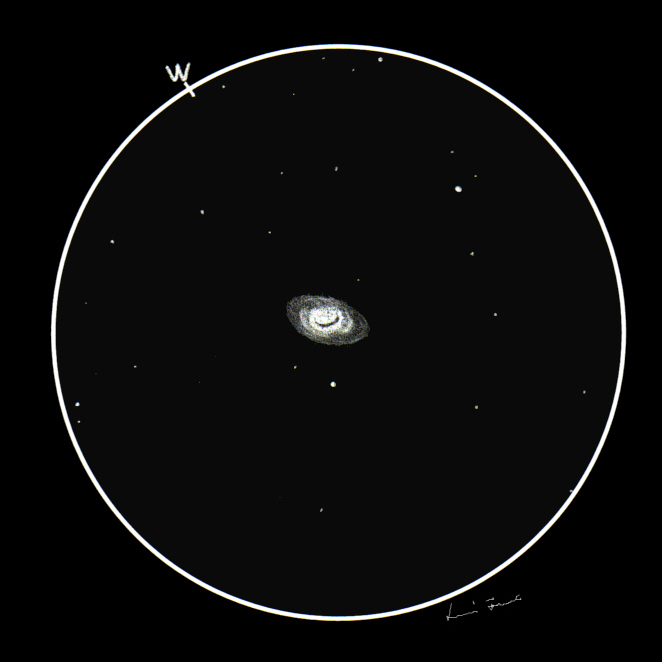
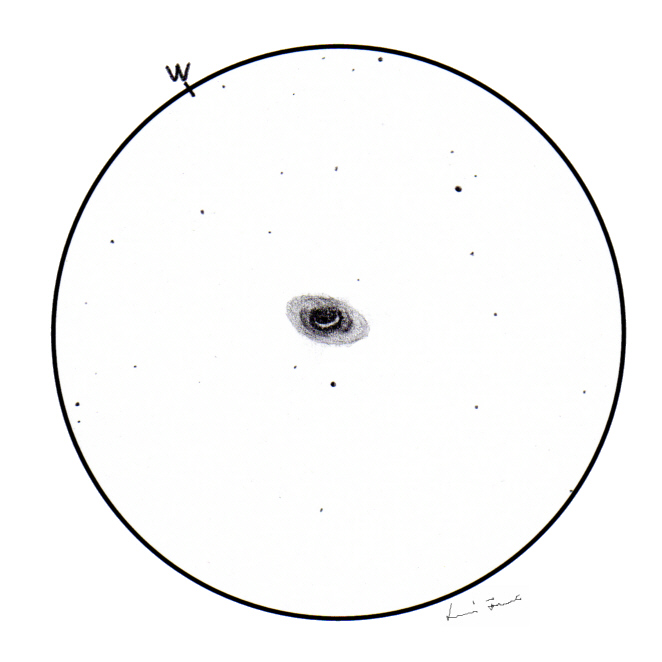
M64 (Galaxy)
|
|
Also known as: Black Eye Galaxy
|
|
Right ascension: 12h 57m
|
Declination: 21° 37'
|
|
Constellation: Coma Berenices
|
|
Date/time: 2012.04.26 23:00 UT
|
|
Equipment: 12" f/5 Newtonian
|
|
FoV: 36'
|
Magnification and filter(s): 100x
|
|
Seeing: 4/10
|
Transparency: 3/5
|
|
Location: Nádasdladány, Hungary
|
|
Observer: Ferenc Lovró
|
Description:
The well known M64 or Black Eye Galaxy (sometimes mentioned as Black Eye Nebula) is a fine specimen of large and bright Messier galaxies (although Charles Messier didn't know what galaxies were). It has a tiny star-like central core with a noticeable bulge around it, and a thin dark patch of dust lane to the NE of the core. This feature is not easily visible. On the major axis of the ellipse I can detect signs of spiral arms on both sides of the core.
SQM reading: 21.44 m/arcsec2, 6°C, light wind.
|
|
Hi-resolution image: [ reversed sketch | original sketch ]
|
|
|
M65 + M66 + NGC 3628 (Galaxy)
|
|
Also known as: Leo trio, NGC 3623 + NGC 3627 + NGC 3628
|
|
Right ascension: 11h 19m
|
Declination: 13° 15'
|
|
Constellation: Leo
|
|
Date/time: 2008.03.31 20:30 UT
|
|
Equipment: 12" f/5 Newtonian
|
|
FoV: 50'
|
Magnification and filter(s): 45x
|
|
Seeing: 6/10
|
Transparency: 4/5
|
|
Location: Nádasdladány, Hungary
|
|
Observer: Ferenc Lovró
|
Description:
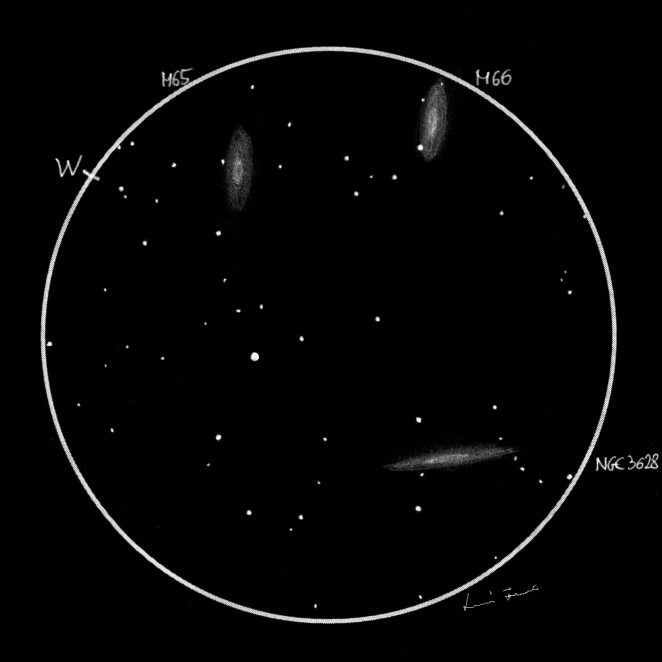
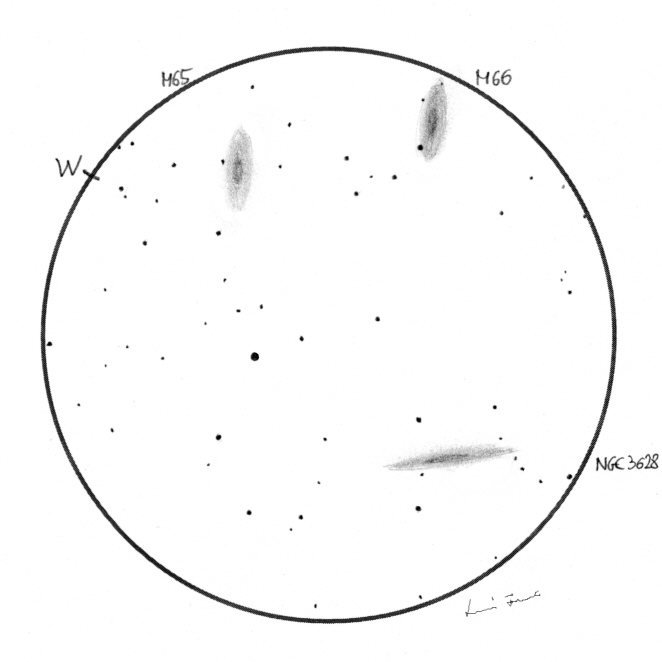
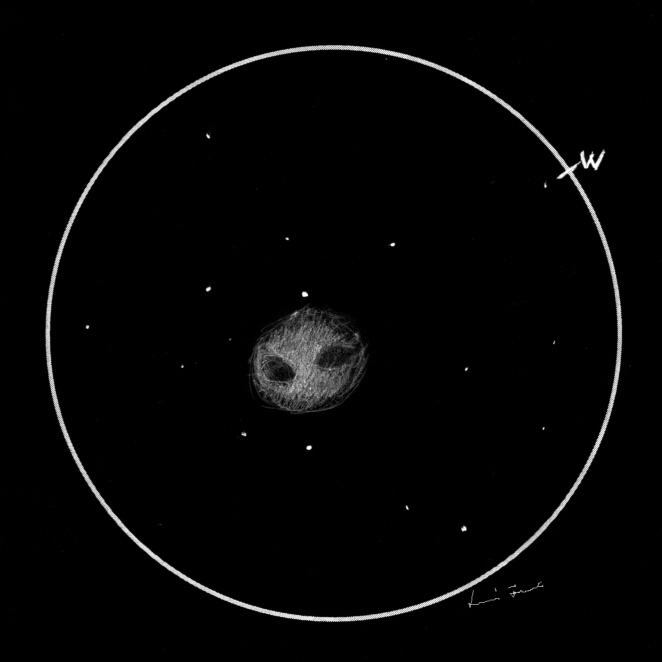
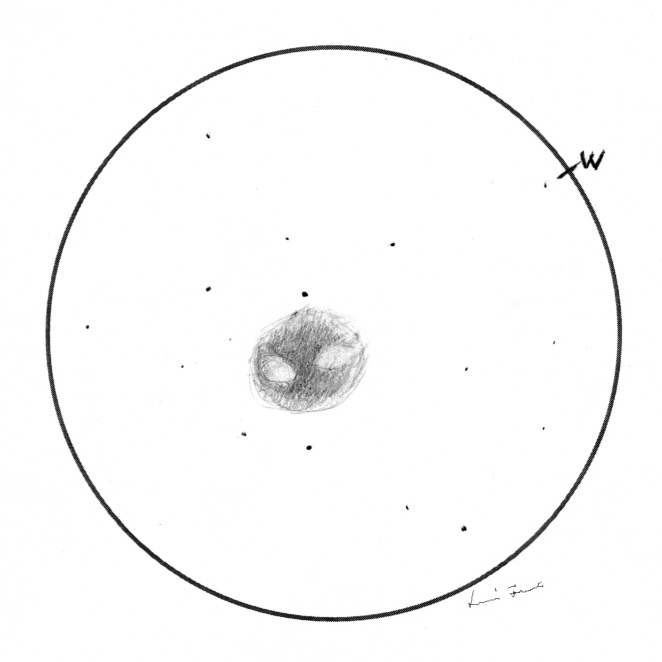
This triplet of galaxies always make me smile: I'm calling it a "dumb face" cluster. The M65-66 double is a classic, easy Messier-object: both can be well seen - perhaps the latter having a brighter, almost star-like core region. It's not clear for me why the NGC 3628 was left out of Messier's catalogue: it's not at all a difficult object either. Its brightness is quite close to that of M65 and while wandering around looking for its more famous companions, you may most probably bump into this one also.
|
|
Hi-resolution image: [ reversed sketch | original sketch ]
|
|
|
M67 (Nyílthalmaz)
|
|
Egyéb elnevezés: NGC 2862
|
|
Rektaszcenzió: 8h 50m
|
Deklináció: 11° 49'
|
|
Csillagkép: Cancer
|
|
Dátum/idő: 2008.03.30 21:30 UT
|
|
Műszer: 300/1500 Newton
|
|
Látómező: 24'
|
Nagyítás és szűrő(k): 71x
|
|
Nyugodtság: 7/10
|
Átlátszóság: 4/5
|
|
Helyszín: Nádasdladány, Magyarország
|
|
Észlelő: Ferenc Lovró
|
Leírás:
A Rák csillagkép második legnagyobb halmaza az M44 (Jászol halmaz) után. Híresebb társához hasonlóan ez is észlelhető szabadszemmel átlagnál kicsit jobb égen. 71x nagyítás mellett a látómező felét kitölti. Megtalálása könnyű, már a 8x50-es keresőtávcső is fényes elmosódott foltként mutatja. Az M67 egy szép, sűrű nyílthalmaz, tagjainak fényessége nagyon változatos: nagyjából tucatnyi 12 magnitúdó körüli csillag dominálja, de a háttérben sok 13-14 magnitúdós csillag könnyen észrevehető. A teljes általam látható csillagpopuláció legalább száz tagból állt, de az objektum háttere erősen diffúz, így feltételezésem szerint még nagy számú halványabb csillagnak kell a háttérben rejtőznie.
|
|
Nagyfelbontású képek: [ inverz rajz | eredeti rajz ]
|
|
M67 (Open cluster)
|
|
Also known as: NGC 2862
|
|
Right ascension: 8h 50m
|
Declination: 11° 49'
|
|
Constellation: Cancer
|
|
Date/time: 2008.03.30 21:30 UT
|
|
Equipment: 12" f/5 Newtonian
|
|
FoV: 24'
|
Magnification and filter(s): 71x
|
|
Seeing: 7/10
|
Transparency: 4/5
|
|
Location: Nádasdladány, Hungary
|
|
Observer: Ferenc Lovró
|
Description:
The second largest open cluster of the constellation Cancer, right after the M44, which can also be seen with naked-eyes even under suburban skies. On a power of 71x, it fills the neary half degree field of vision. It was easily found: even the 8x50 finderscope displays it as a shiny little blur. The M67 is a nice, dense open cluster, with a members of high variety of brightness: there are about a dozen dominant stars of the 12th magnitude, but in the backround you can easily detect stars of 13-14m. The entire population visible to me were at least 100 stars, however the background looks really diffuse, so I assume there must be plenty of even dimmer stars in this cluster.
|
|
Hi-resolution image: [ reversed sketch | original sketch ]
|
|
|
M81 + M82 (Galaxy)
|
|
Also known as: NGC 3031 + NGC 3034
|
|
Right ascension: 9h 56m
|
Declination: 69° 20'
|
|
Constellation: Ursa Major
|
|
Date/time: 2008.03.30 23:00 UT
|
|
Equipment: 12" f/5 Newtonian
|
|
FoV: 52'
|
Magnification and filter(s): 45x
|
|
Seeing: 5/10
|
Transparency: 3/5
|
|
Location: Nádasdladány, Hungary
|
|
Observer: Ferenc Lovró
|
Description:
The famous double galaxy of Ursa Maior is an easy target with any kind of telescope. The brighter M81 spiralgalaxy can be detected even in the finderscope. Its smaller and fainter companion, the irregular M82 is interesting especially when looking at larger magnification levels, with several clearly detectable dense areas. Looks best when having a FoV of at least 1°, as in that case both of the galaxies can be fit into one picture. The nearby NGC 3077 is also worth a look, although it's even smaller and fainter than the M82.
|
|
Hi-resolution image: [ reversed sketch | original sketch ]
|
|
|
M82 (Galaxy)
|
|
Also known as: Cigar galaxy
|
|
Right ascension: 9h 57m
|
Declination: 69° 38'
|
|
Constellation: Ursa Major
|
|
Date/time: 2011.05.26 23:00 UT
|
|
Equipment: 12" f/5 Newtonian
|
|
FoV: 11'
|
Magnification and filter(s): 300x
|
|
Seeing: 9/10
|
Transparency: 4/5
|
|
Location: Nádasdladány, Hungary
|
|
Observer: Ferenc Lovró
|
Description:
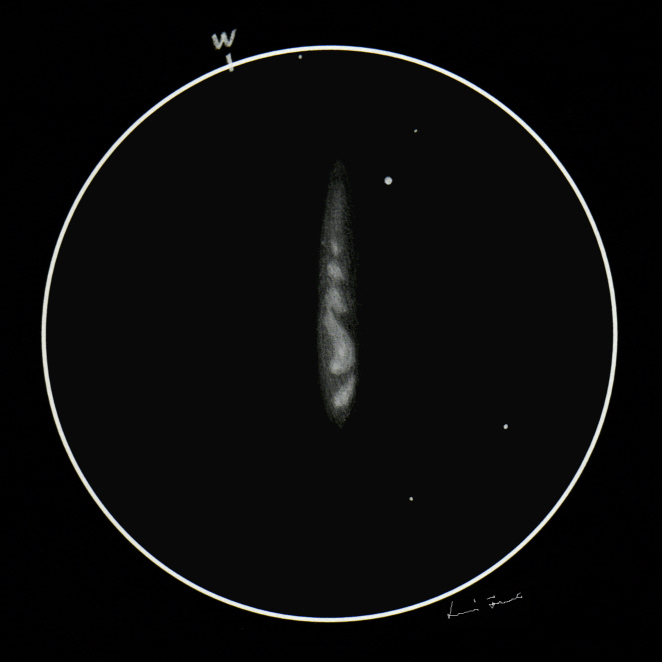
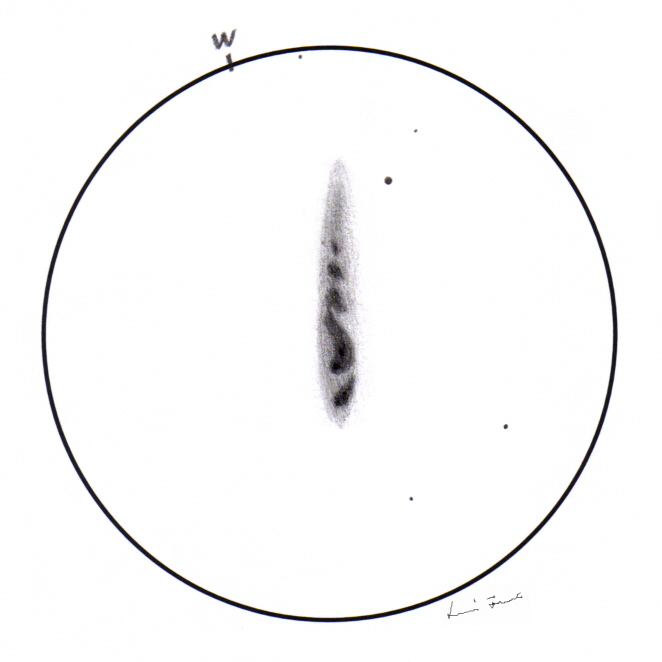
A surprisingly excellent seeing calls for a high-magnification study. As Saturn is just below my horizon, I decide to pick a rather complicated structure: the irregular Cigar galaxy of the UMa constellation. Thanks to the 300x power, the FoV is coal black, the galaxy is so bright that it actually ruins my dark adaptation, faint stars sparkling at the edge of averted vision visibility. Too bad, that the galaxy itself is located on a rather light polluted part of my sky, but it still shows plenty of structures. During the observation, I had my second magneto-acoustic meteor experience in my life: this is the phenomenon when you actually hear a swishing or crackling sound at the same time the meteor flares in the atmosphere. The common part in both cases were that I was standing VERY close to a wire mesh fence, and a <0 mag meteor in the zenith, with a definite ionized tail.
|
|
Hi-resolution image: [ reversed sketch | original sketch ]
|
|
|
M82 + SN 2014J (Galaxy)
|
|
Also known as: Cigar galaxy
|
|
Right ascension: h m
|
Declination: ° '
|
|
Constellation: Ursa Major
|
|
Date/time: 2014.01.23 17:30 UT
|
|
Equipment: 12" f/5 Newtonian
|
|
FoV: '
|
Magnification and filter(s): 167xx
|
|
Seeing: 3/10
|
Transparency: 2/5
|
|
SQM: 19.94 m/as2
|
|
Humidity: moderate
|
Wind: breeze
|
|
Sight: 4 - lots of details, very interesting, unique look
|
|
Difficulty: 2 - easily visible, some dark adaptation needed, averted vision might add to details
|
|
Position: 2 - easy, bright star nearby
|
|
Location: Nádasdladány, Hungary
|
|
Observer: Ferenc Lovró
|
Description:
On 2014.01.22 Fossey et al. discovered this possible supernova in the famous M82 irregular galaxy. Surprisingly the discovery were made at a visual magnitude of about 11.7m, which is quite bright, and especially weird that in such a well-known galaxy a supernova can remain undiscovered for so long (days actually, within the range of a 12" telescope visually). I believe that the reason might be that on long exposure photographs the SN is not so different than the little bright knots in the GX, and probably many algorithms missed identifying the exploded star.
So, despite the fact that the satellite images shown 100% cloud coverage, I decided to believe to my own eyes and not satellites, and went out to check the sky condition. To my surprise, the sky was clear! There was a nice little hole in the clouds above me, hooray!
Although the GX was in a bad position for me - just half a degree above our roof, and right in the middle of the light pollution of a nearby lamp and the smoke out of our chimney - I could catch both the GX and its SN very easily. I've estimated the SN at a visual magniture of 11.4m, which is about 0.1-0.2m lower than actual measured brightness around that time.
The conclusion behind this supernova is that there is still a good chance to beat robots and algorithms and discover a supernova visually! Just imagine how many observers around the globe have seen this supernova without realizing that they have discovered something new.
|
|
Hi-resolution image: [ reversed sketch | original sketch ]
|
|
|
NGC 4459 + NGC 4477 + NGC 4479 + NGC 4473 + NGC 4458 + NGC 4461 + NGC 4435 + NGC 4438 (Galaxy)
|
|
Also known as: Markarian's Chain
|
|
Right ascension: 12h 28m
|
Declination: 13° 1'
|
|
Constellation: Virgo
|
|
Date/time: 2012.04.25 22:00 UT
|
|
Equipment: 12" f/5 Newtonian
|
|
FoV: '
|
Magnification and filter(s): 71x
|
|
Seeing: 6/10
|
Transparency: 4/5
|
|
Location: Nádasdladány, Hungary
|
|
Observer: Ferenc Lovró
|
Description:
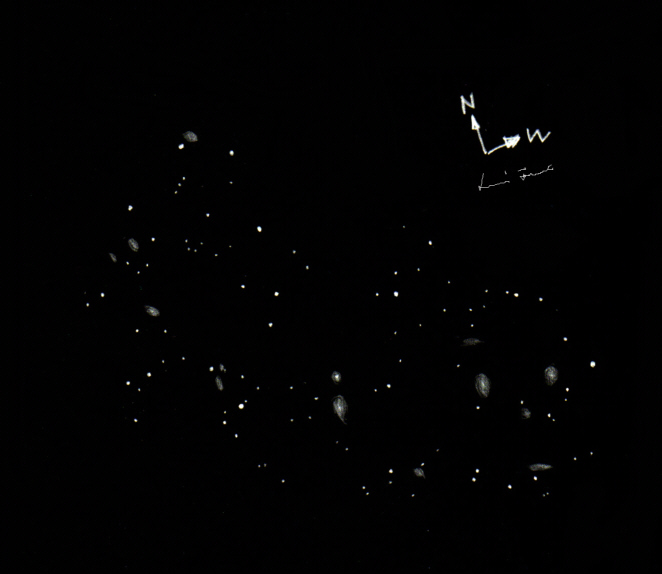
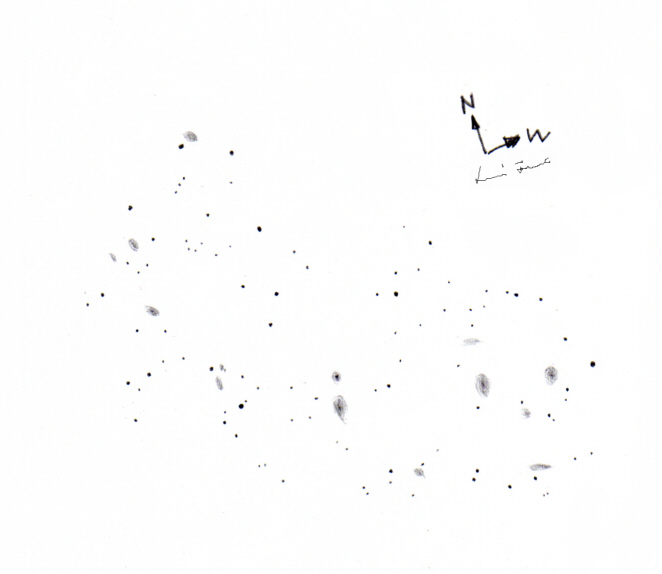
Almost all members of this spectacular cluster of galaxies is fairly bright, except maybe for NGC 4479 and NGC 4402. The Messier galaxies are especially bright: M84 and M86. The galaxy NGC 4435 has a star-like core and NGC 4438 is remarkably peculiar shaped. The image is a mosaic of multiple FoV's, with a total coverage of about 1x1.5 degrees. The galaxies from left to right are: NGC 4479, NGC 4477, NGC 4473, NGC 4459, NGC 4461, NGC 4458, NGC 4435, NGC 4438, NGC 4425, NGC 4402, M86, NGC 4387, NGC 4388, M84.
SQM reading: 21.32 m/arcsec2, 7°C, light wind.
|
|
Hi-resolution image: [ reversed sketch | original sketch ]
|
|
|
M92 (Globular cluster)
|
|
Also known as: NGC 6341
|
|
Right ascension: 17h 17m
|
Declination: 43° 8'
|
|
Constellation: Hercules
|
|
Date/time: 2008.05.29 21:30 UT
|
|
Equipment: 12" f/5 Newtonian
|
|
FoV: 50'
|
Magnification and filter(s): 71x
|
|
Seeing: 5/10
|
Transparency: 4/5
|
|
Location: Nádasdladány, Hungary
|
|
Observer: Ferenc Lovró
|
Description:
A rather neglected globular in Hercules. I wonder why it is treated like this compared to M13, as it is very bright and spectacular, although its visible diameter is only about half of the more famous companion. Its core area even looks brighter than that of the M13, it looks less homogeneous. It behaves fine at higher powers, at 167x it looks perfectly split.
|
|
Hi-resolution image: [ reversed sketch | original sketch ]
|
|
|
M93 (Open cluster)
|
|
Right ascension: 7h 45m
|
Declination: -2° 53'
|
|
Constellation: Puppis
|
|
Date/time: 2013.03.02 19:15 UT
|
|
Equipment: 4.5" f=8 Newtonian
|
|
FoV: 37'
|
Magnification and filter(s): 100x
|
|
Seeing: 6/10
|
Transparency: 4/5
|
|
SQM: 21.32 m/as2
|
Temperature: -4°C
|
|
Humidity: low
|
Wind: none
|
|
Sight: 2 - minor details, somewhat interesting
|
|
Difficulty: 3 - moderately visible, dark adaptation needed, averted vision might add to details
|
|
Position: 3 - moderate, some starhopping needed
|
|
Location: Lipótfa, Zselic, Hungary
|
|
Observer: Ferenc Lovró
|
Description:
Small, compact open cluster, mostly made of faint stars. If I turn off my observers torch, the FoV is full of fainter stars - not a surprise as the Milky Way creates the background for this object.
|
|
Hi-resolution image: [ reversed sketch | original sketch ]
|
|
|
M97 (Planetary nebula)
|
|
Also known as: Owl nebula, NGC 3587
|
|
Right ascension: 11h 15m
|
Declination: 55° 1'
|
|
Constellation: Ursa Major
|
|
Date/time: 2008.04.24 20:30 UT
|
|
Equipment: 12" f/5 Newtonian
|
|
FoV: 20'
|
Magnification and filter(s): 167x + UHC filter(s)
|
|
Seeing: 3/10
|
Transparency: 3/5
|
|
Location: Nádasdladány, Hungary
|
|
Observer: Ferenc Lovró
|
Description:
The M97, also known as the Owl-nebula is a very spectacular, famous planetary, in the vicinity of M108. It's a nearly regular circle, slightly elongated in E-W directions. Also on the Eastern and Western corner one can find two darker spots, the eyes of the owl. The planetary itself is quite an easy object, looks much brighter than the 11m as listed in catalogues, a homogenous shape with sharply fading edges. Discovering the eyes is a bit harder: especially the Western spot is tend to blink. Using your averted vision helps a lot to see the details. I was using my Baader UHC filter to finish this sketch, however according to my experiences a slightly better seeing helps much more than the filter.
|
|
Hi-resolution image: [ reversed sketch | original sketch ]
|
|
|
M103 (Nyílthalmaz)
|
|
Egyéb elnevezés: NGC 581
|
|
Rektaszcenzió: 1h 33m
|
Deklináció: 60° 42'
|
|
Csillagkép: Cassiopeia
|
|
Dátum/idő: 2008.02.19 20:00 UT
|
|
Műszer: 300/1500 Newton
|
|
Látómező: 27'
|
Nagyítás és szűrő(k): 71x
|
|
Nyugodtság: 6/10
|
Átlátszóság: 3/5
|
|
Helyszín: Nádasdladány, Magyarország
|
|
Észlelő: Ferenc Lovró
|
Leírás:
Közel teliholdas éjjelen, mikor a planetáris ködök és galaxisok észlelése lehetetlenné válik, a fényesebb nyílthalmazok - mint amilyen az M103 is - még mindig fényesen sziporkáznak az okulárban. A halmaz 6' átmérőjű, a Delta Cas közelében található, és különösen alacson nagyítás mellett látványos. Környezetében további érdekes halmazokat találni, mint például Trumpler 1, NGC 663 vagy az NGC 659. Ezek mindegyikét érdemes felkeresni akár gyenge égboltú észlelőhelyről is.
|
|
Nagyfelbontású képek: [ inverz rajz | eredeti rajz ]
|
|
M103 (Open cluster)
|
|
Also known as: NGC 581
|
|
Right ascension: 1h 33m
|
Declination: 60° 42'
|
|
Constellation: Cassiopeia
|
|
Date/time: 2008.02.19 20:00 UT
|
|
Equipment: 12" f/5 Newtonian
|
|
FoV: 27'
|
Magnification and filter(s): 71x
|
|
Seeing: 6/10
|
Transparency: 3/5
|
|
Location: Nádasdladány, Hungary
|
|
Observer: Ferenc Lovró
|
Description:
On a night with a near fullmoon, when planetary nebulaes and galaxies are an impossible mission, brighter open clusters such as the M103 are still sparkling vividly in the eyepiece. The OC that's 6' in diameter can be located near the Delta Cas, especially spectacular on low magnification. In its neighborhood one may find such other interesting clusters like the Trumpler 1, the NGC 663 or the NGC 659, all of which worth a look even from light-polluted places.
|
|
Hi-resolution image: [ reversed sketch | original sketch ]
|
|
|
M106 + NGC 4248 (Galaxy)
|
|
Also known as: NGC 4258 + NGC 4248
|
|
Right ascension: 12h 19m
|
Declination: 47° 18'
|
|
Constellation: Canes Venatici
|
|
Date/time: 2008.05.02 21:00 UT
|
|
Equipment: 12" f/5 Newtonian
|
|
FoV: 45'
|
Magnification and filter(s): 71x
|
|
Seeing: 4/10
|
Transparency: 4/5
|
|
Location: Nádasdladány, Hungary
|
|
Observer: Ferenc Lovró
|
Description:
Large, spectacular spiral galaxy with a gross magnitude of 8.4, two magnificent arms and a very shiny core. Elongated towards N-S, which is also the direction of the two arms. The Southern arm looks brighter, while the Northern one larger and blurred. Only a quarter degrees away you can find its easily detectable companion, the NGC 4248 (12.5m). If you can see this tiny galaxy, you should take the chance to look around the M106 in a radius of 1-2 degrees, and observe the other members of the galaxy-group named after it. Around half a dozen of the smaller galaxies are brighter than 4248, and only a couple are similar or fainter.
|
|
Hi-resolution image: [ reversed sketch | original sketch ]
|
|
|
M108 (Galaxy)
|
|
Also known as: NGC 3556
|
|
Right ascension: 11h 11m
|
Declination: 55° 40'
|
|
Constellation: Ursa Major
|
|
Date/time: 2008.04.24 21:00 UT
|
|
Equipment: 12" f/5 Newtonian
|
|
FoV: 45'
|
Magnification and filter(s): 71x
|
|
Seeing: 3/10
|
Transparency: 3/5
|
|
Location: Nádasdladány, Hungary
|
|
Observer: Ferenc Lovró
|
Description:
Shiny, elongated galaxy near the famous Owl-nebula. Its core looks almost like a star, I estimate a brightness of around 12m. More dense parts are visible, the most notable is the very shiny area towards the Western end of the galaxy.
|
|
Hi-resolution image: [ reversed sketch | original sketch ]
|
|
|
|
 gmail*com.
 [25]
[25]