|
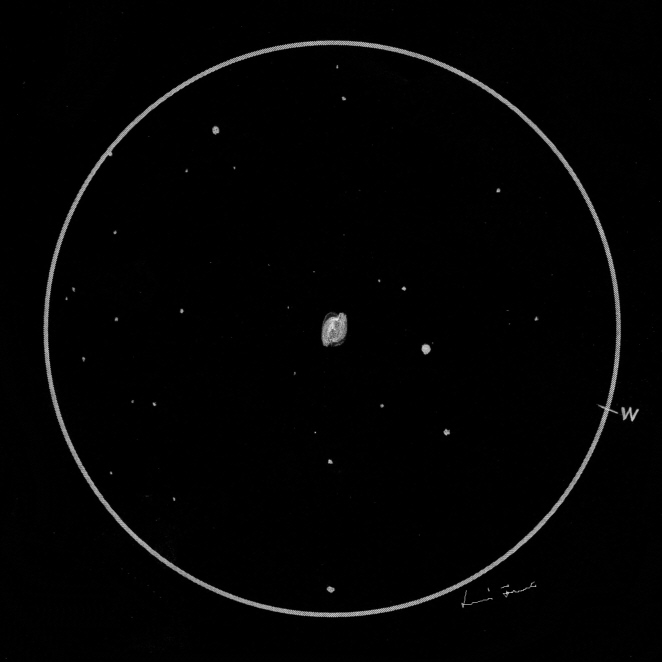
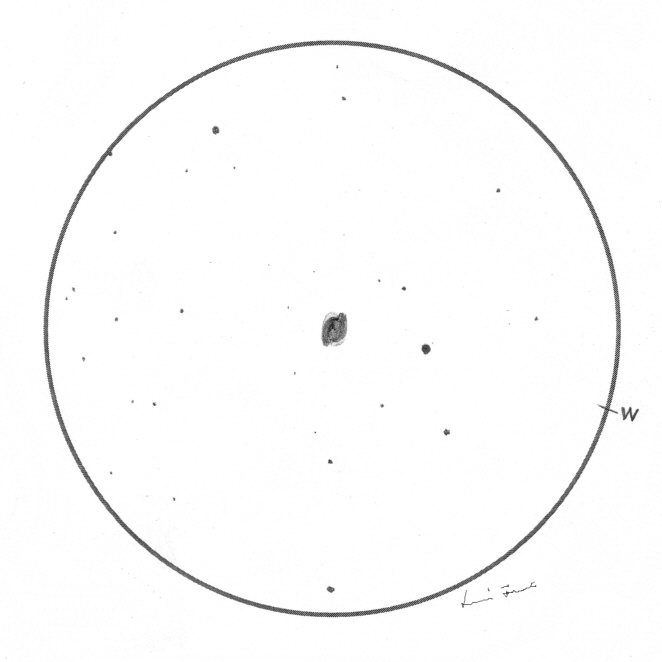
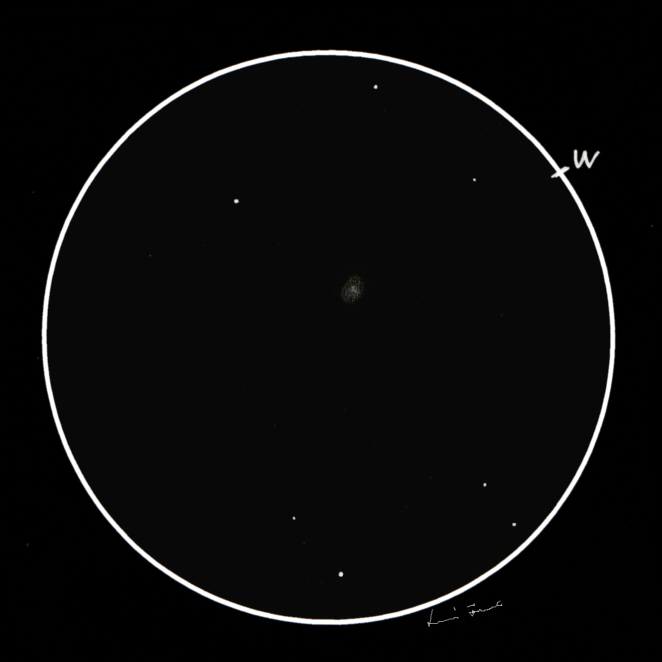
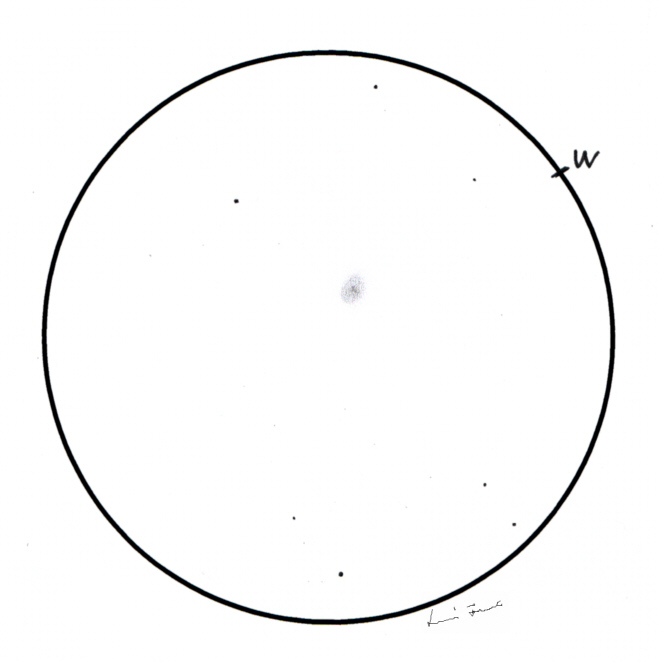
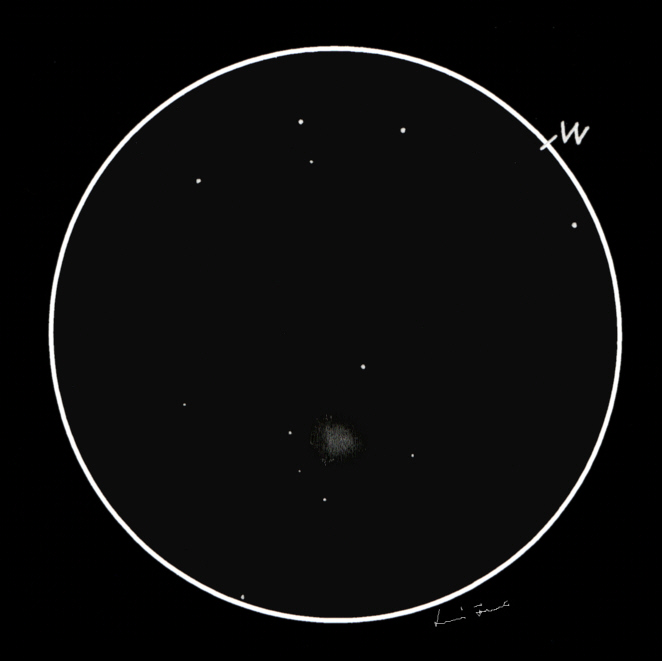
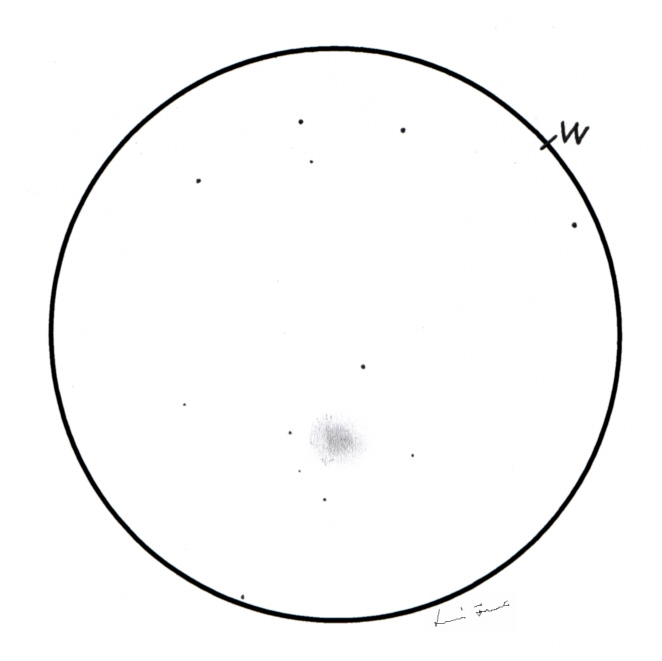
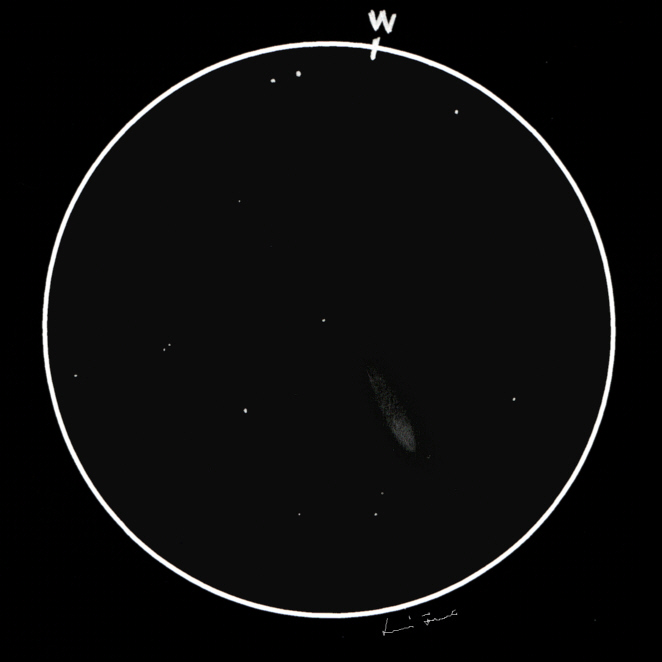
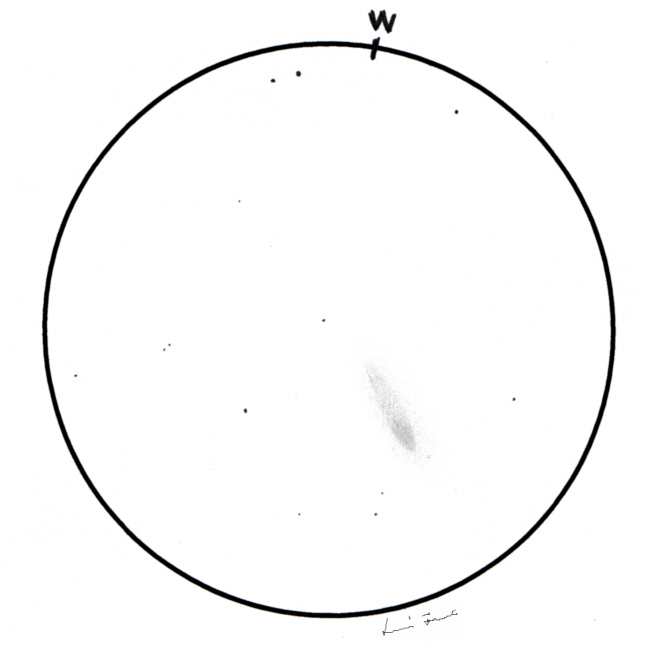
NGC 6543 (Planetary nebula)
|
|
Also known as: Cat's eye nebula
|
|
Right ascension: 17h 59m
|
Declination: 66° 38'
|
|
Constellation: Draco
|
|
Date/time: 2008.06.29 22:00 UT
|
|
Equipment: 12" f/5 Newtonian
|
|
FoV: 14'
|
Magnification and filter(s): 250x + UHC filter(s)
|
|
Seeing: 7/10
|
Transparency: 5/5
|
|
Location: Nádasdladány, Hungary
|
|
Observer: Ferenc Lovró
|
Description:
The first thing that catches your attention on this planetary nebula is its marvellous sea blue colour. After that you may notice its asymmetric shape, which is just like two halves of nut sticked together, slided a bit apart. With the UHC filter on the view is even more spectacular: many additional faint details appear around the planetary, and it also appears slightly larger than without it. It demands for a very calm, stable atmosphere. The oval planetary has a longer axle on the N-S direction.
|
|
Hi-resolution image: [ reversed sketch | original sketch ]
|
|
|
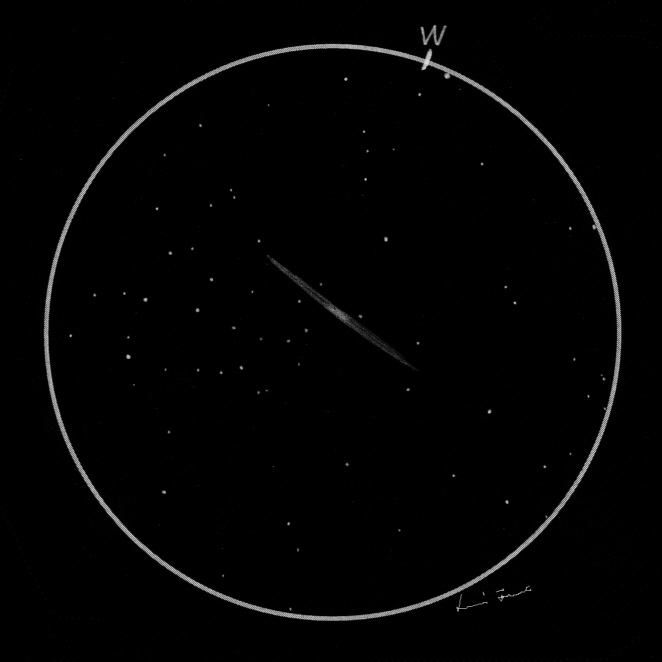
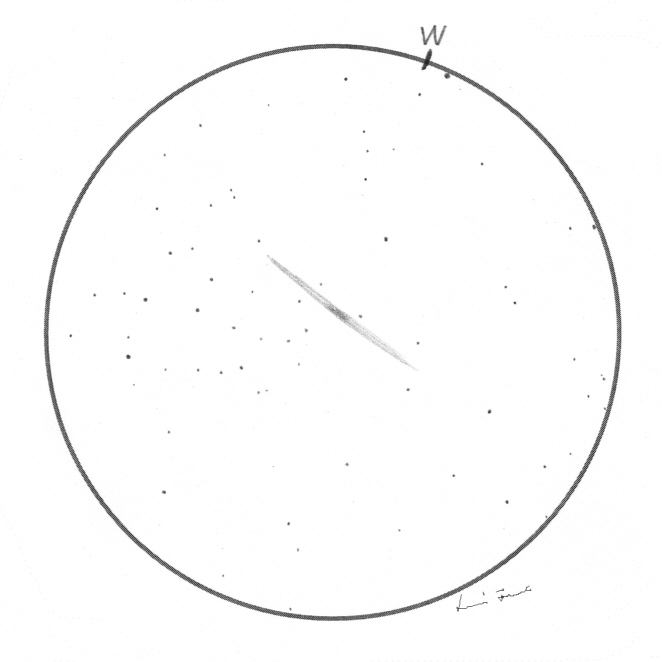
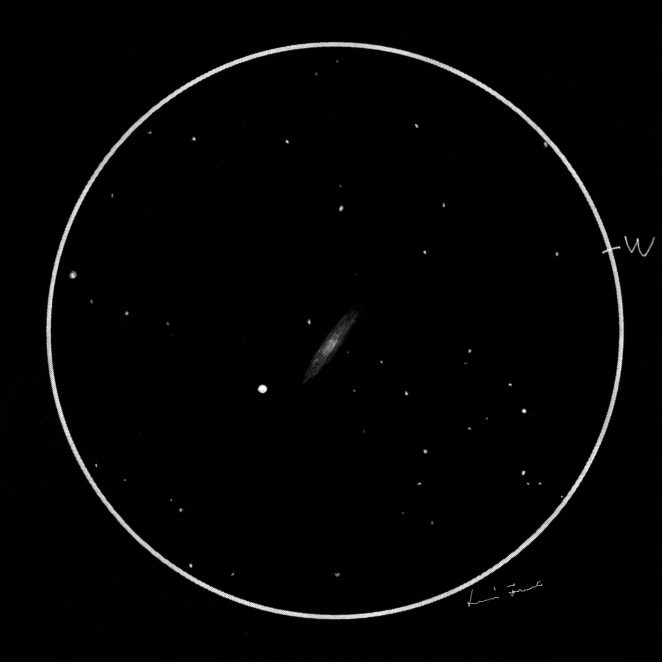
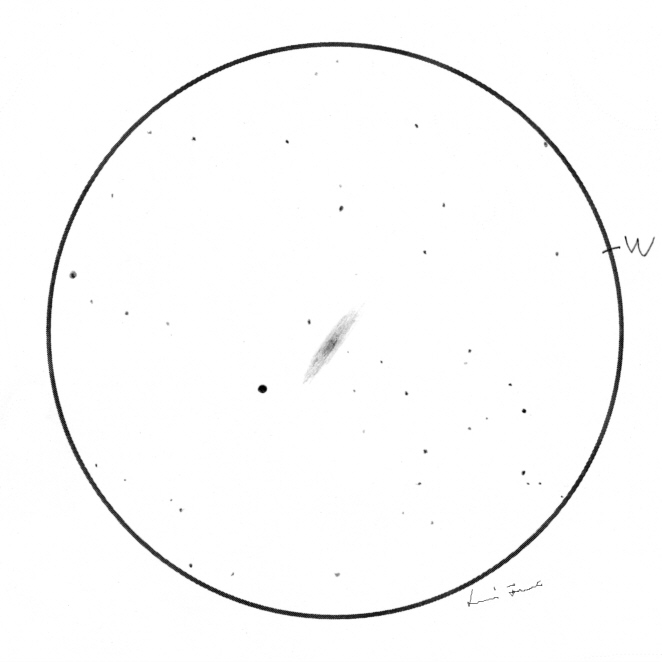
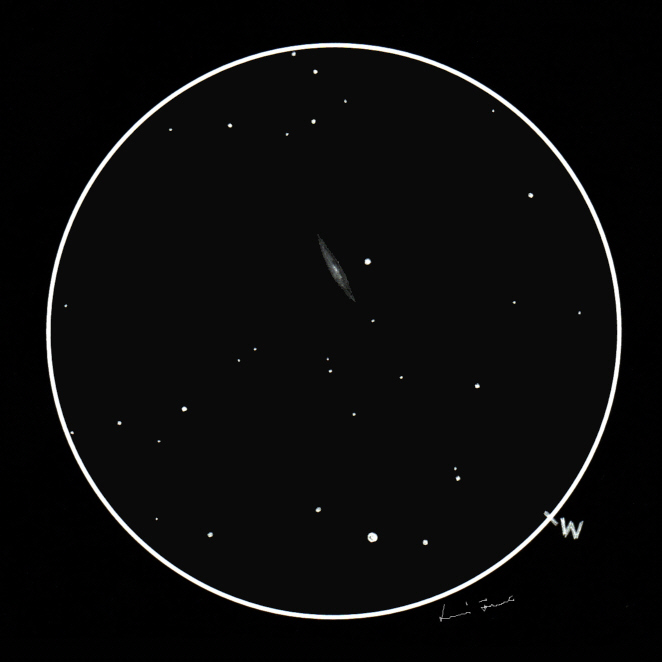
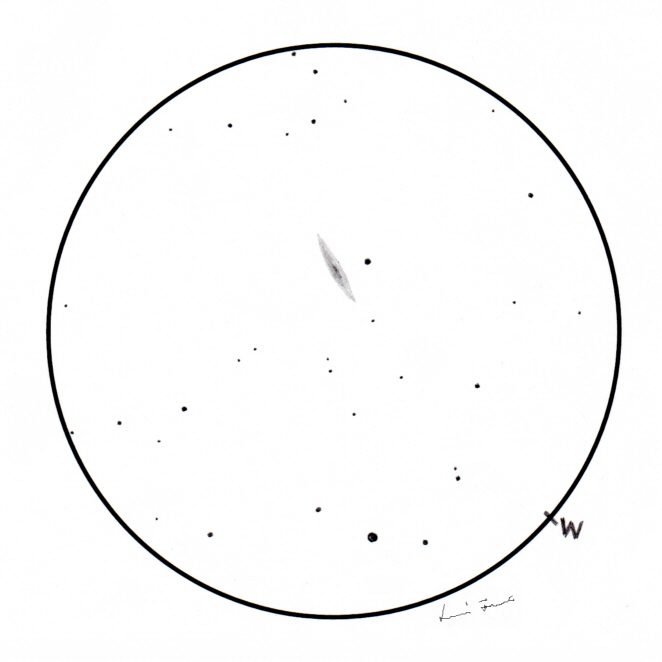
NGC 5907 (Galaxy)
|
|
Also known as: Splinter galaxy
|
|
Right ascension: 15h 16m
|
Declination: 56° 19'
|
|
Constellation: Draco
|
|
Date/time: 2008.06.29 23:00 UT
|
|
Equipment: 12" f/5 Newtonian
|
|
FoV: 40'
|
Magnification and filter(s): 71x
|
|
Seeing: 7/10
|
Transparency: 5/5
|
|
Location: Nádasdladány, Hungary
|
|
Observer: Ferenc Lovró
|
Description:
A gigantic, greatly elongated galaxy, visible totally from its edge on. It covers an area of about 13' x 1.4' on the boundary of the constellations Draco and Boötes. It has a homogeneous colour, even its core is just slightly brighter than the rest of its outside territories. When looking at its shape, it's very clear why it is commonly referred to as the Splinter galaxy.
|
|
Hi-resolution image: [ reversed sketch | original sketch ]
|
|
This sketch was featured on Astronomy Sketch of the Day on Oct 23, 2008.
|
|
|
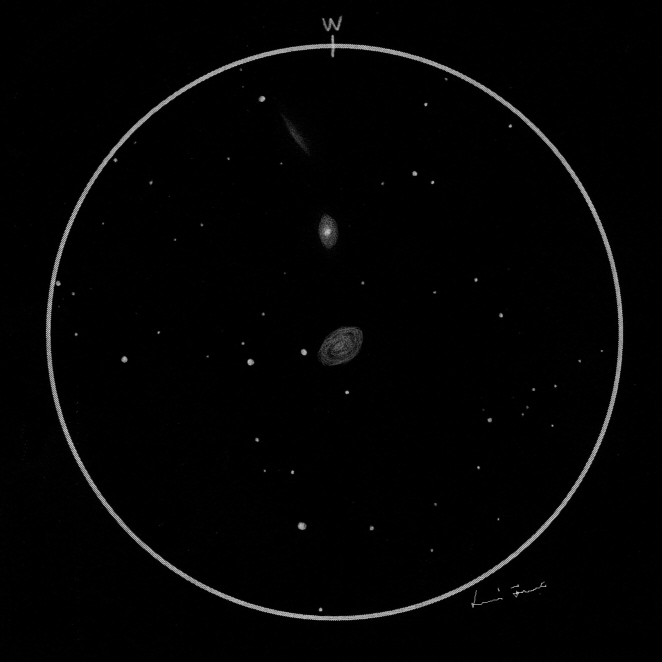
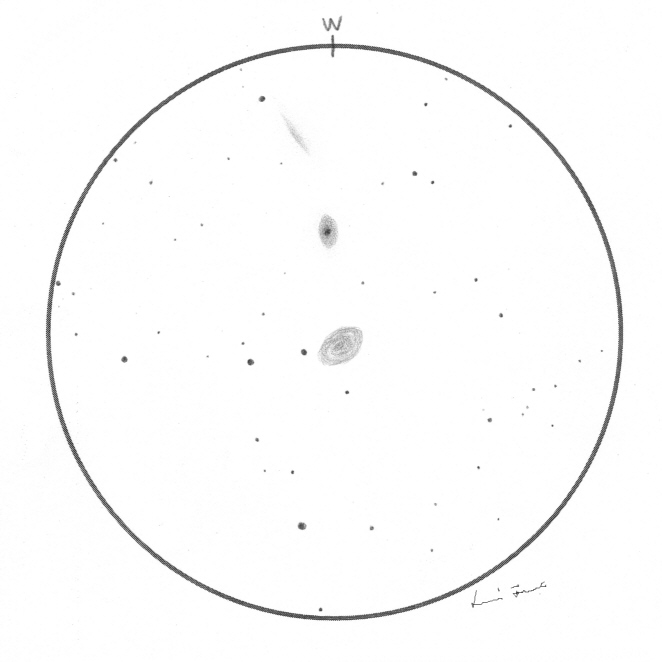
NGC 5981 + NGC 5982 + NGC 5985 (Galaxy)
|
|
Also known as: Draco trio
|
|
Right ascension: 15h 38m
|
Declination: 59° 21'
|
|
Constellation: Draco
|
|
Date/time: 2008.06.30 00:00 UT
|
|
Equipment: 12" f/5 Newtonian
|
|
FoV: 36'
|
Magnification and filter(s): 71x
|
|
Seeing: 7/10
|
Transparency: 5/5
|
|
Location: Nádasdladány, Hungary
|
|
Observer: Ferenc Lovró
|
Description:
The trio, also known as the "Draco group" is just like an illustration for a book to show the variety of galaxies: it consists three totally different galaxies lined up on line from East to West. Some details about these galaxies westward: the huge NGC 5985 (11m) is a nearly face-on spiral galaxy. Plenty of its arms are visible even with direct vision! Its galactic core is not really bright. This is followed by the tiny NGC 5982 (11m) which is an elliptic galaxy with homogeneous surface and a very bright, star-like core. While drawing these, I've noticed that something just appears more to the West: it was the faint NGC 5981 (13.2m), another spiral galaxy, but with edge on. If I were just taking a small glimpse instead of taking the time to sketch this area, I'd have surely miss this gem. This is why sketching is wonderful: it is what makes observation complete!
|
|
Hi-resolution image: [ reversed sketch | original sketch ]
|
|
|
NGC 6503 (Galaxy)
|
|
Right ascension: 17h 49m
|
Declination: 70° 08'
|
|
Constellation: Draco
|
|
Date/time: 2009.07.25 22:00 UT
|
|
Equipment: 12" f/5 Newtonian
|
|
FoV: 26'
|
Magnification and filter(s): 167x
|
|
Seeing: 5/10
|
Transparency: 5/5
|
|
Location: Jászszentlászló, Hungary
|
|
Observer: Ferenc Lovró
|
Description:
Bright, small galaxy near a very yellowish star, which I captured on a surprisingly cold night that offered an excellent transparency in the early evening hours near the village of Jászszentlászló, Hungary during the Kiskun Astro Camp. Its shape is not perfectly cigar shaped, but its northwestern end looks a bit truncated. Its surface is not entirely homogeneous: next to its gradually brightened yet not star-like core it shows many little details, changes in luminosity of its surface. SQM reading: 21.24 m/arcsec^2, 12°C. The faintest field star visible directly is about 15.1 magnitudes bright, the NELM was 6.5 at this time of the evening.
|
|
Hi-resolution image: [ reversed sketch | original sketch ]
|
|
|
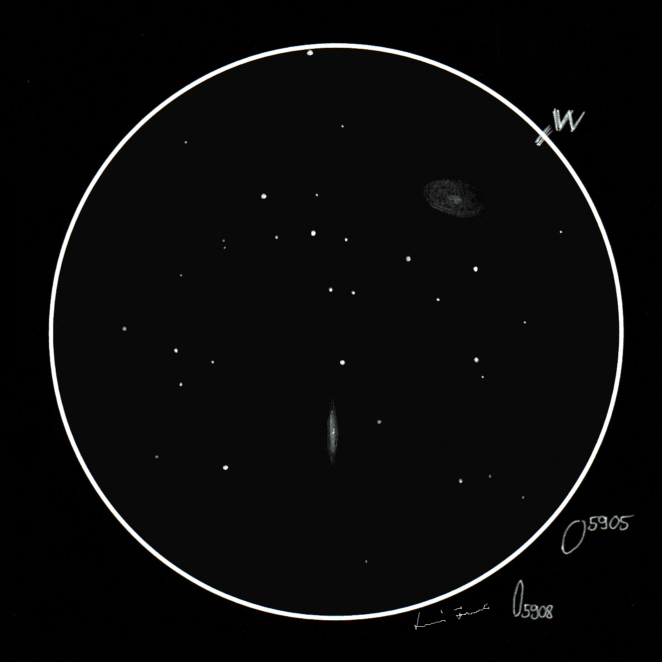
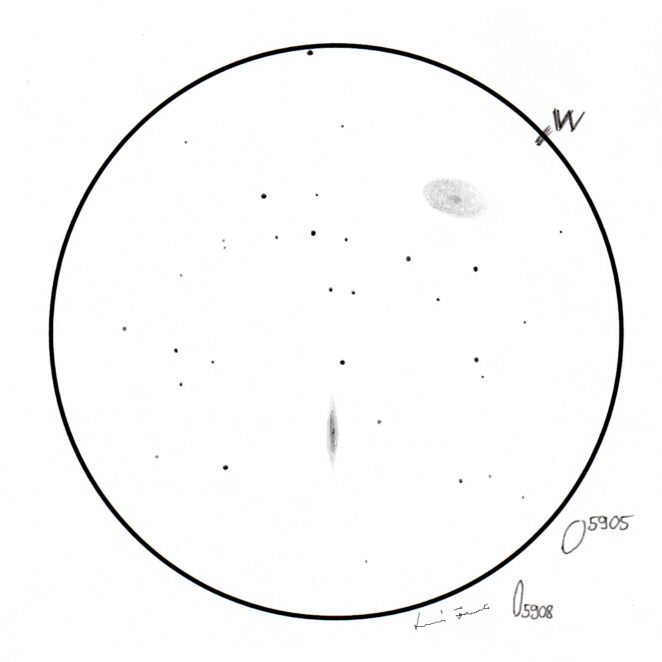
NGC 5905 + NGC 5908 (Galaxy)
|
|
Right ascension: 15h 16m
|
Declination: 55° 26'
|
|
Constellation: Draco
|
|
Date/time: 2010.06.05 22:30 UT
|
|
Equipment: 12" f/5 Newtonian
|
|
FoV: 28'
|
Magnification and filter(s): 100x
|
|
Seeing: 6/10
|
Transparency: 3/5
|
|
Location: Nádasdladány, Hungary
|
|
Observer: Ferenc Lovró
|
Description:
The NGC 5908 is a perfect example of an edge-on galaxy, elongated in a direction of NW-SE, brighter than its companion with a faint, but star-like central core. Another interesting detail I noticed is a bar-like feature in this galaxy. The NGC 5905 is much fainter, a very hard object, shows no sign of a star-like core and it's so faint that I'm sometimes not at all sure in its elongation. This doublet can be found 1° South of the very spectacular Splinter galaxy (NGC 5907).
|
|
Hi-resolution image: [ reversed sketch | original sketch ]
|
|
|
NGC 6015 (Galaxy)
|
|
Right ascension: 15h 52m
|
Declination: 62° 17'
|
|
Constellation: Draco
|
|
Date/time: 2010.06.05 23:00 UT
|
|
Equipment: 12" f/5 Newtonian
|
|
FoV: 31'
|
Magnification and filter(s): 100x
|
|
Seeing: 6/10
|
Transparency: 3/5
|
|
Location: Nádasdladány, Hungary
|
|
Observer: Ferenc Lovró
|
Description:
Large, fairly bright galaxy with barely brighter centre. Looks quite homogeneous. Located in a nice environment, rich in stars.
|
|
Hi-resolution image: [ reversed sketch | original sketch ]
|
|
|
NGC 5987 (Galaxy)
|
|
Right ascension: 15h 40m
|
Declination: 58° 3'
|
|
Constellation: Draco
|
|
Date/time: 2010.06.06 21:30 UT
|
|
Equipment: 12" f/5 Newtonian
|
|
FoV: 24'
|
Magnification and filter(s): 167x
|
|
Seeing: 4/10
|
Transparency: 4/5
|
|
Location: Nádasdladány, Hungary
|
|
Observer: Ferenc Lovró
|
Description:
Small, faint galaxy, highly elongated in the E-W direction. It seems that its Southern side is a bit brighter, the core is slightly star-like, moderately brighter than the surface. Located in a nice environment rich of spectacular star formations that helps to find it.
|
|
Hi-resolution image: [ reversed sketch | original sketch ]
|
|
|
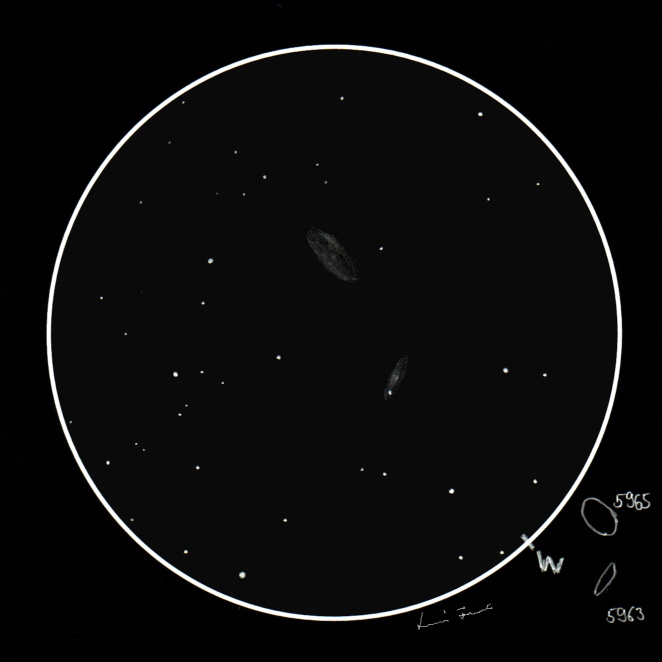
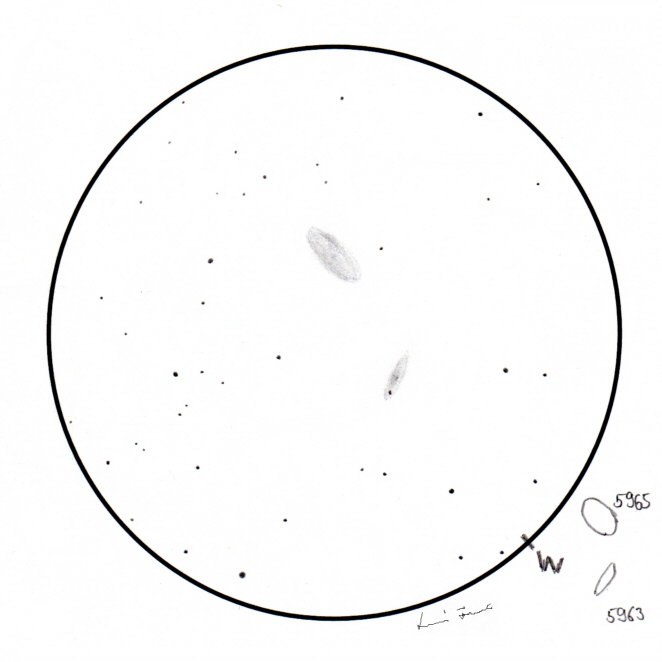
NGC 5963 + NGC 5965 (Galaxy)
|
|
Right ascension: 15h 34m
|
Declination: 56° 35'
|
|
Constellation: Draco
|
|
Date/time: 2010.06.06 22:00 UT
|
|
Equipment: 12" f/5 Newtonian
|
|
FoV: 33'
|
Magnification and filter(s): 100x
|
|
Seeing: 4/10
|
Transparency: 4/5
|
|
Location: Nádasdladány, Hungary
|
|
Observer: Ferenc Lovró
|
Description:
From the two galaxies the NGC 5963 is the brighter and displays a faint star-like core. The NGC 5965 is rather homogeneous with constant surface brightness, yet its Southern side seem to be a little bit brighter than the rest. Later on I've checked some photographs and now it seems that I've seen only the very central features of the NGC 5963.
|
|
Hi-resolution image: [ reversed sketch | original sketch ]
|
|
|
NGC 6223 (Galaxy)
|
|
Right ascension: 16h 43m
|
Declination: 61° 35'
|
|
Constellation: Draco
|
|
Date/time: 2015.07.07 23:00 UT
|
|
Equipment: 12" f/5 Newtonian
|
|
FoV: 10'
|
Magnification and filter(s): 250x
|
|
Seeing: 4/10
|
Transparency: 2/5
|
|
SQM: 19.72 m/as2
|
Temperature: 24°C
|
|
Humidity: high
|
Wind: breeze
|
|
Sight: 1 - nothing spectacular
|
|
Difficulty: 4 - hardly visible, dark adaptation and very dark skies needed, averted vision is required to see details
|
|
Position: 3 - moderate, some starhopping needed
|
|
Location: Talpa Minor Observatory
|
|
Observer: Ferenc Lovró
|
Description:
Extremely faint, tiny galaxy, although I'm sure that with better sky conditions (the rising Moon lits the highly humid sky) it would be easier and more spectacular. It's slightly elongated to the WNW-ESE direction, but almost round by shape with a core only slightly brighter than the rest. At 71x power it only appears occasionally at 250x it clearly appears by direct vision at all times, but it's a definitely hard sight.
|
|
Hi-resolution image: [ reversed sketch | original sketch ]
|
|
|
NGC 6140 (Galaxy)
|
|
Right ascension: 16h 21m
|
Declination: 65° 22'
|
|
Constellation: Draco
|
|
Date/time: 2015.07.10 22:00 UT
|
|
Equipment: 12" f/5 Newtonian
|
|
FoV: 16'
|
Magnification and filter(s): 214x
|
|
Seeing: 7/10
|
Transparency: 4/5
|
|
SQM: 21.11 m/as2
|
Temperature: 19°C
|
|
Humidity: low
|
Wind: none
|
|
Sight: 1 - nothing spectacular
|
|
Difficulty: 5 - almost invisible, total dark adaptation, very dark skies and averted vision is a must to see the object
|
|
Position: 3 - moderate, some starhopping needed
|
|
Location: Talpa Minor Observatory
|
|
Observer: Ferenc Lovró
|
Description:
Very faint, small galaxy, with a nearly undeterminable shape: most of the time it appears spherical, but sometimes it turns into a triangle pointing to the East. Reacts fine to averted vision, rewarding me with a much larger size, but even with this method it is just barely visible. The 15.7m star on its North appears to be surrounded by faint fuzziness. New limiting magnitude record! Two of the stars on this sketch are no less than 15.8m faint! :D
|
|
Hi-resolution image: [ reversed sketch | original sketch ]
|
|
|
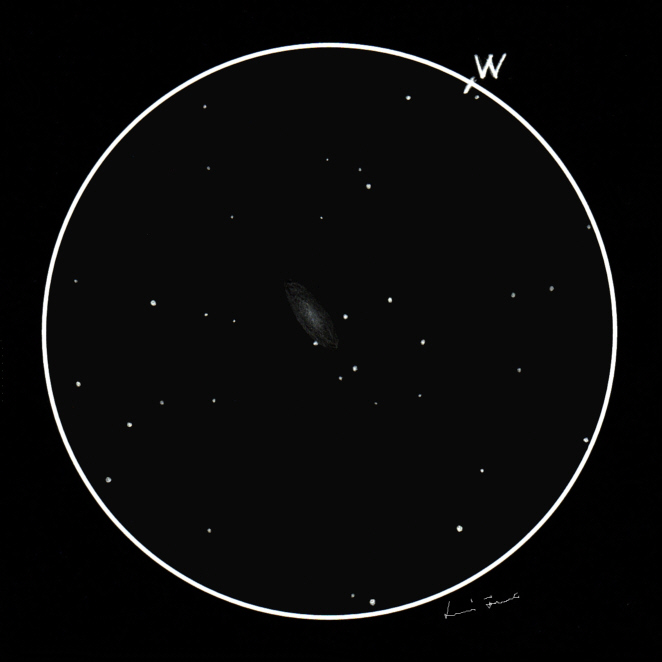
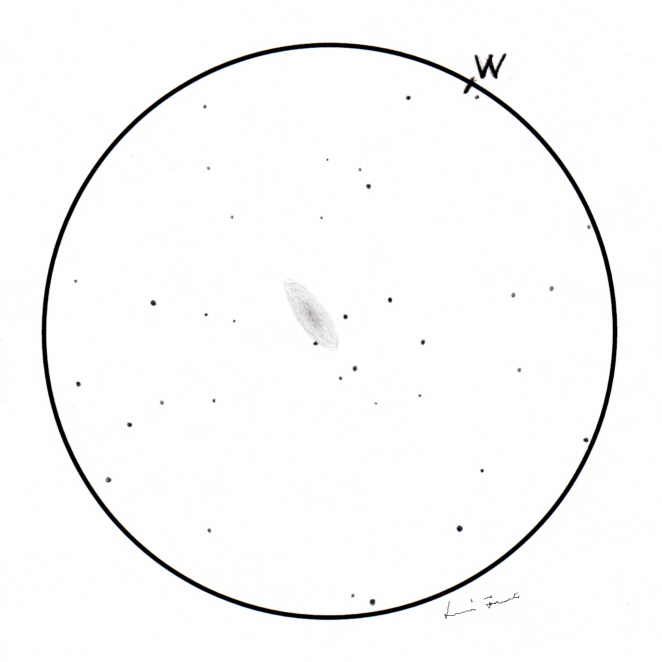
NGC 5949 (Galaxy)
|
|
Right ascension: 15h 28m
|
Declination: 64° 43'
|
|
Constellation: Draco
|
|
Date/time: 2015.07.10 22:30 UT
|
|
Equipment: 12" f/5 Newtonian
|
|
FoV: 12'
|
Magnification and filter(s): 250x
|
|
Seeing: 6/10
|
Transparency: 4/5
|
|
SQM: 21.09 m/as2
|
Temperature: 18°C
|
|
Humidity: low
|
Wind: none
|
|
Sight: 3 - definite details, interesting look
|
|
Difficulty: 3 - moderately visible, dark adaptation needed, averted vision might add to details
|
|
Position: 3 - moderate, some starhopping needed
|
|
Location: Talpa Minor Observatory
|
|
Observer: Ferenc Lovró
|
Description:
Oval galaxy elongated to the NW-SE. Based on my map (Triatlas-B) it should be a tiny, faint object, yet to my surprise it is relatively large, and definitely easy to see. Reacts very well to increasing magnification. It appears a bit asymmetrical: its SE side is brighter and its NW side is more elongated.
|
|
Hi-resolution image: [ reversed sketch | original sketch ]
|
| |
|
|
 gmail*com.
 ikonra kattintva magyarul is olvashatod az észlelést.
 [25]
[25]